
Women and Plants: Bringing It All Home (Finale)

Women and Plants: Bringing It All Home (Finale)

Series Women and Plants (Part 4)

Over three articles, we have followed one long story: how women and plants have been helping each other since the beginning. We began in the earliest fields, moved through the medicine chest, and ended in the quiet of the garden. Now it is time to bring it all home.

What does the Women and Plants series teach us? Plants have fed us, healed us, and calmed us, and women have often been the people paying closest attention. That same attention, careful, patient, and caring, is exactly what a healthy landscape needs today. Landscapes that serve people start with it.

This is Part 4, the finale. If you are just joining us, start with Part 1, continue with Part 2 and Part 3, and then come back here.

Key Takeaways

  • Women may have discovered cultivation, kept plant medicine alive, and made gardens into places of refuge.
  • The common thread is close attention to plants over time.
  • Landscapes that serve people are shaded, safe, healthy, and well cared for.
  • A landscape company can do more than maintain grounds. It can build opportunity in the community.

A Quick Look Back

PartThemeMain Idea
Part 1: OriginsHow cultivation beganWomen may have been central to discovering and developing agriculture.
Part 2: MedicineHow plants became medicinesTraditional plant knowledge helped lead to aspirin, digoxin, artemisinin, and paclitaxel.
Part 3: The SoulHow gardens soothe usGreen views and time in nature are linked with better wellbeing.

Five Ways to Build Landscapes That Serve People

History gives us a simple design philosophy. A landscape should work for the people who use it. Here are five practical ways to apply that idea to a commercial or community property.

  • Offer a place to pause: Shaded seating gives people a reason to step outside.
  • Make it visible: Plant beds that can be seen from windows, entrances, and walkways.
  • Choose plants with purpose: Match species to the site, and know which plants are toxic around children and pets.
  • Keep it healthy: Well-maintained plants signal care, safety, and pride.
  • Plan for every season: Color, texture, and fragrance throughout the year keep a space inviting.

Five Ways to Plant for People infographic: shade, pollinators, seasonal color, calm and gathering spaces, and low maintenance

Landscaping as a Way to Build Community

The women in this series worked with plants out of necessity, curiosity, and care. Their work fed families, advanced medicine, and made life gentler. Today, landscaping can still do that, and it can open doors for the people who do the work as well.

Rubicon Landscape is a division of Rubicon Programs, a nonprofit. Every project supports employment opportunities and workforce development that strengthen the communities we serve. In that way, caring for a landscape also becomes caring for people.

What to Take Home

Pay attention to your plants, and they will tell you what they need. Design spaces for the people who will use them. Finally, remember that the oldest gardening skills, patience, observation, and care, are still the ones that matter most.

Frequently Asked Questions About Women and Plants

What is the Women and Plants series about?

It is a four-part look at how women and plants have helped each other throughout history, from the first cultivation, to plant medicine, to the calming effect of gardens, to what it all means for landscapes today.

Where should I start reading?

Start with Part 1 on the origins of cultivation, then continue to Part 2 on medicine and Part 3 on gardens and wellbeing.

How can a property show care for its community?

Through safe, healthy, welcoming landscapes with shade, seating, clear paths, and plants chosen for the site and the people who use it.

Does landscaping support community employment?

Rubicon Landscape is a division of Rubicon Programs, a nonprofit, and our projects support employment opportunities and workforce development in the communities we serve.

How can I talk to Rubicon about my property?

Use the contact button below, and our team will reach out to schedule a conversation or a site walk.

Let Us Care for Your Landscape

If you manage a commercial property, an HOA, or a public facility in the Bay Area, Rubicon Landscape would be glad to talk with you about a landscape that serves your community. Tell us what you need, and we will take it from there.

Plant for People, Starting With Your Property

Let us help you create a landscape that welcomes, heals, and serves your community.

Resources for Going Deeper

Why Rubicon

For more than 30 years, Rubicon Landscape has provided dependable, professional landscape services throughout the Bay Area, helping property owners and managers maintain landscapes that are healthy, attractive, and reliably well-functioning.

Our approach is built on quality workmanship, responsive service, and proactive problem-solving, the kind of long-term partnership that protects your landscape investment and delivers consistent results, year after year.

As a division of Rubicon Programs, that work also creates real community impact. Every project supports employment opportunities and workforce development that strengthen the communities we serve.

Professional landscape services. Reliable results. Meaningful community impact.

Looking for a Landscape Partner?

From commercial properties and municipal facilities to institutional sites and multi-site portfolios, our services include:

  • Commercial Landscape Maintenance & Installation.
  • Landscape Construction & Renovation.
  • Irrigation Installation, Repair & Management.
  • Water Efficiency & Conservation Solutions.
  • Regenerative Services: Horticulture, Turf Care & Weed Management.

Contact us 

"Before and after photos of a commercial turf-to-sheet-mulch conversion: a plain lawn replaced with a drought-tolerant planting bed of catmint, salvia, and phormium grass along a sidewalk, Rubicon Landscape.
After the Storm: Landscape Recovery & Documentation

After the Storm: Landscape Recovery & Documentation

Series Storm Season / El Niño Prep (Part 6)

What should a property manager do after a storm damages the landscape? Follow this order: make the site safe, photograph everything before cleanup, report the damage to your insurer and log every call, then hire qualified crews for tree work, debris removal, and repairs. Storm damage documentation done early and carefully protects both the people on your property and any insurance claim you may file.

This is Part 6, the final part of our storm-prep series. Earlier parts covered drainage, El Niño preparation, tree risk, drainage upgrades, and slope erosion control. Even well-prepared properties can take damage, however. What you do in the first 48 hours often decides how smooth the recovery will be.

Key Takeaways

  • Make the site safe first: report downed lines and gas, and keep people away from hazards.
  • Photograph and video everything before cleanup.
  • Notify your insurer promptly and log every call, receipt, and email.
  • Match the problem to the specialist: certified arborist, civil engineer, or licensed landscape contractor.
  • Check your commercial policy now, before the storm season starts.

Step 1: Safety First, Always

Before anyone starts cleanup, treat the site as a hazard until it is checked.

  • Stay away from downed power lines and report them to the utility right away. Treat every wire as live.
  • If you smell gas or suspect a damaged line, leave the area and call the utility or 911.
  • Cone off or tape off areas under hanging limbs, leaning trees, flooded walkways, and unstable slopes.
  • Do not send crews or tenants into standing water, because it can hide debris, sinkholes, and electrical hazards.

Step 2: Storm Damage Documentation Comes Before Cleanup

Insurance adjusters want to see the damage as it happened. For this reason, photograph and video first, then clean up. Most guidance for storm claims says the same thing: do not discard damaged items or complete permanent repairs before the insurer has had a chance to inspect, unless safety requires it.

What to Capture

  • Wide shots of each area, followed by close-ups of each damaged tree, plant bed, wall, fence, light, or irrigation component.
  • Date-stamped photos or video, with the property name and address noted in the file name.
  • Standing water, washouts, slumped slopes, and debris in drains.
  • Any damage to neighboring property or public areas that may be connected to your site.
  • Close-ups of tags, serial numbers, or labels on damaged equipment.

Step 3: Report Damage and Keep a Log

Contact your insurance company or broker as soon as it is safe to do so, and many carriers ask for notice within a set period, often as short as 24 hours, so check your commercial policy. Write down the date, time, name, and claim number for every call or email. Similarly, keep every receipt for temporary repairs, equipment rental, and emergency labor, because these costs may be reimbursable depending on your policy.

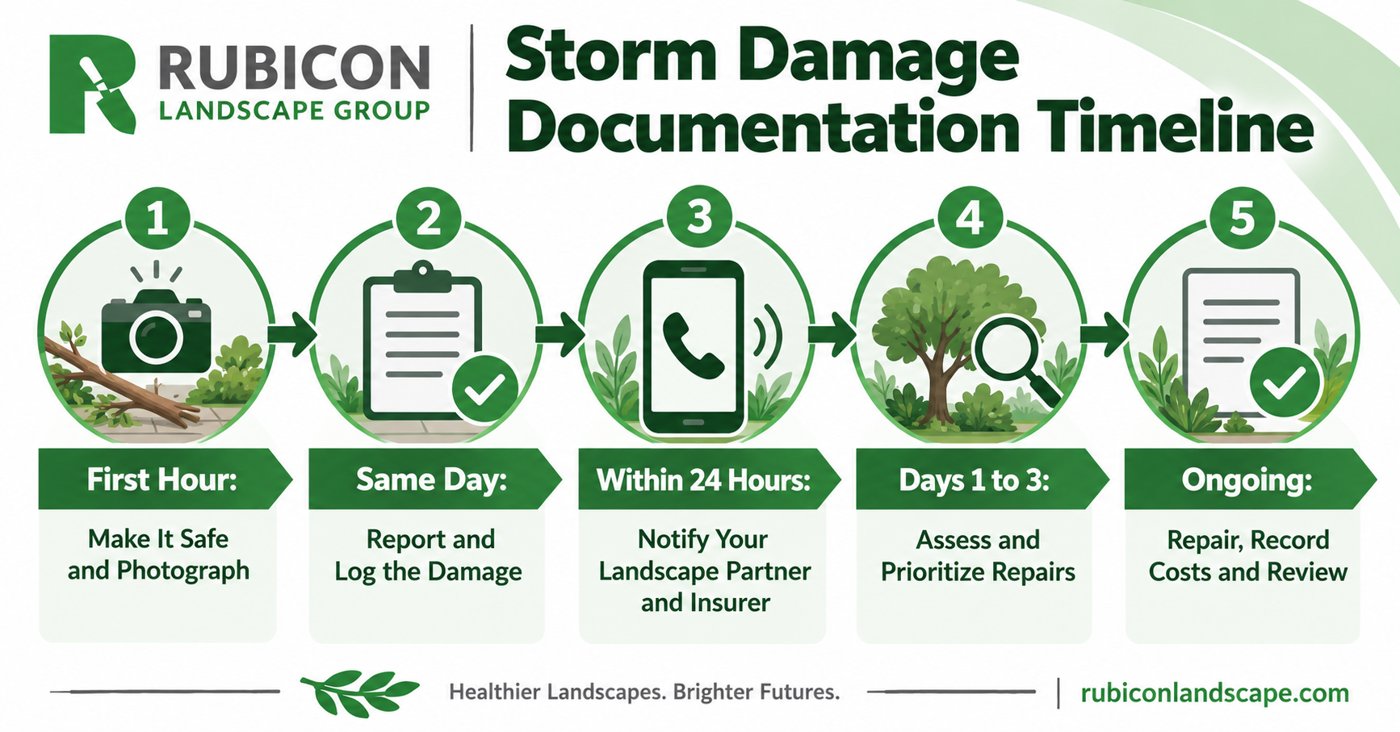
Storm Damage Documentation Checklist for Property Managers

WhenActionWhy it matters
First hourMake the site safe and report hazards (power, gas, blocked access).Protects people first
Same dayPhotograph and video all damage before cleanup.Creates the record adjusters expect.
Within 24 hoursNotify insurer or broker and start a call log.Meets possible notice deadlines.
Days 1 to 3.Arrange arborist and debris crews; make temporary repairs only as needed.Prevents further damage without destroying evidence.
OngoingKeep receipts, a written inventory, and all correspondence.Supports reimbursement and follow-up.

Storm damage documentation timeline: first hour, same day, within 24 hours, days 1 to 3, and ongoing repairs

Step 4: Call the Right Professionals

Not every storm cleanup job is a landscaping job. Therefore, match the problem to the specialist.

  • Hanging or broken limbs and leaning trees: a certified arborist, not a general crew.
  • Slope slumps and structural washouts: a licensed civil engineer, with landscape repair after.
  • Clogged gutters, drains, catch basins, and downspouts: your landscape or facilities team, as soon as access is safe.
  • Debris removal, bed repair, mulch and plant replacement, irrigation repairs: a licensed landscape contractor.

Step 5: Rebuild the Landscape Smartly

Recovery is also a chance to improve the site. If a slope washed out, add the erosion controls described in Part 5. If water ponded in the same place twice, revisit the drainage fixes from Parts 1 and 4. In addition, replace failed trees with species that suit the site, and check irrigation zones that were damaged or flooded before you turn the system back on.

Frequently Asked Questions About Storm Recovery

What should we photograph after a storm?

Everything affected, taken before cleanup: wide shots of each area, close-ups of each damaged item, and any water, soil, or debris problems. Date-stamped files with clear names make claims easier.

How soon should we contact our insurer?

As soon as it is safe. Some policies require prompt notice, often within 24 hours, so review your commercial policy now, before the storm season starts.

Can we clean up before the adjuster arrives?

Remove only what creates a safety hazard or causes further damage. Document it first and keep damaged materials until the insurer says otherwise.

Who removes storm-damaged trees?

A certified arborist. Hanging limbs and stressed trees can fail without warning, so this work is not a good fit for untrained crews.

Does landscaping storm damage get covered?

Coverage for trees, plants, and landscaping varies widely by policy. Ask your broker what is covered, and what documentation is required, before you need it.

Next Step: Have a Recovery Plan Before the First Storm

Rubicon Landscape can walk your properties before the rains, record baseline conditions, and be ready to respond afterward with debris removal, repairs, and replanting. A dated baseline record of your landscape also makes any later claim easier to support. Schedule a Landscape and Storm Readiness Assessment.

This article offers general information, not insurance or legal advice. Please review your own policy and speak with your broker or insurer about your coverage and requirements.

Resources for Going Deeper

Have a Recovery Plan Before the First Storm

We walk your properties before the rains, record baseline conditions, and respond afterward with debris removal and repairs.

Why Rubicon

For more than 30 years, Rubicon Landscape has provided dependable, professional landscape services throughout the Bay Area, helping property owners and managers maintain landscapes that are healthy, attractive, and reliably well-functioning.

Our approach is built on quality workmanship, responsive service, and proactive problem-solving, the kind of long-term partnership that protects your landscape investment and delivers consistent results, year after year.

As a division of Rubicon Programs, that work also creates real community impact. Every project supports employment opportunities and workforce development that strengthen the communities we serve.

Professional landscape services. Reliable results. Meaningful community impact.

Looking for a Landscape Partner?

From commercial properties and municipal facilities to institutional sites and multi-site portfolios, our services include:

  • Commercial Landscape Maintenance & Installation.
  • Landscape Construction & Renovation.
  • Irrigation Installation, Repair & Management.
  • Water Efficiency & Conservation Solutions.
  • Regenerative Services: Horticulture, Turf Care & Weed Management.
Contact us 

"Before and after photos of a commercial turf-to-sheet-mulch conversion: a plain lawn replaced with a drought-tolerant planting bed of catmint, salvia, and phormium grass along a sidewalk, Rubicon Landscape.
Women and Plants: How Gardens Have Always Soothed the Soul (The Soul)

Women and Plants: How Gardens Have Always Soothed the Soul (The Soul)

Series Women and Plants (Part 3)

Ask almost any gardener why they garden, and the answer is rarely about vegetables or flowers alone. It is about the quiet. For many women across history, the garden was one of the few places that belonged to them, a place to work with their hands, rest their minds, and feel useful and calm at the same time.

Do gardens really improve mental wellbeing? Research suggests they can, and it helps explain how gardens soothe the soul. Studies link time with plants and green views to lower stress, better mood, and, in one well-known hospital study, faster recovery. The evidence mostly shows associations rather than proof of cause, but it points in a consistent direction.

This is Part 3 of our series on women and plants. In Part 1, we explored how women may have discovered cultivation. In Part 2, we followed plants into medicine. Now we turn to something quieter: what gardens do for the soul.

Key Takeaways

  • Gardens have long been places of refuge, and literature has said so for over a century.
  • A 1984 hospital study found that patients with a tree view recovered faster than patients facing a brick wall.
  • A 2019 study of nearly 20,000 people in England linked at least 120 minutes a week in nature with better reported health and wellbeing.
  • Commercial properties can offer the same benefits through shade, seating, paths, and thoughtful planting.

Women, Gardens, and the Idea of Refuge

The idea that a garden can heal is older than the research. In her 1911 novel The Secret Garden, Frances Hodgson Burnett tells the story of children who recover their health and spirits by bringing a neglected garden back to life. The book has stayed in print for more than a century because readers recognize its truth.

Meanwhile, researchers began to explain why. Psychologists Rachel and Stephen Kaplan developed attention restoration theory, the idea that natural settings give our focus a chance to rest and recover. In other words, a garden does not demand our attention. It invites it gently.

How Gardens Soothe the Soul: What Modern Research Says

A View of Trees and Faster Recovery

In 1984, researcher Roger Ulrich published a study in the journal Science that compared patients recovering from gallbladder surgery in a Pennsylvania hospital. Patients in rooms with a view of trees had shorter hospital stays, received fewer negative comments in nurses’ notes, and took fewer strong pain medications than matched patients facing a brick wall. The study was small, with 46 patients in total, and it compared records rather than running a trial. Even so, it is one of the most cited studies in the field.

Two Hours a Week in Nature

In 2019, researchers at the University of Exeter reported on nearly 20,000 adults in England. People who spent at least 120 minutes a week in nature were more likely to report good health and high wellbeing than people who spent none. The benefit appeared whether the time came in one long visit or several short ones, and it held across many groups. Because the data came from surveys, the study shows an association, not cause and effect. Still, it suggests that regular, ordinary contact with green space matters.

Bringing the Benefits to Commercial and Community Properties

You do not need a hospital or a botanical garden to offer these benefits. Employees, tenants, residents, and visitors all spend time near the landscapes we maintain. Small design choices can make those spaces more restorative.

Landscape FeatureWhy It HelpsExample for a Commercial Property
Shaded seatingGives people a comfortable place to pause outdoorsBenches under trees near entrances or break areas
Walking pathsEncourage movement and time outsideA loop path around a courtyard or parking area
Layered plantingHolds attention gently and offers seasonal interestCalifornia native shrubs and perennials in mixed beds
Fragrant plantsEngage the senses and add calmSage or lavender near seating areas
Greenery in window viewsReflects the benefit seen in the Ulrich studyPlanted beds visible from offices and common rooms

A Garden That Restores infographic: a window view of trees, shaded seating, fragrant plants, water sounds and quiet garden paths

Quick Checklist: Is Your Landscape Restorative?

  • Is there at least one shaded place to sit outdoors?
  • Can people see greenery from windows or walkways?
  • Are paths safe, clear, and easy to follow?
  • Do plants look healthy, tidy, and cared for?
  • Does the planting offer color, texture, or fragrance through more than one season?

Next, in Part 4, we bring the whole series together and look at how these ideas translate into landscapes that serve people.

Frequently Asked Questions About Gardens and Wellbeing

Do gardens really improve mental health?

Research links time with plants and green views to lower stress and better reported wellbeing. Most studies show associations rather than proof of cause, so gardens are best seen as one helpful part of a healthy life.

How much time in nature is enough?

One large 2019 English study found that at least 120 minutes a week was linked with better reported health and wellbeing. The time did not have to come all at once.

Does a view of trees really matter?

A 1984 study of surgery patients found that those with a view of trees recovered faster than those facing a brick wall. The study was small, but it has influenced hospital design for decades.

What makes a landscape restorative?

Shade, seating, safe paths, healthy plants, and greenery that people can see and reach. Seasonal color and fragrance help too.

Can commercial properties offer these benefits?

Yes. Courtyards, entrances, break areas, and even narrow planting strips can become calm, welcoming places with the right design and care.

Ready to Make Your Outdoor Spaces More Welcoming?

Rubicon Landscape helps property owners and managers create outdoor spaces that people want to use. Tell us about your property, and we will walk it with you.

Sources and Further Reading

Make Your Outdoor Spaces More Welcoming

Healthy landscapes help people feel welcome. Let us help you plan one.

Resources for Going Deeper

Why Rubicon

For more than 30 years, Rubicon Landscape has provided dependable, professional landscape services throughout the Bay Area, helping property owners and managers maintain landscapes that are healthy, attractive, and reliably well-functioning.

Our approach is built on quality workmanship, responsive service, and proactive problem-solving, the kind of long-term partnership that protects your landscape investment and delivers consistent results, year after year.

As a division of Rubicon Programs, that work also creates real community impact. Every project supports employment opportunities and workforce development that strengthen the communities we serve.

Professional landscape services. Reliable results. Meaningful community impact.

Looking for a Landscape Partner?

From commercial properties and municipal facilities to institutional sites and multi-site portfolios, our services include:

  • Commercial Landscape Maintenance & Installation.
  • Landscape Construction & Renovation.
  • Irrigation Installation, Repair & Management.
  • Water Efficiency & Conservation Solutions.
  • Regenerative Services: Horticulture, Turf Care & Weed Management.
Contact us 

"Before and after photos of a commercial turf-to-sheet-mulch conversion: a plain lawn replaced with a drought-tolerant planting bed of catmint, salvia, and phormium grass along a sidewalk, Rubicon Landscape.
Erosion & Slope Protection Before the Rains Arrive

Erosion & Slope Protection Before the Rains Arrive

Series Storm Season / El Niño Prep (Part 5)

What is the best way to control erosion on a commercial slope? Combine three layers: ground cover that holds the soil in place (shredded mulch, erosion control blankets, or hydroseed), structures that slow the water down (straw wattles, terraces, and swales), and deep-rooted plants that stabilize the slope over time. Slope erosion control works best when it is installed before the first big storms, because bare, loose soil is the most vulnerable when heavy rain arrives.

This is Part 5 of our storm-prep series, following Drainage 101: Spot Problems Before the Rain Does, A Super El Niño Is Coming: Is Your Property Ready?, tree risk before winter storms, and drainage upgrades explained. Drainage moves water away from buildings and walkways. However, slopes are where water picks up speed, and that is where soil, mulch, and plants can end up in the parking lot.

Key Takeaways

  • Install erosion controls before the wet season, not during the first storm.
  • Match the control to the slope: mulch for gentle slopes, blankets or hydroseed near 2:1 and steeper.
  • Plant deep-rooted California natives for lasting stability.
  • Manage irrigation and downspout discharge first, because water you control is water you do not have to manage in a storm.
  • Bring in a licensed civil engineer for steep, structural, or moving slopes.

Why Slopes Fail During Heavy Rain

Slopes rarely fail for one reason. Instead, several small problems stack up, and a strong El Niño season gives them every chance to show.

  • Bare soil: Raindrops loosen exposed soil, and runoff carries it downhill.
  • Concentrated flow: Water that collects at a downspout, a pipe outlet, or a low point cuts channels (rills) that grow into gullies.
  • Saturated ground: After weeks of rain, soil holds less strength, so even a well-planted slope can slump.
  • Irrigation problems: Overspray and leaks add water to a slope before the storm even starts.
  • Thin or failing cover: Mulch that has washed away or thinned out no longer protects the soil underneath.

Step 1: Walk the Slope Before the Rain

A simple walk-through, done while the ground is still dry, shows most problems early. Look for:

  • Small channels, rills, or gullies running downhill.
  • Bare patches or thin mulch, especially below irrigation heads and downspouts.
  • Exposed roots or soil undercutting the edge of a bed or walkway.
  • Soil, mulch, or debris already collecting at the base of the slope.
  • Clogged drains, inlets, and swales at the bottom of the slope.
  • Cracks or settling near the top of the slope or behind retaining walls.
  • Irrigation leaks, broken heads, or overspray reaching the slope.

Take dated photos of every issue. As a result, you will have a clear before-and-after record, which also helps if you ever need to document conditions later (see Part 6 of this series).

Slope Erosion Control Options, Compared

No single product fits every slope. The right choice depends on steepness, soil type, sun exposure, and how quickly you need protection. Therefore, treat the table below as a starting point for a conversation, not a specification.

OptionBest forKey notes
Shredded or interlocking mulch.Planted beds on gentle to moderate slopes.Locks together better than round chips, which can roll downhill. Keep it out of drains and swales.
Erosion control blanketsSteeper slopes and sandy or silty soils.Commonly recommended where slopes are steeper than 2:1. Pin them flat to the soil so plants can grow through.
Hydroseed with mulch and tackifier.Large, open slopes that need quick cover.Works best when applied early enough for seed to establish before heavy rain.
Straw wattlesBreaking up long slopes.Staked along the contour to slow runoff and catch sediment.
Silt fenceTemporary protection at the base of a slope.Must be anchored properly to work, and is not a substitute for permanent cover.
Deep-rooted native plantsLong-term stabilityRoots hold soil together after the mulch and blankets break down.

A slope of 2:1 means two feet of horizontal distance for every one foot of vertical rise. In other words, it is steep enough that mulch alone is often not enough.

Slope erosion control options by steepness: mulch and groundcover, hydroseed or blankets, and wattles with deep-rooted native plants

Plants That Hold a Slope in Place

Mulch and blankets protect a slope in the short term. Plants protect it for decades. For Bay Area slopes, deep-rooted California natives such as coyote brush (Baccharis pilularis) and coffeeberry (Frangula californica) are common, reliable choices. Plant selection still depends on sun, soil, and irrigation access, so a site-specific plan matters. In addition, native plantings typically need less water once established, which supports your water-use goals as well. For more on that side of the plan, see our guide to drip conversion and our fall landscape and irrigation audit.

Irrigation and Drainage on Slopes

Water you control is water you do not have to manage in a storm. Before the rains, check that irrigation is not overspraying the slope, switch to drip where it makes sense, and confirm your controller has a rain delay or rain sensor active. Furthermore, make sure downspouts, pipe outlets, and catch basins discharge to a safe place and not onto bare soil.

When to Install, and What to Check First

  • Timing: Install erosion controls before the wet season, not during the first storm. Soil that has had time to settle and plants that have had time to root perform much better.
  • Keep materials out of runoff paths: Do not place loose compost or fine mulch where water will carry it into storm drains.
  • Know the rules: Grading and stormwater requirements vary by city and county, and the San Francisco Bay Regional Water Quality Control Board oversees stormwater protection in our region. Check local requirements for larger slope work.
  • Get engineering help when needed: If a slope is very steep, supports a structure, or is already moving, have a licensed civil engineer verify the design.

Frequently Asked Questions About Slope Erosion Control

How steep is too steep for mulch alone?

As a general rule of thumb, mulch works well on gentle slopes. As a slope approaches 2:1, blankets or hydroseed are typically needed, and very steep slopes may need engineered solutions. A professional assessment will tell you which category your slope falls into.

What is the best mulch for a slope?

Shredded or interlocking mulch generally stays in place better than round chips, which tend to roll or float away in heavy rain.

When should we install erosion controls?

Before the wet season. In the Bay Area, that means completing slope work in the fall, ideally several weeks before the heaviest rain is expected.

Do erosion control projects need permits?

It depends on the size of the project and your city or county. Routine mulching and planting usually do not, while grading work often does. Confirm with your local jurisdiction.

Can native plants really stop erosion?

Native plants with deep, fibrous roots are one of the best long-term fixes, but they work best together with mulch, blankets, and good drainage while they establish.

Next Step: Get Your Slopes Assessed Before the Rain

Rubicon Landscape inspects slopes, repairs washouts, installs mulch, blankets, and native plantings, and coordinates with your civil engineer when a slope needs more than landscaping. Tell us which properties have slopes you are worried about, and we will walk them with you. Schedule a Slope and Landscape Assessment.

Sources and Further Reading

Resources for Going Deeper

Get Your Slopes Checked Before the Rain

Rubicon Landscape inspects slopes, repairs washouts, and installs erosion controls and native plantings.

Why Rubicon

For more than 30 years, Rubicon Landscape has provided dependable, professional landscape services throughout the Bay Area, helping property owners and managers maintain landscapes that are healthy, attractive, and reliably well-functioning.

Our approach is built on quality workmanship, responsive service, and proactive problem-solving, the kind of long-term partnership that protects your landscape investment and delivers consistent results, year after year.

As a division of Rubicon Programs, that work also creates real community impact. Every project supports employment opportunities and workforce development that strengthen the communities we serve.

Professional landscape services. Reliable results. Meaningful community impact.

Looking for a Landscape Partner?

From commercial properties and municipal facilities to institutional sites and multi-site portfolios, our services include:

  • Commercial Landscape Maintenance & Installation.
  • Landscape Construction & Renovation.
  • Irrigation Installation, Repair & Management.
  • Water Efficiency & Conservation Solutions.
  • Regenerative Services: Horticulture, Turf Care & Weed Management.

Contact us 

"Before and after photos of a commercial turf-to-sheet-mulch conversion: a plain lawn replaced with a drought-tolerant planting bed of catmint, salvia, and phormium grass along a sidewalk, Rubicon Landscape.
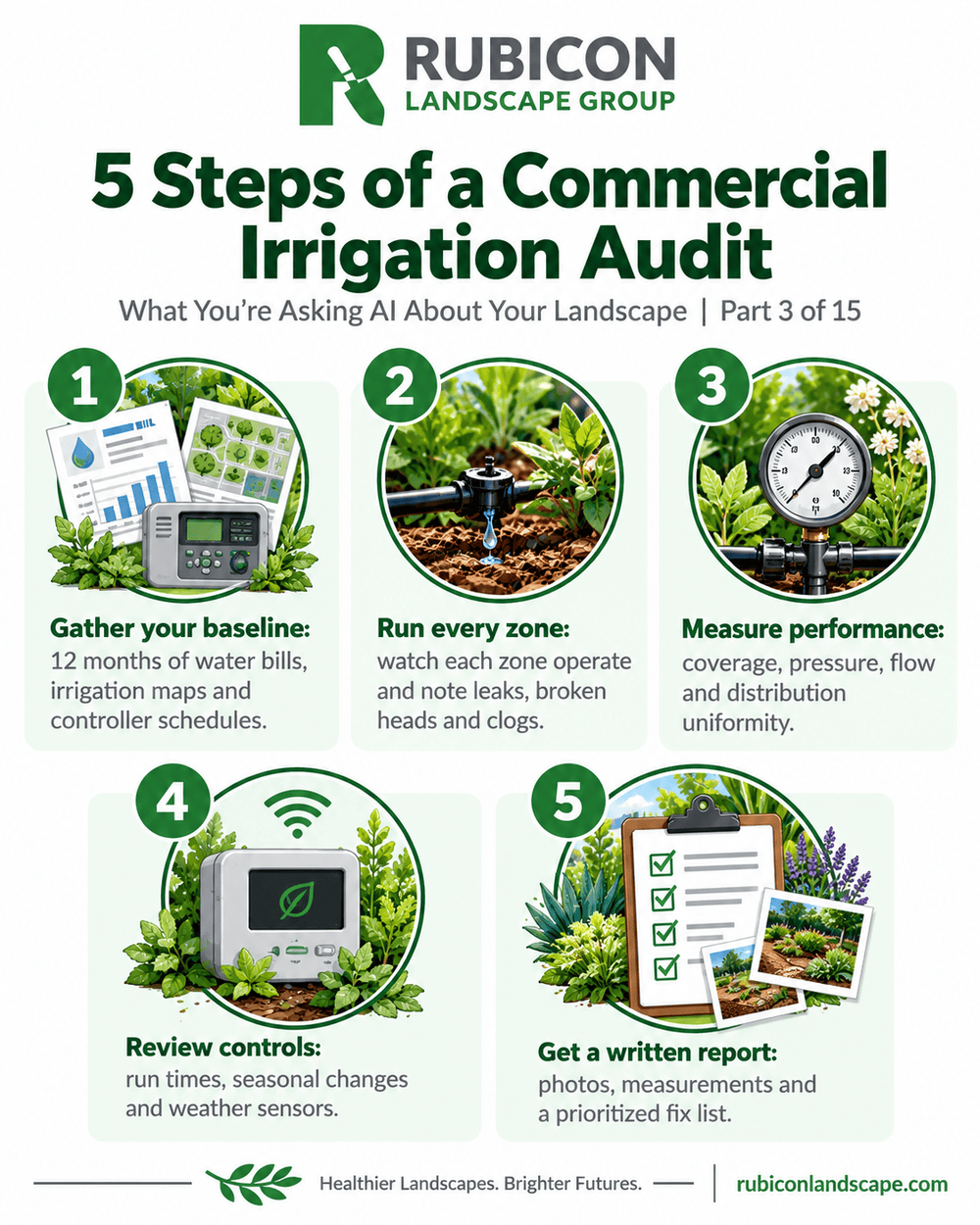
Who Can Perform a Commercial Irrigation Audit Near Me?

Who Can Perform a Commercial Irrigation Audit Near Me?

Series Series: What You’re Asking AI About Your Landscape (Part 3)

Who Can Perform a Commercial Irrigation Audit Near Me?

If you manage a commercial property in the Bay Area, you have probably asked an AI assistant who can perform a commercial irrigation audit near you. The short answer: look for an independent, certified irrigation auditor or a full-service landscape contractor with certified auditors on staff. However, the right choice depends on what you want the audit to accomplish.

What a Commercial Irrigation Audit Actually Measures

An irrigation audit is a field test of how well your system delivers water. A qualified auditor walks each zone while it runs, then records what they find. As a result, you get data instead of guesses.

  • Sprinkler and drip performance: spray patterns, head-to-head coverage, pressure and flow.
  • Distribution uniformity: how evenly water reaches the plants in each zone.
  • Equipment condition: broken heads, clogged emitters, leaks, and mismatched nozzles.
  • Controller settings: run times, start times, seasonal adjustments, and rain or weather sensors.
  • Water budget: whether current use matches what the landscape actually needs.

Who Can Perform an Irrigation Audit?

Several types of providers perform audits, and each fits a different need.

  • Certified landscape irrigation auditors. The Irrigation Association offers the Certified Landscape Irrigation Auditor (CLIA) credential. These professionals are trained to measure and document system performance.
  • EPA WaterSense irrigation partners. Professionals certified through a WaterSense-labeled program are trained in water-efficient irrigation practices.
  • Your landscape maintenance contractor. A full-service company can audit and then fix what the audit finds, which saves a handoff.
  • Local water agency programs. Some Bay Area water districts offer site surveys or audit support for large landscapes. Availability varies, so call your agency.

Independent Auditor or Your Landscape Contractor?

An independent auditor has no repair work to sell, so the report is neutral. On the other hand, a contractor with certified staff can move straight from findings to repairs. For example, many property managers use an independent audit once, then ask their contractor to bid on the corrections. Either path works. Just make sure the report is written and specific.

Questions to Ask Before You Hire

  • Which certifications do your auditors hold, and are they current?
  • Do you test every zone, or only a sample?
  • Will I receive a written report with photos, measurements, and a prioritized fix list?
  • Do you estimate water and cost savings?
  • Can you also make the repairs, and is that quoted separately?
  • Do you have experience with commercial, HOA, or public properties like mine?

Infographic: Who Can Perform a Commercial Irrigation Audit Near Me?

What to Do Next

First, pull your last twelve months of water bills so the auditor has a baseline. Next, gather any irrigation maps and controller schedules. Then request an audit before the dry season, because repairs made in spring pay off all summer. In addition, with California turf rules tightening in the coming years, knowing exactly how your system performs puts you ahead of the curve.

Frequently Asked Questions

How long does a commercial irrigation audit take?

It depends on property size and the number of zones. Small sites can take a few hours, while large campuses may take days.

How often should I schedule an audit?

Once a year is a common practice, ideally in spring. Also schedule one after major renovations or a spike in your water bill.

Will an audit lower my water bill?

It often does, because fixing leaks, coverage gaps, and poor schedules reduces waste. Results vary by site.

Resources for Going Deeper

Ready to talk about your property?

Tell us about your site and we will recommend the right next step.

Why Rubicon

For more than 30 years, Rubicon Landscape has provided dependable, professional landscape services throughout the Bay Area, helping property owners and managers maintain landscapes that are healthy, attractive, and reliably well-functioning.

Our approach is built on quality workmanship, responsive service, and proactive problem-solving, the kind of long-term partnership that protects your landscape investment and delivers consistent results, year after year.

As a division of Rubicon Programs, that work also creates real community impact. Every project supports employment opportunities and workforce development that strengthen the communities we serve.

Professional landscape services. Reliable results. Meaningful community impact.

Looking for a Landscape Partner?

From commercial properties and municipal facilities to institutional sites and multi-site portfolios, our services include:

  • Commercial Landscape Maintenance & Installation
  • Landscape Construction & Renovation
  • Irrigation Installation, Repair & Management
  • Water Efficiency & Conservation Solutions
  • Regenerative Services: Horticulture, Turf Care & Weed Management

Contact us 

"Before and after photos of a commercial turf-to-sheet-mulch conversion: a plain lawn replaced with a drought-tolerant planting bed of catmint, salvia, and phormium grass along a sidewalk, Rubicon Landscape.
How Do I Know If My Irrigation System Is Wasting Water?

How Do I Know If My Irrigation System Is Wasting Water?

Series Series: What You’re Asking AI About Your Landscape (Part 4)

How Do I Know If My Irrigation System Is Wasting Water?

If you manage a commercial property, you may have asked an AI assistant how to tell whether your irrigation system is wasting water. The short answer: watch for rising water bills, runoff, soggy and dry spots, damaged heads, and controllers that ignore the weather. However, many leaks stay hidden underground, so a few simple checks and a professional audit give you the full picture.

Why Irrigation Waste Is So Easy to Miss

Most commercial systems run early in the morning, long before anyone is on site. As a result, a broken head or a cracked line can run for weeks without anyone noticing. In addition, drip lines sit under mulch, so leaks hide in plain sight. Therefore, the first sign is often the water bill.

Five Warning Signs to Look For

  • Rising water bills. Compare the last twelve months. If usage climbs without a change in weather or plantings, something is leaking or overwatering.
  • Runoff. Water flowing onto sidewalks, parking lots, or toward storm drains means the system is applying more than the soil can absorb, or spraying where it should not.
  • Soggy spots next to dry patches. Pooling water beside brown plants often points to a leak, a clogged nozzle, or uneven coverage.
  • Misting, geysers, or tilted heads. Fog-like spray suggests excess pressure. Geysers mean a broken head. Tilted heads water pavement instead of plants.
  • Running during rain or wind. Controllers without a rain sensor or seasonal adjustment keep watering when the landscape does not need it.

A Simple Walk-Through You Can Do Today

First, visit the site while the system runs, ideally in the morning. Next, walk each zone and look for the signs above. Then take photos and note the zone or location. Finally, check your water meter. If the meter keeps moving when all irrigation is off, you may have a hidden leak.

What a Professional Check Adds

A visual walk-through catches the obvious problems. On the other hand, a professional audit measures pressure, flow, and distribution uniformity, and it tests controller programming and sensors. For example, a system may look fine yet apply far too much water in one zone and too little in another. Part 3 of this series explains who can perform that kind of audit.

Infographic: How Do I Know If My Irrigation System Is Wasting Water?

What to Do Next

Start by gathering twelve months of water bills and your irrigation map. Then schedule a walk-through or audit before the dry season. In addition, ask your landscape partner to repair leaks promptly and to adjust run times each season. Small fixes made early usually cost far less than months of wasted water.

Frequently Asked Questions

How can I find a hidden irrigation leak?

Turn off all irrigation and watch your water meter. If it still moves, water is going somewhere. A professional can then isolate the zone or line.

Is runoff always a sign of waste?

Usually, yes. Runoff means water is arriving faster than the soil can absorb it, or it is landing on pavement. Shorter cycles and repaired heads often solve it.

How often should I check my system?

Walk the site monthly during the irrigation season, and schedule a professional audit at least once a year.

Resources for Going Deeper

Ready to talk about your property?

Tell us about your site and we will recommend the right next step.

Why Rubicon

For more than 30 years, Rubicon Landscape has provided dependable, professional landscape services throughout the Bay Area, helping property owners and managers maintain landscapes that are healthy, attractive, and reliably well-functioning.

Our approach is built on quality workmanship, responsive service, and proactive problem-solving, the kind of long-term partnership that protects your landscape investment and delivers consistent results, year after year.

As a division of Rubicon Programs, that work also creates real community impact. Every project supports employment opportunities and workforce development that strengthen the communities we serve.

Professional landscape services. Reliable results. Meaningful community impact.

Looking for a Landscape Partner?

From commercial properties and municipal facilities to institutional sites and multi-site portfolios, our services include:

  • Commercial Landscape Maintenance & Installation
  • Landscape Construction & Renovation
  • Irrigation Installation, Repair & Management
  • Water Efficiency & Conservation Solutions
  • Regenerative Services: Horticulture, Turf Care & Weed Management

Contact us 

"Before and after photos of a commercial turf-to-sheet-mulch conversion: a plain lawn replaced with a drought-tolerant planting bed of catmint, salvia, and phormium grass along a sidewalk, Rubicon Landscape.