
Women and Plants: Bringing It All Home (Finale)

Women and Plants: Bringing It All Home (Finale)

Series Women and Plants (Part 4)

Over three articles, we have followed one long story: how women and plants have been helping each other since the beginning. We began in the earliest fields, moved through the medicine chest, and ended in the quiet of the garden. Now it is time to bring it all home.

What does the Women and Plants series teach us? Plants have fed us, healed us, and calmed us, and women have often been the people paying closest attention. That same attention, careful, patient, and caring, is exactly what a healthy landscape needs today. Landscapes that serve people start with it.

This is Part 4, the finale. If you are just joining us, start with Part 1, continue with Part 2 and Part 3, and then come back here.

Key Takeaways

  • Women may have discovered cultivation, kept plant medicine alive, and made gardens into places of refuge.
  • The common thread is close attention to plants over time.
  • Landscapes that serve people are shaded, safe, healthy, and well cared for.
  • A landscape company can do more than maintain grounds. It can build opportunity in the community.

A Quick Look Back

PartThemeMain Idea
Part 1: OriginsHow cultivation beganWomen may have been central to discovering and developing agriculture.
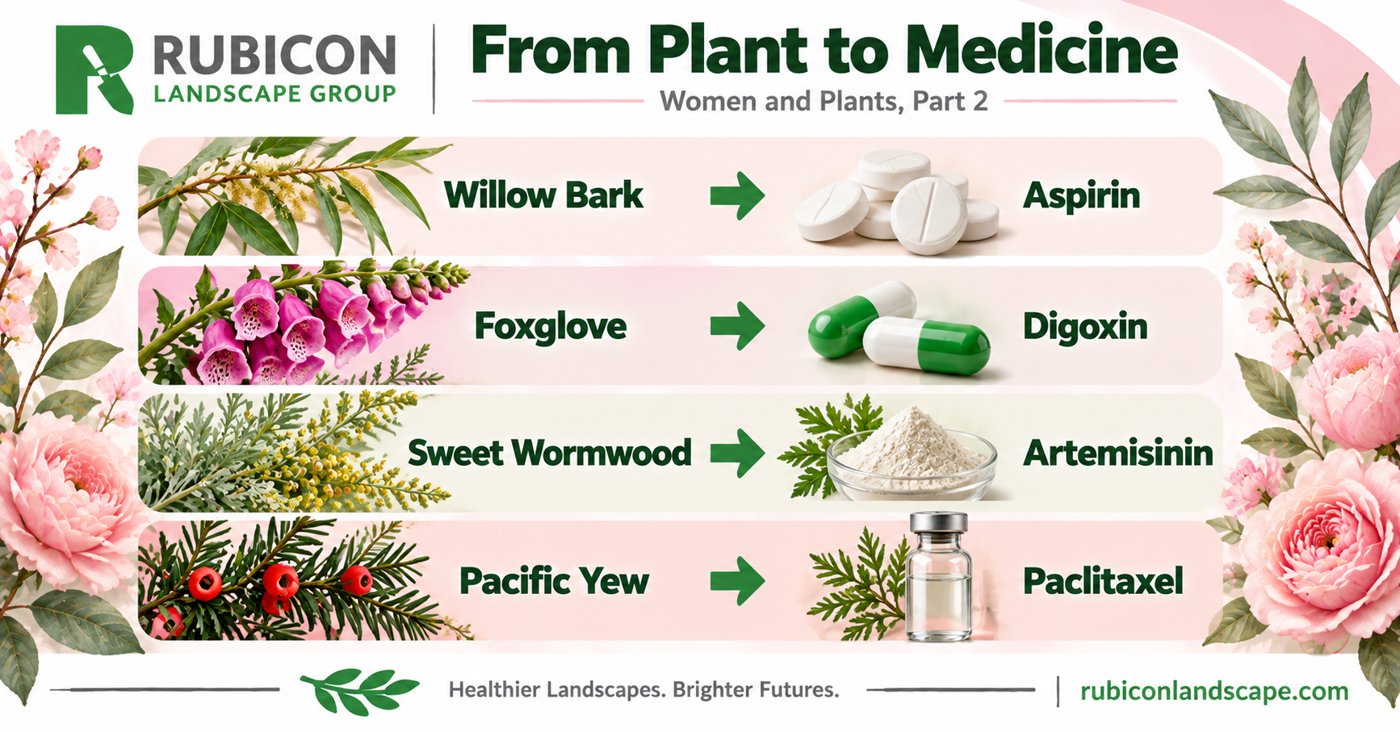
Part 2: MedicineHow plants became medicinesTraditional plant knowledge helped lead to aspirin, digoxin, artemisinin, and paclitaxel.
Part 3: The SoulHow gardens soothe usGreen views and time in nature are linked with better wellbeing.

Five Ways to Build Landscapes That Serve People

History gives us a simple design philosophy. A landscape should work for the people who use it. Here are five practical ways to apply that idea to a commercial or community property.

  • Offer a place to pause: Shaded seating gives people a reason to step outside.
  • Make it visible: Plant beds that can be seen from windows, entrances, and walkways.
  • Choose plants with purpose: Match species to the site, and know which plants are toxic around children and pets.
  • Keep it healthy: Well-maintained plants signal care, safety, and pride.
  • Plan for every season: Color, texture, and fragrance throughout the year keep a space inviting.
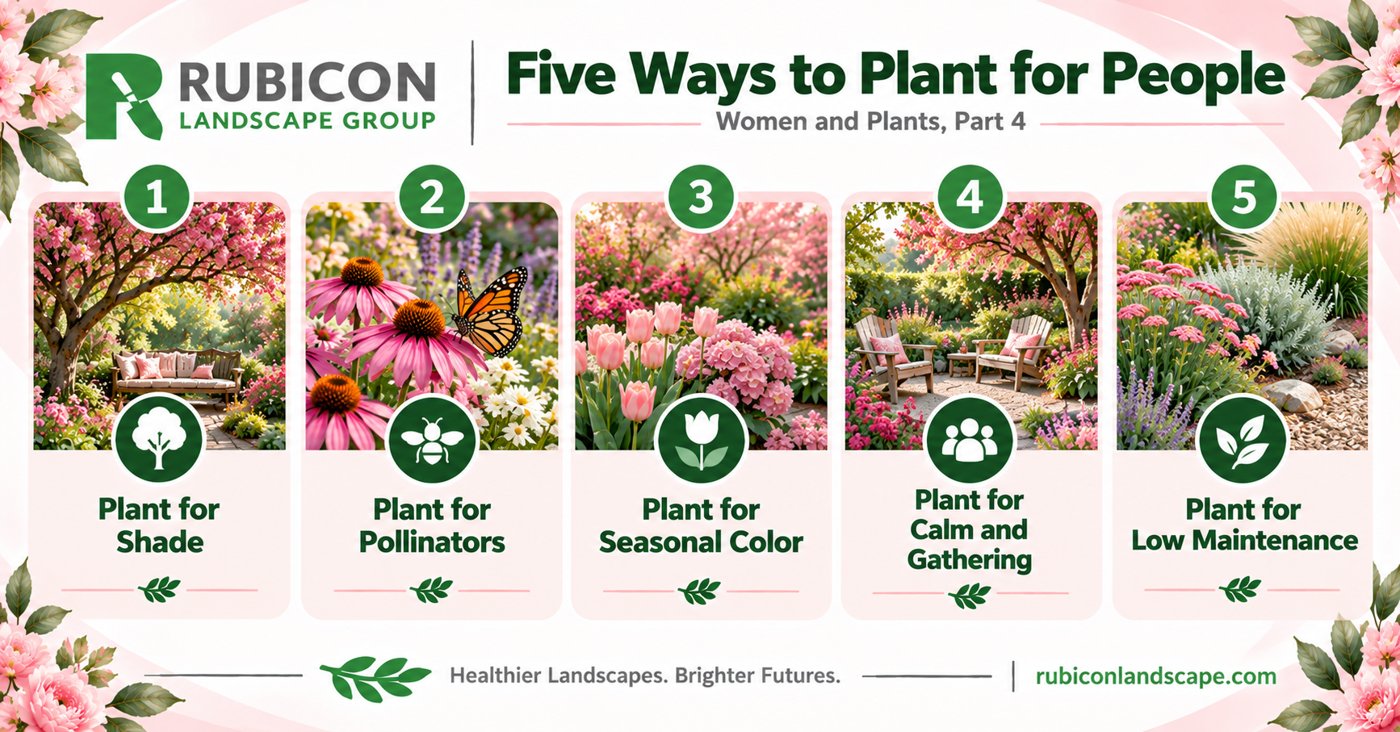
Five Ways to Plant for People infographic: shade, pollinators, seasonal color, calm and gathering spaces, and low maintenance

Landscaping as a Way to Build Community

The women in this series worked with plants out of necessity, curiosity, and care. Their work fed families, advanced medicine, and made life gentler. Today, landscaping can still do that, and it can open doors for the people who do the work as well.

Rubicon Landscape is a division of Rubicon Programs, a nonprofit. Every project supports employment opportunities and workforce development that strengthen the communities we serve. In that way, caring for a landscape also becomes caring for people.

What to Take Home

Pay attention to your plants, and they will tell you what they need. Design spaces for the people who will use them. Finally, remember that the oldest gardening skills, patience, observation, and care, are still the ones that matter most.

Frequently Asked Questions About Women and Plants

What is the Women and Plants series about?

It is a four-part look at how women and plants have helped each other throughout history, from the first cultivation, to plant medicine, to the calming effect of gardens, to what it all means for landscapes today.

Where should I start reading?

Start with Part 1 on the origins of cultivation, then continue to Part 2 on medicine and Part 3 on gardens and wellbeing.

How can a property show care for its community?

Through safe, healthy, welcoming landscapes with shade, seating, clear paths, and plants chosen for the site and the people who use it.

Does landscaping support community employment?

Rubicon Landscape is a division of Rubicon Programs, a nonprofit, and our projects support employment opportunities and workforce development in the communities we serve.

How can I talk to Rubicon about my property?

Use the contact button below, and our team will reach out to schedule a conversation or a site walk.

Let Us Care for Your Landscape

If you manage a commercial property, an HOA, or a public facility in the Bay Area, Rubicon Landscape would be glad to talk with you about a landscape that serves your community. Tell us what you need, and we will take it from there.

Plant for People, Starting With Your Property

Let us help you create a landscape that welcomes, heals, and serves your community.

Resources for Going Deeper

Why Rubicon

For more than 30 years, Rubicon Landscape has provided dependable, professional landscape services throughout the Bay Area, helping property owners and managers maintain landscapes that are healthy, attractive, and reliably well-functioning.

Our approach is built on quality workmanship, responsive service, and proactive problem-solving, the kind of long-term partnership that protects your landscape investment and delivers consistent results, year after year.

As a division of Rubicon Programs, that work also creates real community impact. Every project supports employment opportunities and workforce development that strengthen the communities we serve.

Professional landscape services. Reliable results. Meaningful community impact.

Looking for a Landscape Partner?

From commercial properties and municipal facilities to institutional sites and multi-site portfolios, our services include:

  • Commercial Landscape Maintenance & Installation.
  • Landscape Construction & Renovation.
  • Irrigation Installation, Repair & Management.
  • Water Efficiency & Conservation Solutions.
  • Regenerative Services: Horticulture, Turf Care & Weed Management.
Contact us 

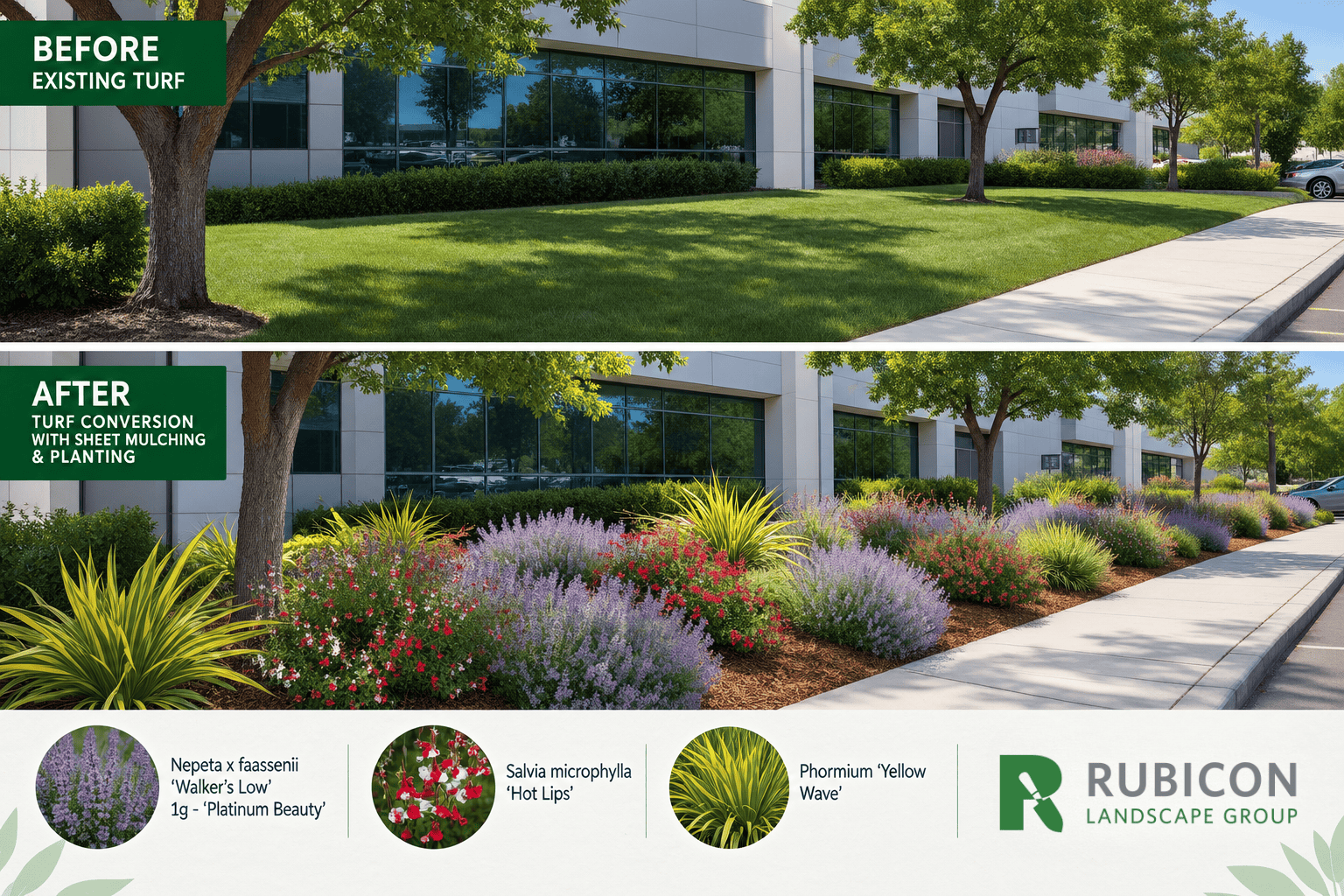
"Before and after photos of a commercial turf-to-sheet-mulch conversion: a plain lawn replaced with a drought-tolerant planting bed of catmint, salvia, and phormium grass along a sidewalk, Rubicon Landscape.
Women and Plants: How Gardens Have Always Soothed the Soul (The Soul)

Women and Plants: How Gardens Have Always Soothed the Soul (The Soul)

Series Women and Plants (Part 3)

Ask almost any gardener why they garden, and the answer is rarely about vegetables or flowers alone. It is about the quiet. For many women across history, the garden was one of the few places that belonged to them, a place to work with their hands, rest their minds, and feel useful and calm at the same time.

Do gardens really improve mental wellbeing? Research suggests they can, and it helps explain how gardens soothe the soul. Studies link time with plants and green views to lower stress, better mood, and, in one well-known hospital study, faster recovery. The evidence mostly shows associations rather than proof of cause, but it points in a consistent direction.

This is Part 3 of our series on women and plants. In Part 1, we explored how women may have discovered cultivation. In Part 2, we followed plants into medicine. Now we turn to something quieter: what gardens do for the soul.

Key Takeaways

  • Gardens have long been places of refuge, and literature has said so for over a century.
  • A 1984 hospital study found that patients with a tree view recovered faster than patients facing a brick wall.
  • A 2019 study of nearly 20,000 people in England linked at least 120 minutes a week in nature with better reported health and wellbeing.
  • Commercial properties can offer the same benefits through shade, seating, paths, and thoughtful planting.

Women, Gardens, and the Idea of Refuge

The idea that a garden can heal is older than the research. In her 1911 novel The Secret Garden, Frances Hodgson Burnett tells the story of children who recover their health and spirits by bringing a neglected garden back to life. The book has stayed in print for more than a century because readers recognize its truth.

Meanwhile, researchers began to explain why. Psychologists Rachel and Stephen Kaplan developed attention restoration theory, the idea that natural settings give our focus a chance to rest and recover. In other words, a garden does not demand our attention. It invites it gently.

How Gardens Soothe the Soul: What Modern Research Says

A View of Trees and Faster Recovery

In 1984, researcher Roger Ulrich published a study in the journal Science that compared patients recovering from gallbladder surgery in a Pennsylvania hospital. Patients in rooms with a view of trees had shorter hospital stays, received fewer negative comments in nurses’ notes, and took fewer strong pain medications than matched patients facing a brick wall. The study was small, with 46 patients in total, and it compared records rather than running a trial. Even so, it is one of the most cited studies in the field.

Two Hours a Week in Nature

In 2019, researchers at the University of Exeter reported on nearly 20,000 adults in England. People who spent at least 120 minutes a week in nature were more likely to report good health and high wellbeing than people who spent none. The benefit appeared whether the time came in one long visit or several short ones, and it held across many groups. Because the data came from surveys, the study shows an association, not cause and effect. Still, it suggests that regular, ordinary contact with green space matters.

Bringing the Benefits to Commercial and Community Properties

You do not need a hospital or a botanical garden to offer these benefits. Employees, tenants, residents, and visitors all spend time near the landscapes we maintain. Small design choices can make those spaces more restorative.

Landscape FeatureWhy It HelpsExample for a Commercial Property
Shaded seatingGives people a comfortable place to pause outdoorsBenches under trees near entrances or break areas
Walking pathsEncourage movement and time outsideA loop path around a courtyard or parking area
Layered plantingHolds attention gently and offers seasonal interestCalifornia native shrubs and perennials in mixed beds
Fragrant plantsEngage the senses and add calmSage or lavender near seating areas
Greenery in window viewsReflects the benefit seen in the Ulrich studyPlanted beds visible from offices and common rooms

A Garden That Restores infographic: a window view of trees, shaded seating, fragrant plants, water sounds and quiet garden paths

Quick Checklist: Is Your Landscape Restorative?

  • Is there at least one shaded place to sit outdoors?
  • Can people see greenery from windows or walkways?
  • Are paths safe, clear, and easy to follow?
  • Do plants look healthy, tidy, and cared for?
  • Does the planting offer color, texture, or fragrance through more than one season?

Next, in Part 4, we bring the whole series together and look at how these ideas translate into landscapes that serve people.

Frequently Asked Questions About Gardens and Wellbeing

Do gardens really improve mental health?

Research links time with plants and green views to lower stress and better reported wellbeing. Most studies show associations rather than proof of cause, so gardens are best seen as one helpful part of a healthy life.

How much time in nature is enough?

One large 2019 English study found that at least 120 minutes a week was linked with better reported health and wellbeing. The time did not have to come all at once.

Does a view of trees really matter?

A 1984 study of surgery patients found that those with a view of trees recovered faster than those facing a brick wall. The study was small, but it has influenced hospital design for decades.

What makes a landscape restorative?

Shade, seating, safe paths, healthy plants, and greenery that people can see and reach. Seasonal color and fragrance help too.

Can commercial properties offer these benefits?

Yes. Courtyards, entrances, break areas, and even narrow planting strips can become calm, welcoming places with the right design and care.

Ready to Make Your Outdoor Spaces More Welcoming?

Rubicon Landscape helps property owners and managers create outdoor spaces that people want to use. Tell us about your property, and we will walk it with you.

Sources and Further Reading

Make Your Outdoor Spaces More Welcoming

Healthy landscapes help people feel welcome. Let us help you plan one.

Resources for Going Deeper

Why Rubicon

For more than 30 years, Rubicon Landscape has provided dependable, professional landscape services throughout the Bay Area, helping property owners and managers maintain landscapes that are healthy, attractive, and reliably well-functioning.

Our approach is built on quality workmanship, responsive service, and proactive problem-solving, the kind of long-term partnership that protects your landscape investment and delivers consistent results, year after year.

As a division of Rubicon Programs, that work also creates real community impact. Every project supports employment opportunities and workforce development that strengthen the communities we serve.

Professional landscape services. Reliable results. Meaningful community impact.

Looking for a Landscape Partner?

From commercial properties and municipal facilities to institutional sites and multi-site portfolios, our services include:

  • Commercial Landscape Maintenance & Installation.
  • Landscape Construction & Renovation.
  • Irrigation Installation, Repair & Management.
  • Water Efficiency & Conservation Solutions.
  • Regenerative Services: Horticulture, Turf Care & Weed Management.
Contact us 

"Before and after photos of a commercial turf-to-sheet-mulch conversion: a plain lawn replaced with a drought-tolerant planting bed of catmint, salvia, and phormium grass along a sidewalk, Rubicon Landscape.
Women and Plants: A History of Healing (Medicine)

Women and Plants: A History of Healing (Medicine)

Series Women and Plants (Part 2)

Long before pharmacies existed, someone in almost every household knew which plant to reach for when a child had a fever or a cut would not close. In many cultures, that someone was a woman. That knowledge was not magic. It was built through patient observation, repeated across seasons, and passed from one generation to the next.

What is the history of women and plant medicine? In many communities, women were the everyday keepers of plant knowledge, gathering, growing, and preparing plants for their families. Remedies rooted in traditional plant use later helped lead to some of the most important medicines in the world, including aspirin, digoxin, artemisinin, and paclitaxel.

This is Part 2 of our series on the long relationship between women and plants. In Part 1, we looked at how women may have discovered cultivation itself. Here, we follow the same habit of close attention into medicine.

Key Takeaways

  • Women were often the household keepers of plant knowledge, much of it passed along by speaking rather than writing.
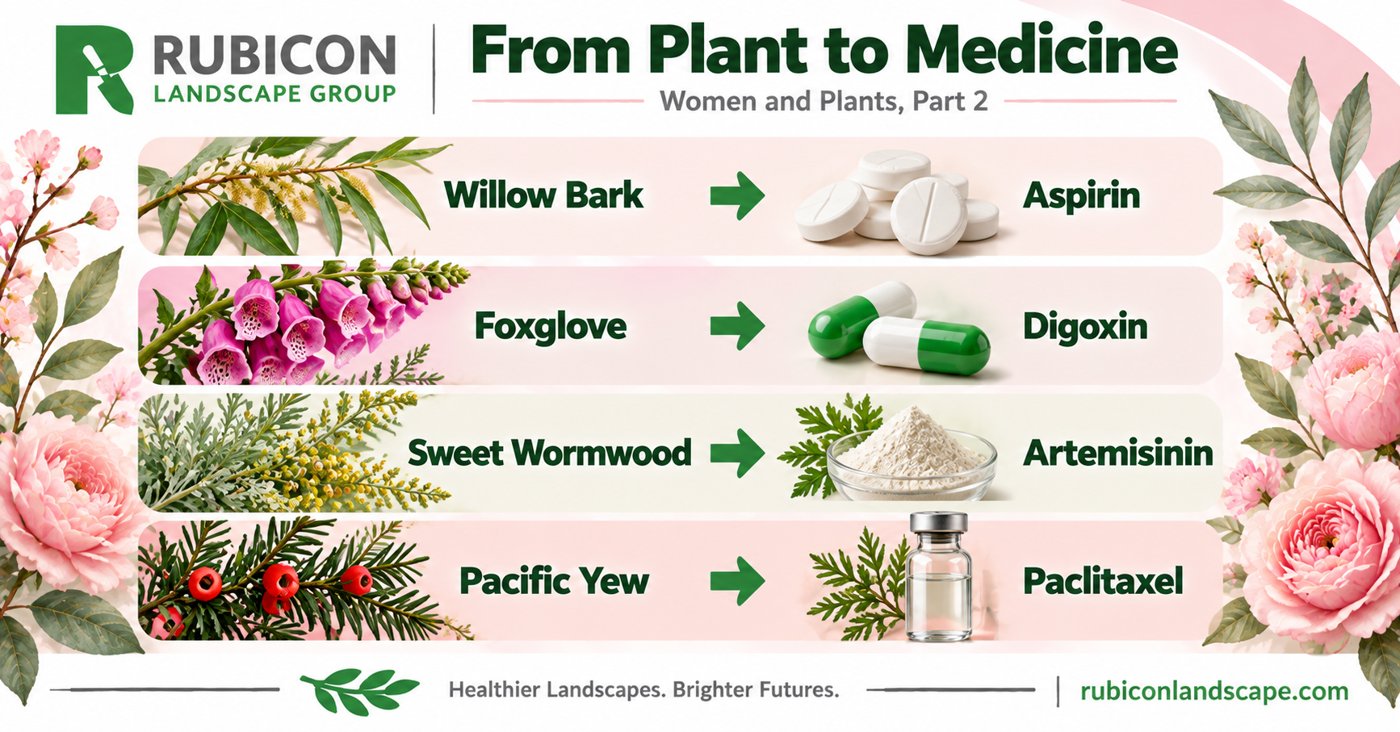
  • Four plants, willow, foxglove, sweet wormwood, and the Pacific yew, each led to a major modern medicine.
  • Women scientists, including Tu Youyou and Susan Band Horwitz, played key roles in modern plant-based discoveries.
  • Many medicinal plants are powerful or poisonous, so they belong in the hands of trained professionals.

Why Women Often Became Keepers of Plant Knowledge

In many communities, women have carried much of the daily work of gathering plants, preparing food, and caring for the sick. Researchers who study traditional plant use, known as ethnobotanists, have documented this pattern in many regions. In medieval Europe, Hildegard of Bingen, a twelfth-century abbess, wrote about the healing properties of plants in her work Physica.

However, the record is uneven. Much of this knowledge traveled by word of mouth, so many names were never written down. As a result, we know less about these women than we would like, and the stories below should be read with that in mind.

Four Plants That Became Modern Medicines

PlantTraditional UseModern Medicine
Willow barkEasing pain and feverAspirin, developed from salicylic acid
FoxgloveTreating dropsy, a swelling often linked to heart failureDigoxin, used for heart conditions
Sweet wormwoodTreating intermittent feversArtemisinin, a malaria treatment
Pacific yewScreened for anticancer activity in the 1960s.Paclitaxel, used in breast and ovarian cancer care

Willow Bark and Aspirin

Physicians in many ancient cultures used willow bark to ease pain and fever. Its active compound, salicin, led chemists to salicylic acid and eventually to aspirin, which Bayer began marketing in the late 1890s. A remedy that families had trusted for centuries became one of the most widely used medicines in the world.

Foxglove and the Heart

In 1785, English physician William Withering published an account of the foxglove and its medical uses, including careful notes on dosing and toxicity. A popular story says he learned of the remedy from an old woman in Shropshire who kept a family recipe for treating dropsy. Withering did write about such a recipe. However, historians question how much of the popular version is embellished, and the woman’s identity is uncertain. What is well documented is his systematic clinical work. Because foxglove is poisonous, his focus on careful dosing mattered a great deal.

Sweet Wormwood and Malaria

In 1969, Chinese pharmacologist Tu Youyou joined a government project to find new malaria treatments. Her team reviewed hundreds of traditional remedies, and an ancient handbook by Ge Hong pointed to sweet wormwood (Artemisia annua). Tu adjusted the extraction method to avoid high heat, and the result was artemisinin. In 2015, she received half of the Nobel Prize in Physiology or Medicine for her discoveries concerning a novel therapy against malaria.

The Pacific Yew and Cancer Care

In 1962, a U.S. Department of Agriculture botanist collected bark from a Pacific yew in Washington State as part of a plant-screening program run with the National Cancer Institute. Researchers later isolated the active compound, paclitaxel. In 1979, Dr. Susan Band Horwitz discovered how it works, by stopping cancer cells from dividing. The FDA approved paclitaxel for ovarian cancer in 1992 and for breast cancer in 1994. Early supply was a serious challenge, because harvesting the bark kills the tree, so researchers developed a semisynthetic version instead.

From Plant to Medicine infographic: willow bark to aspirin, foxglove to digoxin, sweet wormwood to artemisinin, and Pacific yew to paclitaxel

What These Stories Have in Common

The history of women and plant medicine is full of careful observers.

Each story starts with someone paying close attention to a plant over time. In addition, each one shows that traditional knowledge is a starting point, not a finish line. Careful testing, safe dosing, and modern chemistry turned folk remedies into reliable medicines. Finally, credit has often been uneven, which is one more reason to name the women whose work we do know.

A Quick Safety Note

Many medicinal plants are powerful, and some are poisonous. Foxglove is a clear example. Please do not treat these stories as a how-to guide. If you are interested in plant-based remedies, talk with a doctor or pharmacist first.

Why This History Still Matters on the Job

Plants are our daily work at Rubicon Landscape. Understanding what a plant can do for people, and what it can do to them, is part of caring for a property well. As a result, thoughtful plant selection, clear knowledge of which species are toxic, and good communication with property teams all belong in professional landscape care.

Next in the series, in Part 3, we move from the medicine cabinet to the garden bench and ask why gardens have always soothed the soul.

Frequently Asked Questions About Women and Plant Medicine

Did women discover these medicines?

Not alone, and not always. Women were often the household keepers of plant knowledge, and some, such as Tu Youyou and Susan Band Horwitz, made key modern discoveries. However, many contributors across history were never recorded.

What is an ethnobotanist?

An ethnobotanist studies how people in different cultures use plants for food, medicine, building, and ceremony.

Is it safe to use medicinal plants at home?

Not without guidance. Many medicinal plants are powerful, and some are poisonous. Please talk with a doctor or pharmacist before using any plant remedy.

Why is foxglove dangerous?

Foxglove contains compounds that act on the heart and are toxic in the wrong dose. That is why Withering focused so heavily on careful dosing.

Are plant-based medicines still important today?

Yes. Aspirin, digoxin, artemisinin, and paclitaxel all trace back to plants, and researchers continue to study plants for new treatments.

Want a Landscape That Works for People?

Rubicon Landscape designs and maintains commercial landscapes across the Bay Area, with careful plant selection and a mission to create jobs and opportunity. Tell us about your property, and we will help you plan next steps.

Sources and Further Reading

This article is for general information and is not medical advice.

Talk to Rubicon About Your Landscape

Plants are our daily work. Let us help you plan a landscape that serves the people who use it.

Resources for Going Deeper

Why Rubicon

For more than 30 years, Rubicon Landscape has provided dependable, professional landscape services throughout the Bay Area, helping property owners and managers maintain landscapes that are healthy, attractive, and reliably well-functioning.

Our approach is built on quality workmanship, responsive service, and proactive problem-solving, the kind of long-term partnership that protects your landscape investment and delivers consistent results, year after year.

As a division of Rubicon Programs, that work also creates real community impact. Every project supports employment opportunities and workforce development that strengthen the communities we serve.

Professional landscape services. Reliable results. Meaningful community impact.

Looking for a Landscape Partner?

From commercial properties and municipal facilities to institutional sites and multi-site portfolios, our services include:

  • Commercial Landscape Maintenance & Installation.
  • Landscape Construction & Renovation.
  • Irrigation Installation, Repair & Management.
  • Water Efficiency & Conservation Solutions.
  • Regenerative Services: Horticulture, Turf Care & Weed Management.
Contact us 

"Before and after photos of a commercial turf-to-sheet-mulch conversion: a plain lawn replaced with a drought-tolerant planting bed of catmint, salvia, and phormium grass along a sidewalk, Rubicon Landscape.
The Landscaping Company Built to Fund a Mission

The Landscaping Company Built to Fund a Mission

Rubicon Landscape is a social enterprise landscaping company: a full-service commercial landscaping business whose revenue directly funds the workforce development mission of its nonprofit parent, Rubicon Programs. That’s not a tagline. It’s the actual business model, and it only works because the landscaping itself has to hold up on its own merits, every day, on every property.

Here’s what that looks like in practice, not in theory.

First, the Landscaping Has to Be Real

Rubicon Landscape doesn’t get chosen for federal, municipal, and commercial contracts because of the mission behind it. Properties like the Port of Oakland, Treasure Island, Veterans Affairs, the City of San Francisco, and the U.S. Coast Guard hire Rubicon because the crews show up, the work holds up, and the standard doesn’t slip.

That work spans the full range a commercial property actually needs:

  • Landscape maintenance: mowing, pruning, turf care, and seasonal upkeep on a consistent, professional schedule.
  • Irrigation management: system audits, drip conversions, and proactive repair before small problems become expensive ones.
  • Landscape construction and renovation: new plantings, hardscape, and full site transformations.
  • Enhancements and installations: new plantings, features, and upgrades that keep an established property looking cared for, not just maintained.
  • Horticultural and specialty services: soil health, plant selection, and site-specific care for complex properties.


At a site like the King-Garvey Co-op Apartments in San Francisco’s Western Addition, that meant converting an aging overhead irrigation system to drip, reusing existing components where it made sense, on a property that had already undergone a $45 million rehabilitation and couldn’t afford landscaping that looked like an afterthought. At Treasure Island, it means ongoing grounds maintenance across common exterior areas and native habitat at Yerba Buena Island, on a property managed by a public development authority with real standards to meet.

This is the part that has to work first. Without real, competitive landscaping work, there’s no revenue, and without revenue, there’s no mission funded.

Then, the Revenue Does Its Second Job

Every maintenance contract, every irrigation retrofit, every construction project Rubicon Landscape completes generates revenue that flows back into Rubicon Programs, the nonprofit that has spent decades helping people in the East Bay build stability and break cycles of poverty.

That funding supports real, specific programs, not a general fund:

  • Job training and employment: Rubicon Landscape itself is a training ground. Crew members build real, marketable landscaping and irrigation skills on active commercial and federal sites, not in a classroom disconnected from the work.
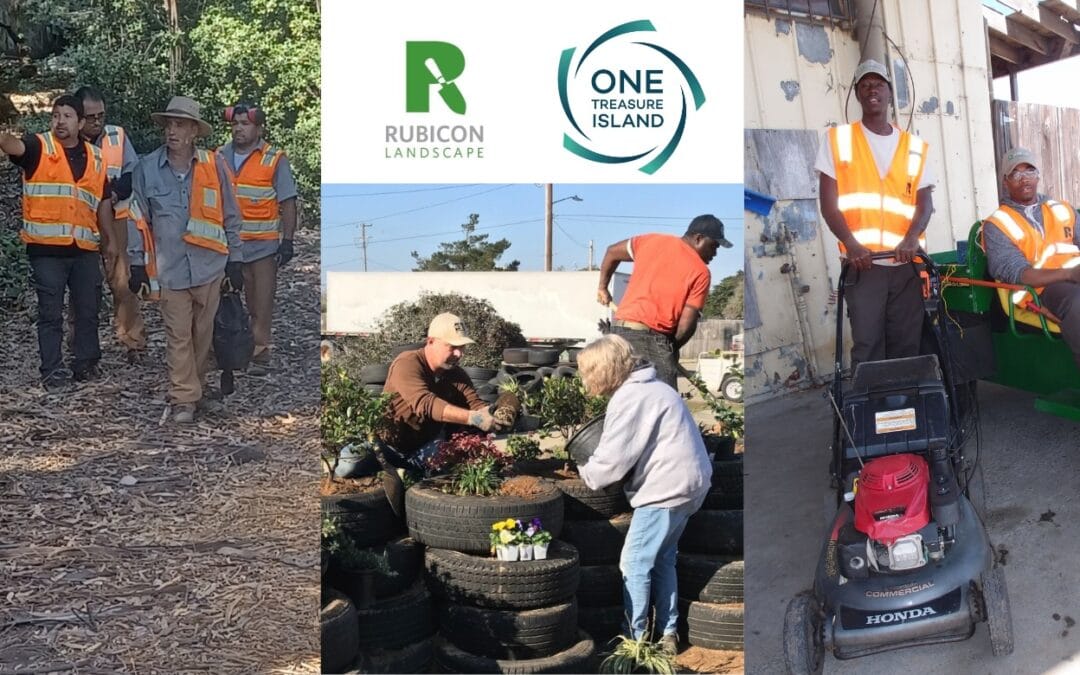
  • The One Treasure Island partnership: since 1997, Rubicon has provided grounds maintenance on Treasure Island through a partnership built specifically to create entry-level job opportunities for economically disadvantaged San Francisco residents. Trainees graduate ready to be hired as gardeners in the landscaping industry, not just Rubicon’s, the industry’s.
  • Workforce development for justice-impacted individuals: programs focused on formerly incarcerated individuals and their families, aimed at reducing recidivism through stable employment and real career paths.
  • Broader community services: economic self-sufficiency programs for extremely low-income participants, built around career planning and long-term stability, not one-time assistance.

Why This Model Actually Works

A lot of companies attach a cause to their marketing. Rubicon Landscape’s model is structurally different: the landscaping crew is the workforce development program. The same person maintaining irrigation at a VA facility or renovating a planting bed on Treasure Island may be building the exact skills and work history that Rubicon Programs’ mission is designed to create.

That means every contract Rubicon wins does two things at once:

  1. It delivers professional landscape services a demanding client actually needs.
  2. It creates or sustains real employment and training inside a mission-driven organization.

Neither side of that is optional. A landscaping arm that couldn’t compete on quality wouldn’t generate the revenue to fund anything. A revenue engine with no mission behind it would just be a landscaping company. Rubicon Landscape has to be genuinely excellent at commercial landscaping specifically because the mission depends on it.

Impact on Two Levels

What makes Rubicon Landscape different comes down to this: our work creates impact on two levels at once.

First, we create beautiful, well-maintained outdoor spaces, spaces that communities, employees, visitors, and customers get to actually enjoy, every day, whether they ever think about who maintains them or not.

Second, we create opportunity. We reinvest in our community, helping advance Rubicon’s broader mission of building stronger communities through meaningful employment and real services.

Those two things might sound like a landscaping company doing its job, and then separately, doing something generous on the side. But look a little closer, and they’re not separate at all.

Caring for the Land and Caring for People, In the Same Breath

There’s a quiet thread running through everything we do at Rubicon, and once you see it, it’s hard to unsee: caring for the land and caring for people have never really been two different things for us. They’re the same instinct, just pointed in two directions.

Think about what it means to care for soil the right way. You don’t reach for more water or more chemicals to cover up a problem. You slow down, you listen to what the land is telling you, and you build something underneath the surface that lets it thrive on its own, season after season, long after you’ve moved on to the next property. That’s patient work. It’s not always visible right away. But it lasts.

Now think about what it means to walk alongside someone building a new life. You don’t hand someone a single paycheck and call it done. You invest in real skills, real experience, real belief that they can build something lasting, so that a year from now, five years from now, they’re standing on their own, not because we’re still holding them up, but because we helped them grow strong enough not to need that anymore.

See the thread? Root cause over quick fix. Patience over shortcuts. Helping something, or someone, become resilient rather than dependent. That’s not a nice comparison we came up with to make our story sound good. It’s genuinely one philosophy, one way of showing up in the world, and we simply get to practice it twice: once in the soil, and once in the lives of the people who work alongside us.

So when a member of our crew spends their morning nurturing a client’s landscape back to health, in a very real way, they’re standing in the same soil that once helped nurture their own path forward. That’s not a metaphor. That’s just how it works here.

What This Means for Your Property

Choosing Rubicon Landscape means choosing a contractor held to the same standard as any other, on maintenance quality, irrigation efficiency, communication, and reliability, because that standard is what makes the rest of the model possible.

It also means your landscaping contract does something most don’t: it funds real job training, real employment, and real community impact for people building a path to stability. Not as a donation. As a direct result of the work being done well.

The landscape benefits. The property benefits. The community benefits. That’s not three separate outcomes. On a Rubicon Landscape property, it’s one outcome, built from the same crew, the same contract, and the same standard of work.

30+ years of experience. Full-service landscape expertise. Community impact that goes beyond the job site.

That’s Rubicon Landscape.

Request a Site Walk 

#RubiconLandscape #RubiconPrograms #CommercialLandscaping #BayAreaLandscaping #LandscapeManagement #LandscapeMaintenance #SocialEnterprise #CommunityImpact #WorkforceDevelopment #StrongerCommunities

Request Bay Area Commercial Landscaping Services

For more than 30 years, Rubicon Landscape has provided dependable, professional landscape services throughout the Bay Area. We help property owners and managers maintain healthy, attractive, and well-functioning landscapes through landscape maintenance, construction, irrigation, water management and regenerative services.

Our approach is built around quality workmanship, responsive service, proactive problem-solving, and long-term partnerships. From maintaining established landscapes to improving irrigation efficiency and managing water use, we work to protect your landscape investment while delivering consistent results.

As a division of Rubicon Programs, our work also creates meaningful community impact. The success of Rubicon Landscape helps support employment opportunities, workforce development, and services that strengthen the communities we serve.

Professional landscape services. Reliable results. Meaningful community impact.

Looking for a Landscape Partner?

Whether you manage a commercial property, municipal facility, institutional site, or multi-site portfolio, Rubicon Landscape has the experience and capabilities to help you maintain, improve, and manage your landscape.

Our services include:

  • Commercial Landscape Maintenance & Installation
  • Landscape Construction & Renovation
  • Irrigation Installation, Repair & Management
  • Water Efficiency & Conservation Solutions
  • Regenerative Services — Horticulture, Turf Care & Weed Management

Request a Consultation 

RESOURCES:

https://www.rescapeca.org/

https://www.qwel.net/

Read AB-1572 Series:

Rubicon Landscape Celebrates Progress of Second Cohort in Beautify Richmond Program

Rubicon Landscape Celebrates Progress of Second Cohort in Beautify Richmond Program

Second Cohort in Beautify Richmond Program Progress Report

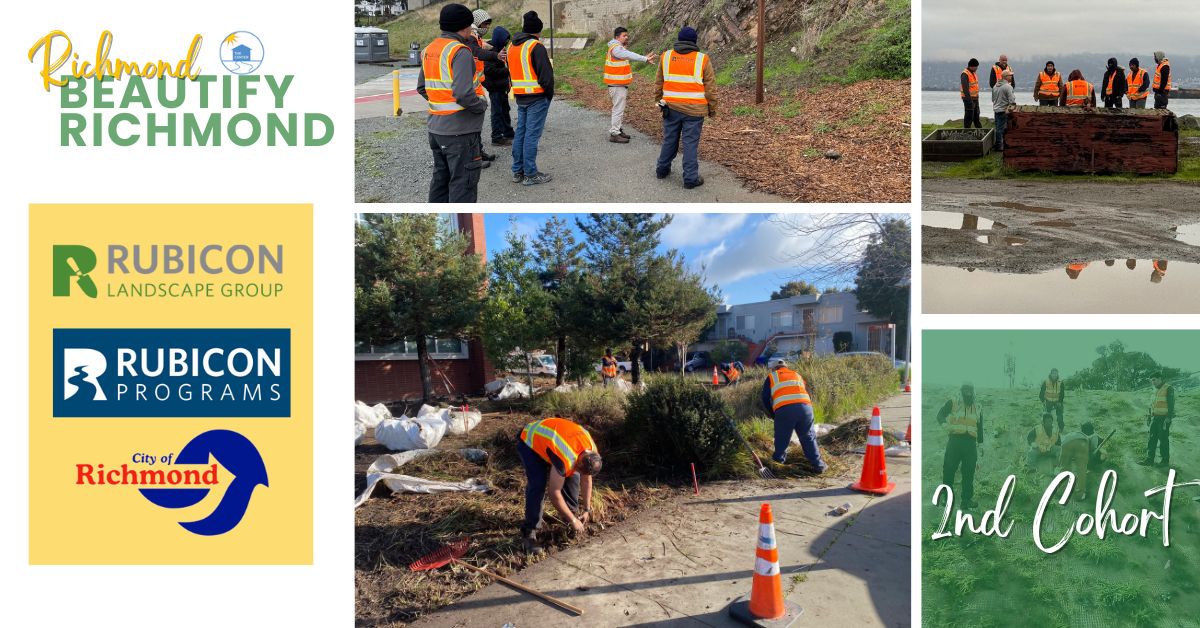
RICHMOND, CALIFORNIA, UNITED STATES, January 30, 2024 — Rubicon Landscape Group, in partnership with Rubicon Programs and the City of Richmond, is pleased to announce the significant progress of its second cohort participating in the Beautify Richmond Program. Under the guidance of Operations Manager Juan Hernandez, the cohorts embarked on an educational tour, enhancing their understanding of environmental stewardship and native plant species.

The tour took the cohorts to Yerba Buena Island, where they engaged with environmentalists and botanists to learn about the island’s native flora and ongoing efforts to combat invasive plant species. Led by Michael Gillett, Director of Operations, and Veronica Switzer, Training Coordinator, the visit provided invaluable hands-on experience, fostering a deeper appreciation for environmental conservation and the significance of native plant restoration.

During the excursion, the cohorts explored the rich history of Yerba Buena Island, distinguishing its natural origins from the man-made landscape of Treasure Island. Over lunch, members of the crew and cohorts had the opportunity to connect, fostering a sense of camaraderie and enabling fruitful discussions about their work and the mission of Rubicon Landscape.

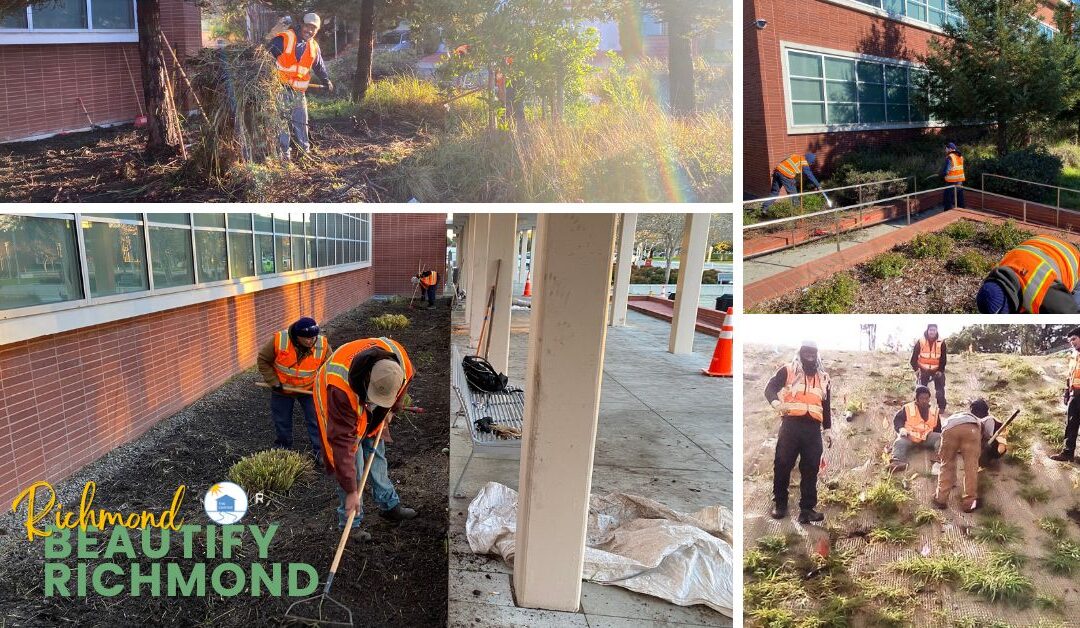
During a recent session at the Civic Center in Richmond, the cohorts engaged in practical landscaping exercises facilitated by Mike Gillett, Director of Operations at Rubicon Landscape. Gillett’s approach involved teaching specific landscaping techniques and then guiding the cohorts as they applied these skills in real-time scenarios. This immersive learning experience has proven to be highly effective, enabling participants to grasp concepts swiftly and build confidence in their abilities.

The cohorts, working at the Civic Center two days a week, have enthusiastically embraced their responsibilities, demonstrating a strong work ethic and eagerness to learn. Led by Gillett, they work diligently in sections, ensuring continuity and efficiency in their landscaping endeavors. As each day concludes, the cohorts seamlessly transition to the next phase of their work, building upon the progress made and maintaining momentum throughout the program.

“We are immensely proud of the dedication and enthusiasm exhibited by the second cohort of the Beautify Richmond Program,” remarked Juan Hernandez, Operations Manager at Rubicon Landscape Group. “Their willingness to learn and contribute to the beautification efforts at the Civic Center is truly inspiring.”

Furthermore, Rubicon Landscape is proud to announce that Vernon Britten, a graduate of the program’s inaugural cohort, has secured a position at the Richmond Civic Center, demonstrating the tangible outcomes and opportunities afforded by the Beautify Richmond Program. Britten’s dedication to the program exemplifies its transformative impact, embodying the ethos of giving back and supporting others on their journey towards personal and professional growth.

“I see the cohort arrive each day for training eager and thankful for the opportunity.  They have become a team encouraging and supporting one another.  I smile as I think to myself how much their strength and resilience inspires me everyday. From Beautify Richmond participant to Rubicon Landscape employee, Vernon motivates and inspires everyone; he leads by example and with purpose, motivating all of us.  I am thankful to be a part of this transformative program we call Beautify Richmond.”
 Veronica Switzer, Training Coordinator


As the second cohort progresses in their journey, Rubicon Landscape reaffirms its commitment to empowering justice-impacted individuals and fostering positive change within the community. With ongoing support from partners like Rubicon Programs and the City of Richmond, the Beautify Richmond Program continues to make strides in providing pathways to sustainable employment and meaningful engagement in environmental conservation efforts.

For more information about Rubicon Landscape Group and the Beautify Richmond Program, please contact:

Rubicon Landscape at +1 510-680-0309 or email veronicas@rubiconprograms.org

About the Beautify Richmond Program:

The Beautify Richmond Program, a collaborative effort between Rubicon Landscape Group, Rubicon Programs, the City of Richmond, and the Reentry Success Center, is a transformative initiative aimed at empowering justice-impacted individuals in Richmond, California. Central to the program is Rubicon Landscape Group’s provision of comprehensive job training in commercial landscape maintenance. Leveraging its expertise and resources, Rubicon Landscape Group offers hands-on training, mentorship, and guidance to equip participants with the necessary skills for a fresh start in life after incarceration. Additionally, the Reentry Success Center plays a pivotal role by providing essential support services such as housing assistance, treatment programs, transportation aid, clothing provisions, and nutritional support to address various personal and professional needs of program participants. Through a structured curriculum, practical experience, and holistic support from Rubicon Landscape Group and the Reentry Success Center, participants embark on a journey of personal and professional growth, gaining valuable skills and resources for successful reintegration into society. The Beautify Richmond Program exemplifies a collaborative effort dedicated to fostering positive change within the community, with a focus on empowering individuals through skill development, support services, and community engagement opportunities.


About Rubicon Landscape Group:

Rubicon Landscape Group is a subsidiary of Rubicon Programs, a Bay Area non-profit organization dedicated to transforming the lives of individuals and families through comprehensive support services and vocational training. With a focus on sustainable landscape management, Rubicon Landscape Group partners with municipalities, HOAs, and commercial properties to deliver high-quality landscaping services while promoting environmental stewardship and community well-being.


Beautify Richmond

Building a Flourishing Community: One Treasure Island’s Partnership with Rubicon Landscape Group

Building a Flourishing Community: One Treasure Island’s Partnership with Rubicon Landscape Group

At One Treasure Island, the mission is clear: to develop a vibrant, diverse, and inclusive community on Treasure Island by offering free services and resources to residents in need. The goal is to create opportunities for all, providing pathways for economic advancement through affordable housing, job assistance, construction training, and a community center. One Treasure Island and its partners are committed to ensuring that every individual can access the resources they need to prosper.

With core values such as community, collaboration, and equality, One Treasure Island partners with those that live and work here to create room for every voice to be heard.

Together, as the Island develops, we will champion integration and access to opportunities within the broader, mixed-income neighborhood. From our community center to our signature education programs, we help our residents achieve stability and new opportunity through our integrated programs.

Integrated Programs: Creating Room For Everyone

Treasure Island is one of San Francisco’s most diverse communities, and as it continues to grow, we aim to see it flourish. We understand that a community thrives when the needs of all its members are met, not just a select few. That’s why we have established integrated programs that cater to the diverse backgrounds and needs of Treasure Island’s residents.

integrated programs at Rubicon Landscape

The commitment extends beyond physical infrastructure; One Treasure Island is dedicated to fostering a sense of belonging and dignity for everyone who lives and works on Treasure Island. To achieve this, we collaborate with local organizations to provide residents with the necessary resources, supportive services, and amenities to thrive.


Rubicon Landscape Group: Training and Support

Rubicon Landscape has partnered with One Treasure Island to share a mission of helping those who live on the island by providing on-the-job training, education, and support for each candidate’s professional goals.

Rubicon Landscape and One Treasure Island work together to support trainee opportunities. Rubicon Enterprises’ Job Readiness Program employees may also choose to participate in One Treasure Island’s Construction Jobs Training Program either before or after their six months as trainees. This complementary training provides additional certifications and opens up more employment opportunities with construction unions. 

Throughout the year, Rubicon employees work alongside volunteers in the gardens giving us the opportunity to share some of the history of the Islands, insight into our regenerative practices, and the methods we use to bring the Yerba Buena Island back to its native origins using the most cutting-edge sustainable practices.    

As a Gold Sponsor at One Treasure Island’s 2023 Gala, Rubicon Landscape Group is commited to the shared vision. Our support goes beyond a financial contribution; it signifies a dedication to building a community where diversity, equity, and opportunity are at the forefront.

Sponsorship

Join Us in Creating a New Vision

Everyone deserves a safe place to live and the opportunity to live with dignity. We are not just constructing a new neighborhood; together, we are pioneering a new vision for community development—one built around diversity, equity, and opportunity for all.

We invite you to be a part of this journey.  Together, we can build a Treasure Island where every resident flourishes.


One treasure island