
Commercial Drip Conversion Components: After the Valve
Swapping a spray valve for drip irrigation isn’t just a tubing swap. Drip conversion components installed after the valve determine whether the system runs efficiently for years or clogs, leaks, and fails within a season. This is Part 3 of our AB 1572 series, following our nonfunctional turf law overview and Bay Area water rebate guide.
Here’s exactly what belongs after the valve, in the right order, and why each piece matters.
Why What’s After the Valve Matters
A drip valve on its own delivers water at spray-system pressure and with spray-system debris tolerance, neither of which drip tubing and emitters can handle. Skip the right components, and the most common failures show up fast:
- Emitters popping off the tubing under excess pressure
- Fine sediment clogging emitters within weeks
- Air pockets causing uneven watering across a zone
- Debris getting pulled into emitters when the system shuts off
Four components, installed in the right order, prevent all of this.
1. Pressure Regulator
Drip components are built for 20 to 40 PSI, well below standard spray-system pressure (typically 40 to 60 PSI). Without a regulator, that excess pressure pops emitters off the tubing, blows out fittings, and shortens the entire system’s lifespan.
Commercial pressure regulators commonly hold a fixed 25 or 40 PSI at flows between 0.5 and 15 GPM, matched to the zone’s actual demand. Check pressure at the end of the line, not at the valve: that’s the only way to confirm the whole run is actually within range.
2. Filter
A 120 to 150 mesh filter (stainless steel or nylon screen) removes the fine sediment and debris that would otherwise clog drip emitters, whose openings are far smaller than a spray nozzle’s.
Installation order matters here: the filter goes in before the pressure regulator, not after. Debris passing through an unfiltered regulator first can damage the regulating mechanism itself, and UC Master Gardener guidance specifically confirms this filter-before-regulator sequence for the same reason.
3. Air / Vacuum Relief Valve
Installed at the highest point in the zone, this valve does two jobs:
- While running: releases trapped air that would otherwise cause uneven watering and water hammer
- At shutoff: prevents a vacuum from forming that can siphon soil and debris backward into emitters, a leading cause of slow, hard-to-diagnose clogging
It’s an easy component to skip since the system runs fine without it at first. The problems it prevents show up gradually, not on day one.
4. Flush Valve / End Cap
At the low point or far end of each dripline run, a flush valve (or a simple end cap) lets sediment that settles at the line’s end get purged out periodically instead of building up and clogging the last few emitters on the run.
This is the cheapest, simplest component on this list, and the easiest to forget. Building it in from the start means a five-minute flush instead of digging up hardened tubing later.
Seeing the Full Sequence
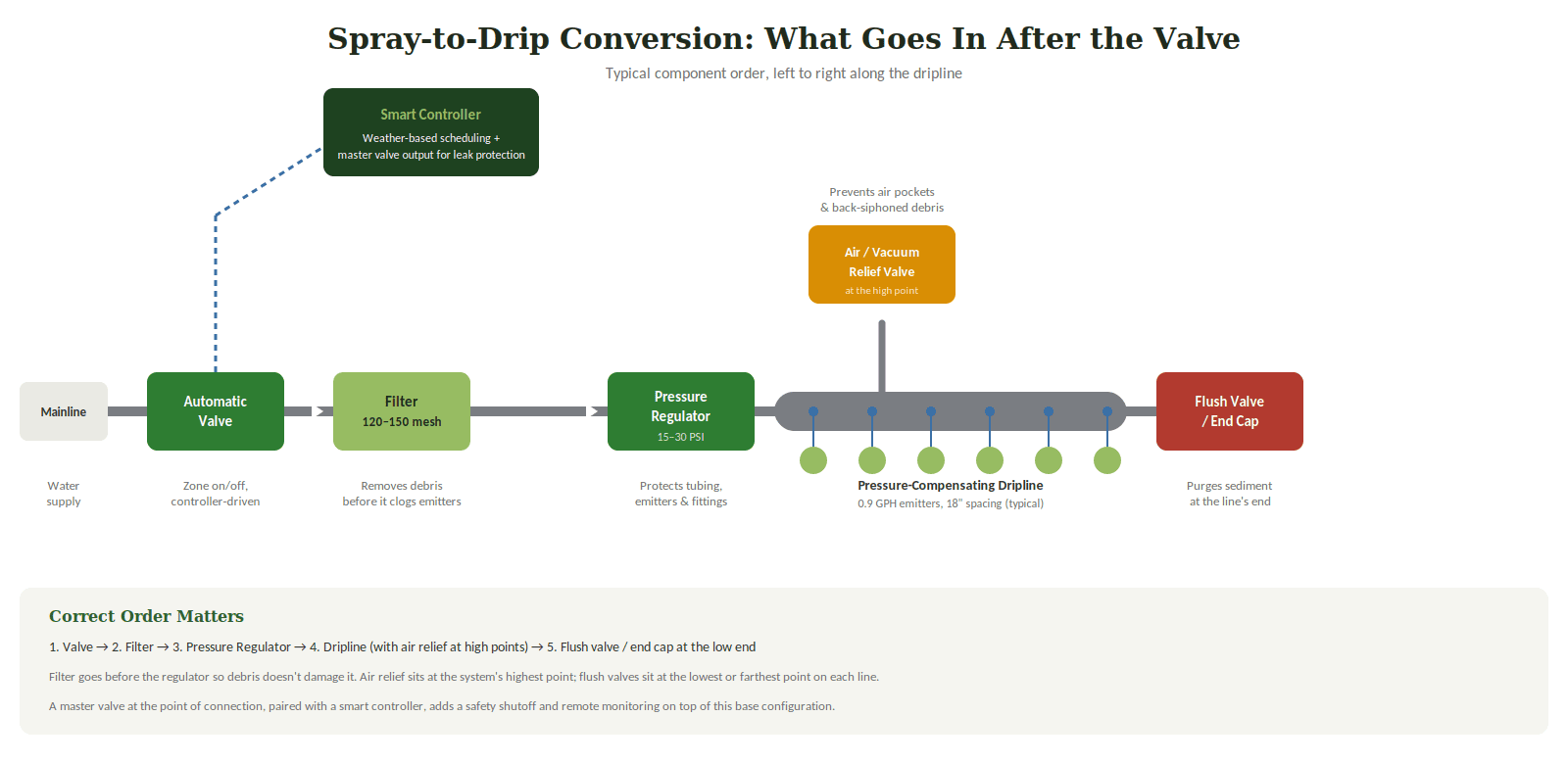
The order shown above isn’t arbitrary. Filter before regulator protects the regulator. Air relief at the high point catches trapped air before it causes problems. Flush valve at the low point clears what the filter didn’t have to catch in the first place, sediment that settles after installation.
Optional But Smart: Master Valve + Controller
None of the four components above require a smart controller to function, but pairing the zone with a master valve and a smart controller adds a meaningful layer of protection and control:
- A master valve sits at the point of connection and stays normally closed, opening only when a zone is actively running. If a zone valve fails open, the master valve limits how much water gets wasted before anyone notices.
- A smart controller adjusts run times based on real weather and ET (evapotranspiration) data instead of a fixed schedule, and many models flag abnormal flow, an early warning for a leak or a stuck valve.
This pairing isn’t just a nice-to-have. Several Bay Area water agencies specifically fund or require smart controllers as part of their rebate programs, covered in our Bay Area water rebate guide, so this is often a cost-neutral upgrade once rebates are factored in.
Getting the Order Right
- Valve: zone on/off, controller-driven
- Filter: 120–150 mesh, removes debris before it reaches the regulator
- Pressure regulator: holds the zone at 20–40 PSI
- Dripline: pressure-compensating tubing with emitters
- Air relief valve: at the system’s highest point
- Flush valve / end cap: at the lowest or farthest point on each line
Get this sequence right once, and the system needs very little intervention afterward beyond periodic flushing and filter checks.
Resources for Going Deeper
- Save Our Water: California’s statewide water conservation program, including outdoor watering guidance
- QWEL (Qualified Water Efficient Landscaper): EPA WaterSense-recognized information covering irrigation auditing and system design
- NALP (National Association of Landscape Professionals): Education for landscape and irrigation professionals and beginners.
- CLCA (California Landscape Contractors Association): California-specific water management guidance.
Get It Installed Right the First Time
Rubicon Landscape’s standardized drip conversion pricing includes every component covered here: filter, pressure regulator, air relief, flush valve, and, where it makes sense, a master valve and smart controller pairing. Every installation is flushed, pressure-checked, and verified for uniform coverage before we call it done.
Working through an AB 1572 conversion or planning ahead of the 2028 deadline? Let’s map out what your property needs.
Request Bay Area Commercial Landscaping Services
For more than 30 years, Rubicon Landscape has provided dependable, professional landscape services throughout the Bay Area. We help property owners and managers maintain healthy, attractive, and well-functioning landscapes through landscape maintenance, construction, irrigation, water management and regenerative services.
Our approach is built around quality workmanship, responsive service, proactive problem-solving, and long-term partnerships. From maintaining established landscapes to improving irrigation efficiency and managing water use, we work to protect your landscape investment while delivering consistent results.
As a division of Rubicon Programs, our work also creates meaningful community impact. The success of Rubicon Landscape helps support employment opportunities, workforce development, and services that strengthen the communities we serve.
Professional landscape services. Reliable results. Meaningful community impact.
Looking for a Landscape Partner?
Whether you manage a commercial property, municipal facility, institutional site, or multi-site portfolio, Rubicon Landscape has the experience and capabilities to help you maintain, improve, and manage your landscape.
Our services include:
- Commercial Landscape Maintenance & Installation
- Landscape Construction & Renovation
- Irrigation Installation, Repair & Management
- Water Efficiency & Conservation Solutions
- Regenerative Services — Horticulture, Turf Care & Weed Management