Series: Storm Season / El Nino Prep (Part 2)
With NOAA putting the odds of a very strong El Nino above 90% this winter, the properties that come through this season without damage won’t be the lucky ones. Instead, they’ll be the ones that checked their drainage in October, rather than finding out what’s wrong during the first real storm.
This is Part 2 of our storm-prep series, following A Super El Nino Is Coming: Is Your Bay Area Property Ready? We’re starting with drainage for a reason: it’s not only the single most common source of storm damage, but almost all of it is also visible before the rain arrives, as long as you know where to look.
Why Drainage Problems Hide Until It’s Too Late
A drainage system can look completely fine on a dry day. Catch basins sit empty. Grading looks flat enough. Downspouts are attached to the building. Because of that, nothing raises a flag.
Then it rains, and suddenly every weakness the dry season was hiding shows up at once: water pooling where it shouldn’t, basins that can’t keep up, downspouts dumping straight at the foundation instead of away from it. By then, you’re no longer doing prevention, you’re doing damage control instead.
Fortunately, almost every drainage problem leaves a visible clue even when it’s dry. So really, you just have to know what you’re looking at.
What to Check: The Four Problem Areas
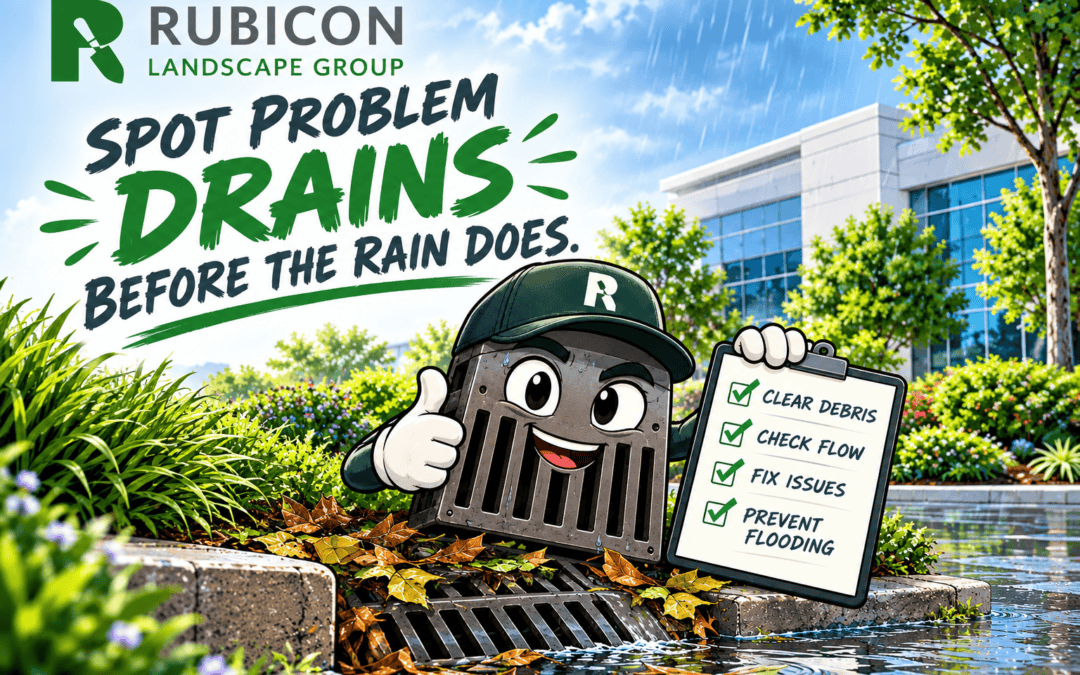
1. Clogged Catch Basins & Storm Drains
Over the course of a full summer and fall, leaves, mulch, and sediment settle into catch basins and storm drain grates without anyone noticing, until the first storm tries to push water through them.
What to look for:
- Visible debris, leaves, or sediment sitting in or over the grate
- A grate that’s noticeably harder to see into than it should be
- Standing water near a basin even after light rain, a sign it’s already restricted
Quick check: pour a few buckets of water near the basin. If it doesn’t drain within a couple of minutes, that likely means something downstream is blocked.
2. Poor Grading
Grading determines whether water moves away from your buildings and hardscape, or toward them instead. Because grading problems often develop slowly, through settling soil, root growth, or years of mulch buildup, a property that graded correctly when it was built can still grade poorly now.
What to look for:
- Water pooling near a building foundation after rain
- Bare, eroded channels in turf or beds that show where water has been flowing
- Mulch or soil visibly washed downhill in a consistent pattern
Quick check: walk the property during or right after a rain, even a light one, and watch where water actually goes. That way, you’ll see real drainage behavior instead of guessing from a dry-day walkthrough.
3. Standing Water Spots
A puddle that disappears within an hour or two is normal. However, a puddle that’s still there a day or two later is a drainage problem, and during a wet winter, it becomes a liability and mosquito issue on top of a landscape one.
What to look for:
- Any spot that holds water noticeably longer than the rest of the property
- Compacted soil (often in high-traffic areas) that visibly resists absorbing water
- Turf that’s consistently thin, yellowed, or mossy in the same spot every year, a classic sign of chronic standing water
Quick check: if you can point to the same wet spot in your memory from last winter, that’s not a fluke, it’s a pattern.
4. Downspout Issues
Downspouts are supposed to move roof water well away from the building. When they don’t, that water usually ends up right at the foundation instead, which is exactly where you don’t want it during a heavy rain year.
What to look for:
- Downspouts that end at ground level with no extension or connection to a drain line
- Erosion channels or bare soil directly below a downspout outlet
- Extensions pointed into planting beds or turf instead of toward a drain or daylight point away from the structure
Quick check: trace each downspout from roof to final discharge point. If you lose the trail before the water is clearly routed away from the building, that’s the problem right there.
Your Drainage Walkthrough Checklist
Check every catch basin and storm drain grate for debris or sediment
Run a bucket test on any basin that looks questionable
Walk the property during or right after rain to see where water actually flows
Flag any bare or eroded channels in turf or planting beds
Note any spot where water stands for more than a few hours
Trace every downspout from roof to final discharge point
Confirm downspout extensions point away from the building, not into beds against the foundation
Photograph problem areas now, since dry-season photos make it much easier to plan and prioritize fixes later
What Happens If These Go Unaddressed
None of these four problems are dramatic on their own. Together, though, in a winter NOAA expects to bring above-normal rainfall concentrated into a few intense months, they compound fast:
- Clogged basins back up and flood hardscape or parking areas
- Poor grading sends water toward foundations instead of away from them
- Standing water areas get worse with every storm instead of draining between them
- Misdirected downspouts add concentrated volume exactly where erosion and foundation issues start
As a result, fixing any one of these in October is a maintenance task. Fixing all four in January, during an active storm, is an emergency call instead, and those cost more, take longer, and often happen while the damage is still getting worse.
Why Property Managers Check This With Rubicon
We don’t just look for standing water and call it done. Instead, our teams trace the actual system, basins, grading, and downspouts, together, because a fix in one spot that ignores the other two doesn’t actually solve anything. That’s ultimately the difference between a real drainage assessment and a surface-level walkthrough.
Ready to Check Your Drainage Before the Rain Does?
We’ll walk your property with the same checklist above, and tell you exactly what needs attention before the season’s first real storm.
Resources for Going Deeper
- Save Our Water: California’s statewide water conservation program, including outdoor watering guidance
- QWEL (Qualified Water Efficient Landscaper): EPA WaterSense-recognized certification covering irrigation auditing and system design
- NALP (National Association of Landscape Professionals): industry certification and continuing education for landscape and irrigation professionals
- CLCA (California Landscape Contractors Association): California-specific water management certification and continuing education
Why Rubicon
For more than 30 years, Rubicon Landscape has provided dependable, professional landscape services throughout the Bay Area, helping property owners and managers maintain landscapes that are healthy, attractive, and reliably well-functioning.
Our approach is built on quality workmanship, responsive service, and proactive problem-solving, the kind of long-term partnership that protects your landscape investment and delivers consistent results, year after year.
As a division of Rubicon Programs, that work also creates real community impact. Every project supports employment opportunities and workforce development that strengthen the communities we serve.
Professional landscape services. Reliable results. Meaningful community impact.
Looking for a Landscape Partner?
From commercial properties and municipal facilities to institutional sites and multi-site portfolios, our services include:
- Commercial Landscape Maintenance & Installation
- Landscape Construction & Renovation
- Irrigation Installation, Repair & Management
- Water Efficiency & Conservation Solutions
- Regenerative Services: Horticulture, Turf Care & Weed Management