How Do I Prepare Commercial Landscaping for Drought?

How Do I Prepare Commercial Landscaping for Drought?

Series Series: What You’re Asking AI About Your Landscape (Part 14)

How Do I Prepare Commercial Landscaping for Drought?

California droughts come back, so you may have asked an AI assistant how to prepare commercial landscaping for drought. The short answer: prepare while water is still available. Tune irrigation, group plants by need, mulch, convert decorative turf, protect trees, and stay on top of your water provider’s rules.

Six Steps to Drought-Proof Your Property

  • Audit and tune irrigation first. Parts 3, 4, and 13 show how.
  • Group plants by water need. Matching zones to plants prevents waste.
  • Mulch bare soil. It holds moisture and reduces evaporation.
  • Convert decorative turf. Move to climate-appropriate planting with drip, as covered in Parts 8 and 12.
  • Prioritize trees. They are the costly assets to replace.
  • Know the rules. Keep your water provider’s restrictions and rebates on your radar.

Why Acting Early Pays Off

Properties that make these changes early adjust faster when restrictions arrive. In addition, they avoid emergency decisions that cost more and look worse. Therefore, a phased plan today usually beats a scramble later.

Infographic: How Do I Prepare Commercial Landscaping for Drought?

What to Do Next

First, audit your irrigation and map your turf. Next, rank trees and high-value planting for protection. Then build a phased conversion plan. Read our turf conversion basics to see how it works. In Part 15, the finale, we cover how to choose a good commercial landscaper in the East Bay.

Frequently Asked Questions

Should I stop watering during a drought?

No. Water efficiently, prioritize trees and key plantings, and follow local rules.

What is the fastest way to cut water use?

Fix leaks, adjust schedules, and add mulch, then convert decorative turf over time.

Are there rebates available?

Many agencies offer them, but most require approval before work starts.

Resources for Going Deeper

Ready to talk about your property?

Tell us about your site and we will recommend the right next step.

Why Rubicon

For more than 30 years, Rubicon Landscape has provided dependable, professional landscape services throughout the Bay Area, helping property owners and managers maintain landscapes that are healthy, attractive, and reliably well-functioning.

Our approach is built on quality workmanship, responsive service, and proactive problem-solving, the kind of long-term partnership that protects your landscape investment and delivers consistent results, year after year.

As a division of Rubicon Programs, that work also creates real community impact. Every project supports employment opportunities and workforce development that strengthen the communities we serve.

Professional landscape services. Reliable results. Meaningful community impact.

Looking for a Landscape Partner?

From commercial properties and municipal facilities to institutional sites and multi-site portfolios, our services include:

  • Commercial Landscape Maintenance & Installation
  • Landscape Construction & Renovation
  • Irrigation Installation, Repair & Management
  • Water Efficiency & Conservation Solutions
  • Regenerative Services: Horticulture, Turf Care & Weed Management
Contact us 

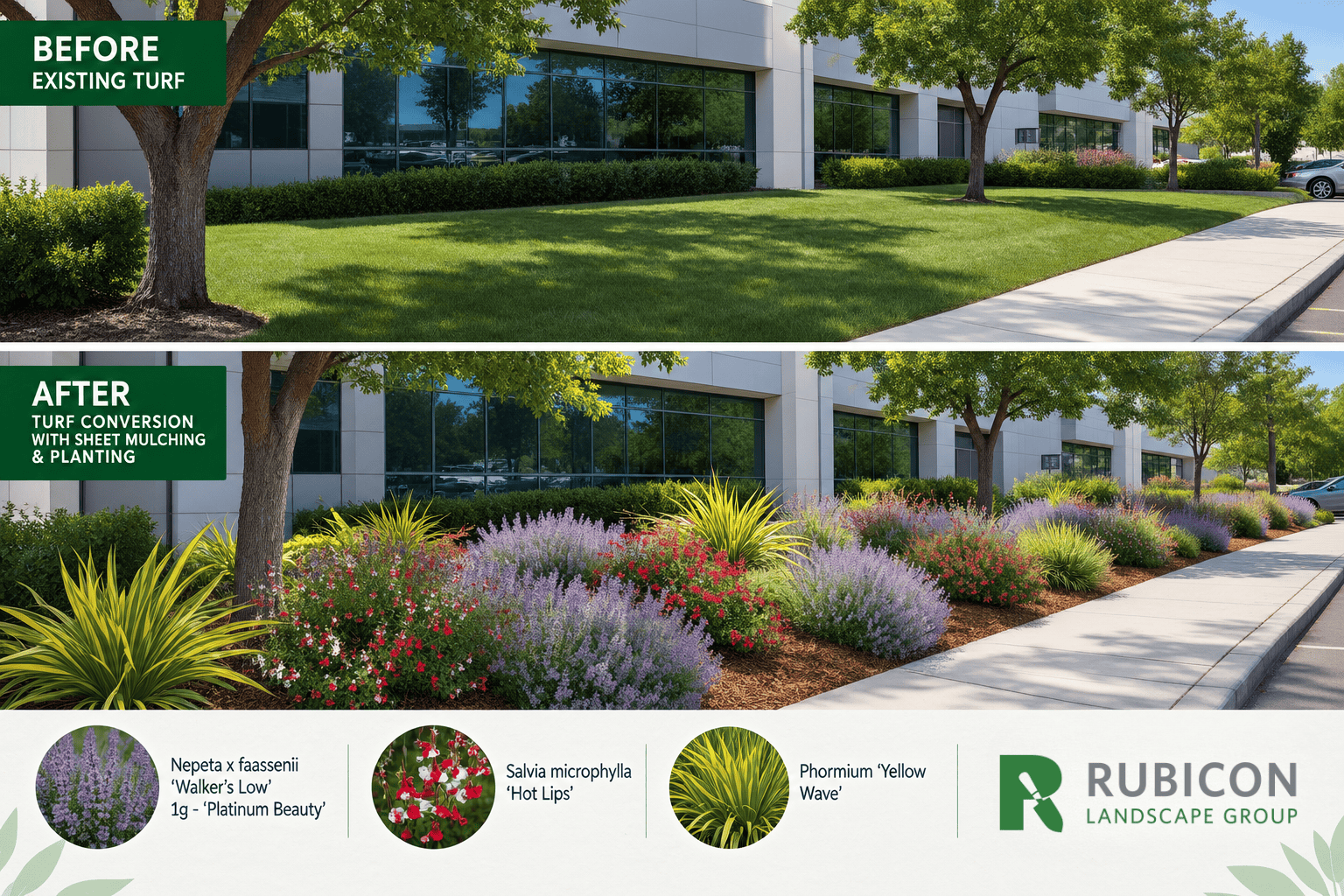
"Before and after photos of a commercial turf-to-sheet-mulch conversion: a plain lawn replaced with a drought-tolerant planting bed of catmint, salvia, and phormium grass along a sidewalk, Rubicon Landscape.
Who Is a Good Commercial Landscaper in the East Bay?

Who Is a Good Commercial Landscaper in the East Bay?

Series Series: What You’re Asking AI About Your Landscape (Part 15)

Who Is a Good Commercial Landscaper in the East Bay?

If you are choosing a provider, you may have asked an AI assistant who is a good commercial landscaper in the East Bay. The short answer: look for water-management expertise, written scope and reporting, relevant references, proper license and insurance, and a proactive partner. Over this series we covered cost, water, audits, controllers, contracts, AB 1572, storms, inspections, drip, and drought. Those topics are also your screening questions.

What a Good Commercial Landscaper Will Do

  • Show irrigation and water-management expertise, not just mowing.
  • Put scope, reporting, and response times in writing.
  • Offer references from properties like yours.
  • Carry the right license and insurance.
  • Be proactive, telling you about problems before you ask.

Questions to Ask Every Bidder

Ask how they audit irrigation, how they report, and how fast they respond to storm damage or leaks. In addition, ask to see sample reports and to speak with a current client. For example, a provider who can show a past audit and a response-time record is far easier to trust.

Infographic: Who Is a Good Commercial Landscaper in the East Bay?

About Rubicon Landscape Group

We are Rubicon Landscape Group, based in Richmond and serving commercial, municipal, institutional, and HOA properties across the Bay Area. Our work also supports local career opportunities. See who we work with.

What to Do Next

Use the questions above to screen providers, then request a walk-through of your property. Thank you for following the series. If you would like to talk about your property, we are glad to help.

Frequently Asked Questions

What should I look for in a commercial landscaper?

Water-management expertise, written scope, references, proper license and insurance, and proactive communication.

How many bids should I collect?

Three is a good starting point, all priced against the same written scope.

Does Rubicon serve the East Bay?

Yes. We are based in Richmond and serve properties across the Bay Area.

Resources for Going Deeper

Ready to talk about your property?

Tell us about your site and we will recommend the right next step.

Why Rubicon

For more than 30 years, Rubicon Landscape has provided dependable, professional landscape services throughout the Bay Area, helping property owners and managers maintain landscapes that are healthy, attractive, and reliably well-functioning.

Our approach is built on quality workmanship, responsive service, and proactive problem-solving, the kind of long-term partnership that protects your landscape investment and delivers consistent results, year after year.

As a division of Rubicon Programs, that work also creates real community impact. Every project supports employment opportunities and workforce development that strengthen the communities we serve.

Professional landscape services. Reliable results. Meaningful community impact.

Looking for a Landscape Partner?

From commercial properties and municipal facilities to institutional sites and multi-site portfolios, our services include:

  • Commercial Landscape Maintenance & Installation
  • Landscape Construction & Renovation
  • Irrigation Installation, Repair & Management
  • Water Efficiency & Conservation Solutions
  • Regenerative Services: Horticulture, Turf Care & Weed Management

Contact us 

"Before and after photos of a commercial turf-to-sheet-mulch conversion: a plain lawn replaced with a drought-tolerant planting bed of catmint, salvia, and phormium grass along a sidewalk, Rubicon Landscape.
Women and Plants: A History of Healing (Medicine)

Women and Plants: A History of Healing (Medicine)

Series Women and Plants (Part 2)

Long before pharmacies existed, someone in almost every household knew which plant to reach for when a child had a fever or a cut would not close. In many cultures, that someone was a woman. That knowledge was not magic. It was built through patient observation, repeated across seasons, and passed from one generation to the next.

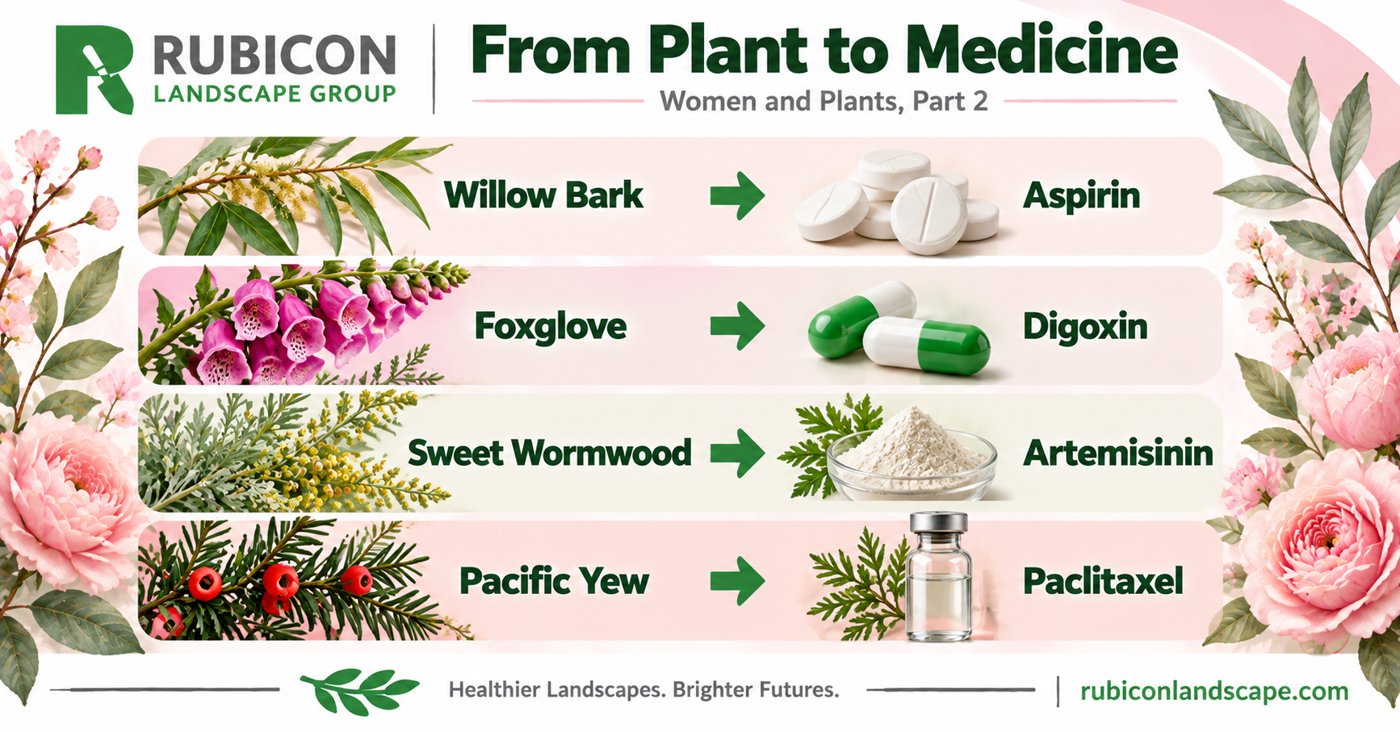
What is the history of women and plant medicine? In many communities, women were the everyday keepers of plant knowledge, gathering, growing, and preparing plants for their families. Remedies rooted in traditional plant use later helped lead to some of the most important medicines in the world, including aspirin, digoxin, artemisinin, and paclitaxel.

This is Part 2 of our series on the long relationship between women and plants. In Part 1, we looked at how women may have discovered cultivation itself. Here, we follow the same habit of close attention into medicine.

Key Takeaways

  • Women were often the household keepers of plant knowledge, much of it passed along by speaking rather than writing.
  • Four plants, willow, foxglove, sweet wormwood, and the Pacific yew, each led to a major modern medicine.
  • Women scientists, including Tu Youyou and Susan Band Horwitz, played key roles in modern plant-based discoveries.
  • Many medicinal plants are powerful or poisonous, so they belong in the hands of trained professionals.

Why Women Often Became Keepers of Plant Knowledge

In many communities, women have carried much of the daily work of gathering plants, preparing food, and caring for the sick. Researchers who study traditional plant use, known as ethnobotanists, have documented this pattern in many regions. In medieval Europe, Hildegard of Bingen, a twelfth-century abbess, wrote about the healing properties of plants in her work Physica.

However, the record is uneven. Much of this knowledge traveled by word of mouth, so many names were never written down. As a result, we know less about these women than we would like, and the stories below should be read with that in mind.

Four Plants That Became Modern Medicines

PlantTraditional UseModern Medicine
Willow barkEasing pain and feverAspirin, developed from salicylic acid
FoxgloveTreating dropsy, a swelling often linked to heart failureDigoxin, used for heart conditions
Sweet wormwoodTreating intermittent feversArtemisinin, a malaria treatment
Pacific yewScreened for anticancer activity in the 1960s.Paclitaxel, used in breast and ovarian cancer care

Willow Bark and Aspirin

Physicians in many ancient cultures used willow bark to ease pain and fever. Its active compound, salicin, led chemists to salicylic acid and eventually to aspirin, which Bayer began marketing in the late 1890s. A remedy that families had trusted for centuries became one of the most widely used medicines in the world.

Foxglove and the Heart

In 1785, English physician William Withering published an account of the foxglove and its medical uses, including careful notes on dosing and toxicity. A popular story says he learned of the remedy from an old woman in Shropshire who kept a family recipe for treating dropsy. Withering did write about such a recipe. However, historians question how much of the popular version is embellished, and the woman’s identity is uncertain. What is well documented is his systematic clinical work. Because foxglove is poisonous, his focus on careful dosing mattered a great deal.

Sweet Wormwood and Malaria

In 1969, Chinese pharmacologist Tu Youyou joined a government project to find new malaria treatments. Her team reviewed hundreds of traditional remedies, and an ancient handbook by Ge Hong pointed to sweet wormwood (Artemisia annua). Tu adjusted the extraction method to avoid high heat, and the result was artemisinin. In 2015, she received half of the Nobel Prize in Physiology or Medicine for her discoveries concerning a novel therapy against malaria.

The Pacific Yew and Cancer Care

In 1962, a U.S. Department of Agriculture botanist collected bark from a Pacific yew in Washington State as part of a plant-screening program run with the National Cancer Institute. Researchers later isolated the active compound, paclitaxel. In 1979, Dr. Susan Band Horwitz discovered how it works, by stopping cancer cells from dividing. The FDA approved paclitaxel for ovarian cancer in 1992 and for breast cancer in 1994. Early supply was a serious challenge, because harvesting the bark kills the tree, so researchers developed a semisynthetic version instead.

From Plant to Medicine infographic: willow bark to aspirin, foxglove to digoxin, sweet wormwood to artemisinin, and Pacific yew to paclitaxel

What These Stories Have in Common

The history of women and plant medicine is full of careful observers.

Each story starts with someone paying close attention to a plant over time. In addition, each one shows that traditional knowledge is a starting point, not a finish line. Careful testing, safe dosing, and modern chemistry turned folk remedies into reliable medicines. Finally, credit has often been uneven, which is one more reason to name the women whose work we do know.

A Quick Safety Note

Many medicinal plants are powerful, and some are poisonous. Foxglove is a clear example. Please do not treat these stories as a how-to guide. If you are interested in plant-based remedies, talk with a doctor or pharmacist first.

Why This History Still Matters on the Job

Plants are our daily work at Rubicon Landscape. Understanding what a plant can do for people, and what it can do to them, is part of caring for a property well. As a result, thoughtful plant selection, clear knowledge of which species are toxic, and good communication with property teams all belong in professional landscape care.

Next in the series, in Part 3, we move from the medicine cabinet to the garden bench and ask why gardens have always soothed the soul.

Frequently Asked Questions About Women and Plant Medicine

Did women discover these medicines?

Not alone, and not always. Women were often the household keepers of plant knowledge, and some, such as Tu Youyou and Susan Band Horwitz, made key modern discoveries. However, many contributors across history were never recorded.

What is an ethnobotanist?

An ethnobotanist studies how people in different cultures use plants for food, medicine, building, and ceremony.

Is it safe to use medicinal plants at home?

Not without guidance. Many medicinal plants are powerful, and some are poisonous. Please talk with a doctor or pharmacist before using any plant remedy.

Why is foxglove dangerous?

Foxglove contains compounds that act on the heart and are toxic in the wrong dose. That is why Withering focused so heavily on careful dosing.

Are plant-based medicines still important today?

Yes. Aspirin, digoxin, artemisinin, and paclitaxel all trace back to plants, and researchers continue to study plants for new treatments.

Want a Landscape That Works for People?

Rubicon Landscape designs and maintains commercial landscapes across the Bay Area, with careful plant selection and a mission to create jobs and opportunity. Tell us about your property, and we will help you plan next steps.

Sources and Further Reading

This article is for general information and is not medical advice.

Talk to Rubicon About Your Landscape

Plants are our daily work. Let us help you plan a landscape that serves the people who use it.

Resources for Going Deeper

Why Rubicon

For more than 30 years, Rubicon Landscape has provided dependable, professional landscape services throughout the Bay Area, helping property owners and managers maintain landscapes that are healthy, attractive, and reliably well-functioning.

Our approach is built on quality workmanship, responsive service, and proactive problem-solving, the kind of long-term partnership that protects your landscape investment and delivers consistent results, year after year.

As a division of Rubicon Programs, that work also creates real community impact. Every project supports employment opportunities and workforce development that strengthen the communities we serve.

Professional landscape services. Reliable results. Meaningful community impact.

Looking for a Landscape Partner?

From commercial properties and municipal facilities to institutional sites and multi-site portfolios, our services include:

  • Commercial Landscape Maintenance & Installation.
  • Landscape Construction & Renovation.
  • Irrigation Installation, Repair & Management.
  • Water Efficiency & Conservation Solutions.
  • Regenerative Services: Horticulture, Turf Care & Weed Management.

Contact us 

"Before and after photos of a commercial turf-to-sheet-mulch conversion: a plain lawn replaced with a drought-tolerant planting bed of catmint, salvia, and phormium grass along a sidewalk, Rubicon Landscape.
How Much Does Commercial Landscape Maintenance Cost?

How Much Does Commercial Landscape Maintenance Cost?

The honest answer is “it depends,” but that’s not a very useful answer when you’re trying to budget. So instead of leaving it there, here’s what commercial landscape maintenance actually costs in the Bay Area, backed by real public contract data, not a generic national average that doesn’t reflect your market.

Why a Single Number Doesn’t Exist

Commercial landscape maintenance pricing varies more than most property managers expect, and not randomly. It moves based on a few specific, predictable factors:

  • Property size and layout: a large, contiguous park or campus costs less per acre to maintain than the same total acreage spread across small, disconnected roadway medians
  • Service level: how often turf gets mowed, whether fertilization is included, how tight the weed-cover tolerance is
  • What’s included: irrigation repair, pest management, and fertilization are sometimes bundled in, sometimes billed separately
  • Site type: a historic or specialty site with a limited, careful scope costs more per acre than a standard greenbelt, even though it’s smaller

Real Pricing Data, Not a National Average

Here’s what public Bay Area contracts actually show, pulled from real, awarded agreements:

Property TypeRateWhat Drove It
Large contiguous parks and greenbelts~$1,800/acre/yearStandard service tier, efficient to maintain in one continuous area
Small, specialty, or historic sites~$7,800/acre/yearFixed visit costs spread across very little area, more handling per square foot
Roadway medians and disconnected segmentsHigher than large parks, lower than specialty sitesMore edging and trimming per acre, traffic control, more drive time between segments

The takeaway: acreage alone doesn’t determine your cost, the shape and type of your property does. Two properties with identical total square footage can have very different maintenance costs depending on whether that space is one open area or a dozen scattered medians.

What Typically Drives Your Price Up or Down

Pushes cost up:

  • Narrow, disconnected areas (medians, street frontages) instead of one contiguous site
  • Higher service tiers (weekly mowing vs. biweekly, tighter weed-cover standards)
  • Included irrigation repair and fertilization versus billed separately
  • Specialty or historic sites with careful, limited-scope requirements

Keeps cost down:

  • Large, contiguous properties that are efficient to service in one visit
  • Drought-tolerant, low-water landscaping versus high-maintenance turf
  • A clear, well-defined scope of work from the start, fewer surprises mean fewer change orders later

A Realistic Way to Think About Your Budget

Rather than one number, think in a range based on your property type:

  • Large park, campus, or greenbelt property: budget in the neighborhood of $1,500 to $2,200 per acre per year for standard-tier maintenance
  • Roadway medians or disconnected segments: expect a meaningfully higher per-acre rate than a large contiguous site, due to the logistics involved
  • Small or specialty sites: budget well above typical per-acre rates, fixed costs concentrate fast on a small footprint

These ranges reflect real, awarded public contracts, not list prices, actual pricing always depends on your specific site conditions and the scope you need.

The Fastest Way to Get an Accurate Number

Public contract data is useful for budgeting, but it can’t replace an actual look at your property. Two sites with the same acreage can need very different levels of care depending on existing plant health, irrigation condition, and how the space is actually used.

Ready for a Real Number for Your Property?

We’ll walk your site, look at what it actually needs, and give you a straightforward quote, no inflated estimate to negotiate down from.

Schedule a Landscape Consultation HERE

#CommercialLandscaping #BayArea #LandscapeMaintenance #PropertyManagement

CONTACT US

Resources for Going Deeper

Why Rubicon

For more than 30 years, Rubicon Landscape has provided dependable, professional landscape services throughout the Bay Area, helping property owners and managers maintain landscapes that are healthy, attractive, and reliably well-functioning.

Our approach is built on quality workmanship, responsive service, and proactive problem-solving, the kind of long-term partnership that protects your landscape investment and delivers consistent results, year after year.

As a division of Rubicon Programs, that work also creates real community impact. Every project supports employment opportunities and workforce development that strengthen the communities we serve.

Professional landscape services. Reliable results. Meaningful community impact.

Looking for a Landscape Partner?

From commercial properties and municipal facilities to institutional sites and multi-site portfolios, our services include:

  • Commercial Landscape Maintenance & Installation
  • Landscape Construction & Renovation
  • Irrigation Installation, Repair & Management
  • Water Efficiency & Conservation Solutions
  • Regenerative Services: Horticulture, Turf Care & Weed Management

Contact us 

"Before and after photos of a commercial turf-to-sheet-mulch conversion: a plain lawn replaced with a drought-tolerant planting bed of catmint, salvia, and phormium grass along a sidewalk, Rubicon Landscape.
Tree Risk Before Winter Storms: What Property Managers Should Look For

Tree Risk Before Winter Storms: What Property Managers Should Look For

Series: Storm Season / El Niño Prep (Part 3)

What should property managers look for before winter storms? Start with four things: dead or weak limbs, weak branch connections, signs of root trouble, and what sits underneath each tree. With a very strong El Niño forecast, saturated soil can loosen a tree’s grip on the ground, so a tree that has stood for decades can fail with little warning. Checking now, while the ground is still dry, costs far less than responding to a failure in January.

This is Part 3 of our storm-prep series, following Drainage 101: Spot Problems Before the Rain Does and A Super El Niño Is Coming: Is Your Property Ready? Drainage problems are mostly about water. Tree problems are about safety and liability, which is why this topic gets a full article of its own.

Know a property manager or facility manager with mature trees on site? Share this guide with them before the first storm.

Why a Strong El Niño Raises Tree Risk

NOAA’s Climate Prediction Center puts the chance of a very strong El Niño this fall and winter above 90%, with a 75% chance that the October to December season will exceed every El Niño on record since 1950. For Bay Area properties, the wettest signal falls in January through March, when soil is already full from earlier storms.

That matters because trees depend on soil to hold their roots in place. When soil is saturated, water takes up the space between soil particles and carries part of the load that the soil would normally carry. As a result, roots lose grip, and a compromised tree can fall even when the wind is not especially strong. In addition, back-to-back storms repeat that wind load on ground that never has time to firm up.

The Four Things to Check

1. Weak Limbs and Branch Connections

What to look for:

  • Dead branches, and limbs that are cracked, split, or hanging.
  • Codominant stems, where two trunks of similar size grow from the same point and compete.
  • Included bark, a seam of bark trapped inside a branch union. It leaves a narrow, weak connection that can split as the limbs grow heavier.
  • Heavy limbs that extend over parking, entries, walkways, or play areas.

Quick check: Walk the canopy line with binoculars and note any limb over a place where people or vehicles pass.

2. Root Problems

What to look for:

  • Soil that is heaved or mounded on the side opposite a lean. This can mean roots are pulling out of the ground.
  • A new lean, or a lean that has increased since last year.
  • Mushrooms or conks at the base of the trunk or along the root flare, which often indicate internal decay.
  • Roots cut or damaged by trenching, paving, irrigation, or utility work.
  • Soil or mulch piled high against the trunk, and shallow roots at the surface.

Quick check: Take dated photos of each tree base now. Next month, compare them. A lean that changes is a reason to call a professional immediately.

3. Wind Exposure

What to look for:

  • Trees on ridgelines, slopes, or the open edge of a parking lot.
  • Trees that were recently sheltered by a neighboring tree or building that has since been removed.
  • Recently planted or transplanted trees, which have shallower root systems and are more likely to lean in strong wind.

Quick check: Ask which direction winter storms usually come from on your site, then look at the trees on that side first.

4. What Is Underneath: The Targets

A weak tree over an empty planting bed and the same tree over a main entrance carry very different consequences. Professional risk assessments weigh both the likelihood of failure and what the tree would hit, so list the cars, doors, walkways, play areas, utility lines, and buildings under each canopy. In practice, that list tells you which trees to deal with first.

The Liability Angle Property Managers Should Understand

California courts apply a negligence standard to tree failures. In general, an owner is not automatically responsible just because a tree falls. Instead, the question is usually whether the owner knew, or should have known, about a hazard and failed to act reasonably. Visible warning signs such as dead branches, rot, fungal growth at the base, a significant lean, or earlier limb failures can show that a problem was knowable. Ownership generally follows where the trunk stands, so trees along property lines deserve attention too.

On the other hand, when a healthy, properly maintained tree fails in a severe storm, courts have generally found no liability, often treating it as an act of nature. In other words, the question is less “did a tree fall?” and more “what did we know, and what did we do about it?”

For that reason, documentation matters. Dated inspection notes, photos, arborist reports, work orders, and pruning invoices help show that your team exercised reasonable care. They also give your insurance carrier a clear record if a claim ever arises.

A note on scope: This is general information, not legal advice. Talk with your attorney and your insurance carrier about your specific obligations.

Save this section for your next risk review, and share it with your insurance contact.

What a Professional Tree Risk Assessment Includes

The International Society of Arboriculture (ISA) trains arborists through its Tree Risk Assessment Qualification (TRAQ) to follow a consistent method. Assessments are described in levels:

  • Level 1, limited visual: a walk-by or drive-by that looks for prominent issues such as large dead trees, severe leans, or hanging limbs. Property managers with many trees often use it to screen quickly and set priorities.
  • Level 2, basic: the standard professional evaluation, where a qualified arborist inspects each tree on the ground, including its base, trunk, and canopy.
  • Level 3, advanced: a deeper investigation of a specific tree using additional tools when a Level 2 finding calls for it.

A good assessment documents the targets, the defects, the likelihood of failure, the consequences, and the options for reducing risk. Ultimately, that report gives you something specific to act on and to file.

Before You Cut: Check Your City’s Tree Rules

Many Bay Area cities protect certain trees, so removing one without a permit can create a different kind of problem. For example, Concord requires a permit to remove protected trees, including native oaks, California bay, buckeye, and sycamore at 12 inches in diameter and other trees at 24 inches, measured 54 inches above the ground. Walnut Creek protects trees with a trunk circumference of 28 inches or more, about 9 inches in diameter. Danville protects heritage trees and certain species.

Cities generally allow emergency removal of a hazardous tree, but they usually want written approval. Because rules differ by city and change over time, confirm the current requirements with your city before any removal.

Property Manager Tree Risk Checklist

☐  Walk every tree near buildings, parking, walkways, play areas, and entries

☐  Note dead, cracked, or hanging limbs, and any limb over a target

☐  Look for codominant stems and included bark at branch unions

☐  Check each base for mushrooms, conks, heaved soil, or a new or increased lean

☐  Look for root damage from trenching, paving, or utility work

☐  Identify trees that are newly exposed to wind or recently planted

☐  Photograph every concern with the date and location

☐  Rank concerns by what sits underneath

☐  Request a qualified arborist assessment for anything on this list

☐  Confirm local permit requirements before any removal

☐  File the notes, photos, and reports where your team can find them

Not sure what you are looking at? Request a pre-storm walkthrough and we will help you sort what can wait from what cannot. Contact Rubicon Landscape Group.

Common Mistakes to Avoid

  • Waiting for the first storm. Once the first serious storm makes the news, every property in the Bay Area calls for the same services at the same time.
  • Checking only from a distance. Roots and the base of the trunk need a close look.
  • Pruning without a plan. Topping a tree, which means cutting main branches back to stubs, creates weakly attached regrowth and is not recommended.
  • Skipping the paperwork. Work that is not documented is hard to prove later.
  • Ignoring trees at the property edge. A neighbor’s fence or a public sidewalk is a target too.

Quick Answers

Who is responsible when a tree falls on a commercial property in California?

Ownership generally follows where the trunk stands. Responsibility for damage usually turns on negligence, meaning whether the owner knew or should have known about a hazard and failed to act reasonably. Talk with your attorney and insurer about your situation.

How often should commercial property trees be inspected?

As a practical standard, we recommend a walkthrough at least once a year and again after any major storm, with closer attention to trees that have known defects or that stand over busy areas.

Can saturated soil cause a healthy-looking tree to fall?

Yes. Saturated soil reduces how firmly roots are held, and the risk is higher for trees that already have root damage, decay, or a lean. A tree can look healthy from the canopy while its roots are not.

Who should assess a tree I am worried about?

Look for an ISA Certified Arborist who also holds the ISA Tree Risk Assessment Qualification (TRAQ). Ask for a written report.

What Comes Next in the Series

Next, we look at drainage upgrades: what French drains, catch basins, and retention basins each solve, and when to install them. If you have not read Part 1 and Part 2 yet, start with A Super El Niño Is Coming and Drainage 101. Follow Rubicon for the rest of the series.

Ready to Check Your Trees Before the Rain?

Schedule a pre-storm property walkthrough with Rubicon. We will review your trees, drainage, and slopes together, flag what needs attention, and help coordinate a qualified arborist assessment where one is warranted.

CONTACT US

Resources for Going Deeper

Why Rubicon

For more than 30 years, Rubicon Landscape has provided dependable, professional landscape services throughout the Bay Area, helping property owners and managers maintain landscapes that are healthy, attractive, and reliably well-functioning.

Our approach is built on quality workmanship, responsive service, and proactive problem-solving, the kind of long-term partnership that protects your landscape investment and delivers consistent results, year after year.

As a division of Rubicon Programs, that work also creates real community impact. Every project supports employment opportunities and workforce development that strengthen the communities we serve.

Professional landscape services. Reliable results. Meaningful community impact.

Looking for a Landscape Partner?

From commercial properties and municipal facilities to institutional sites and multi-site portfolios, our services include:

  • Commercial Landscape Maintenance & Installation
  • Landscape Construction & Renovation
  • Irrigation Installation, Repair & Management
  • Water Efficiency & Conservation Solutions
  • Regenerative Services: Horticulture, Turf Care & Weed Management

Contact us 

"Before and after photos of a commercial turf-to-sheet-mulch conversion: a plain lawn replaced with a drought-tolerant planting bed of catmint, salvia, and phormium grass along a sidewalk, Rubicon Landscape.