How Should a Commercial Property Prepare Its Landscape for Winter Storms?

How Should a Commercial Property Prepare Its Landscape for Winter Storms?

Series Series: What You’re Asking AI About Your Landscape (Part 9)

How Should a Commercial Property Prepare Its Landscape for Winter Storms?

As the rainy season approaches, you may have asked an AI assistant how a commercial property should prepare its landscape for winter storms. The short answer: clear drains, assess trees, protect slopes, adjust irrigation, and document the property before the first big rain. Storm prep costs far less than storm recovery.

Your Pre-Storm Checklist

  • Clear drainage. Clean catch basins, drains, and downspout outlets of leaves and debris.
  • Assess trees. Have trees evaluated for risk and prune dead or weak limbs.
  • Protect slopes. Check for bare soil and add cover or erosion control.
  • Adjust irrigation. Turn the system off or switch it to rain mode.
  • Document conditions. Photograph the property now, so you have a baseline if you need to document damage later.

Why Timing Matters

Once the ground is saturated, even a modest storm can cause erosion, ponding, and tree failures. Therefore, the weeks before the first storm are the best window for prevention. In addition, a documented baseline makes insurance conversations simpler if damage does occur.
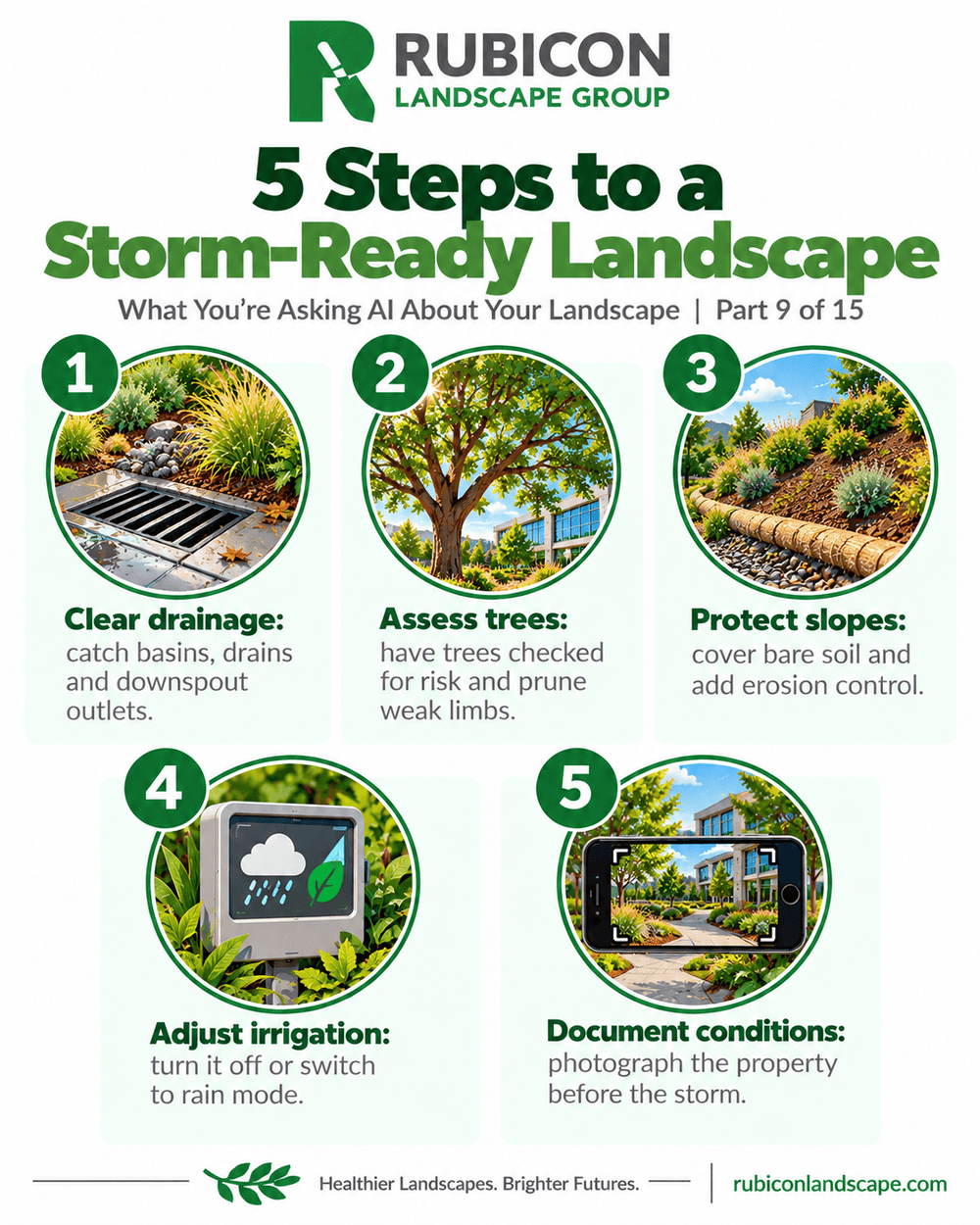
Infographic: How Should a Commercial Property Prepare Its Landscape for Winter Storms?

What to Do Next

First, schedule a storm-readiness walk of the property. Next, prioritize drains, slopes, and tree concerns. Then confirm your storm-response plan with your landscape partner. Helpful resources include our storm-prep guide and drainage checklist. In Part 10, we tackle the opposite problem: overwatering.

Frequently Asked Questions

When should I start storm preparation?

Before the first significant rain, ideally early in the fall.

Should I turn off irrigation before storms?

Yes. Turn it off or switch to rain mode, and use a rain sensor where possible.

What should I photograph?

Slopes, drains, trees, beds, and hardscape, with dates, so you have a clear baseline.

Resources for Going Deeper

Ready to talk about your property?

Tell us about your site and we will recommend the right next step.

Why Rubicon

For more than 30 years, Rubicon Landscape has provided dependable, professional landscape services throughout the Bay Area, helping property owners and managers maintain landscapes that are healthy, attractive, and reliably well-functioning.

Our approach is built on quality workmanship, responsive service, and proactive problem-solving, the kind of long-term partnership that protects your landscape investment and delivers consistent results, year after year.

As a division of Rubicon Programs, that work also creates real community impact. Every project supports employment opportunities and workforce development that strengthen the communities we serve.

Professional landscape services. Reliable results. Meaningful community impact.

Looking for a Landscape Partner?

From commercial properties and municipal facilities to institutional sites and multi-site portfolios, our services include:

  • Commercial Landscape Maintenance & Installation
  • Landscape Construction & Renovation
  • Irrigation Installation, Repair & Management
  • Water Efficiency & Conservation Solutions
  • Regenerative Services: Horticulture, Turf Care & Weed Management
Contact us 

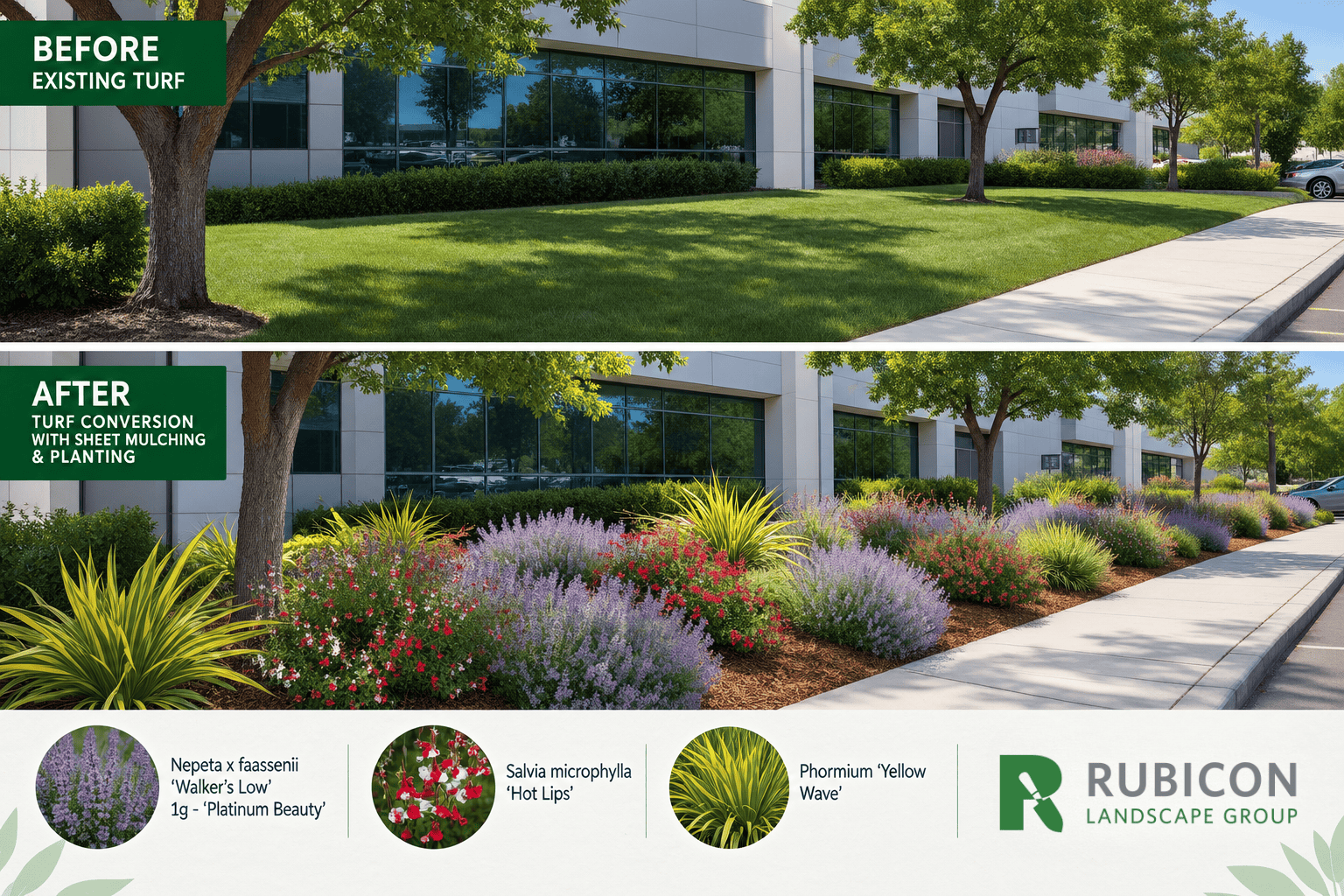
"Before and after photos of a commercial turf-to-sheet-mulch conversion: a plain lawn replaced with a drought-tolerant planting bed of catmint, salvia, and phormium grass along a sidewalk, Rubicon Landscape.
Why Are My Commercial Landscape Areas Overwatered?

Why Are My Commercial Landscape Areas Overwatered?

Series Series: What You’re Asking AI About Your Landscape (Part 10)

Why Are My Commercial Landscape Areas Overwatered?

If your landscape looks stressed despite a high water bill, you may have asked an AI assistant why your commercial landscape areas are overwatered. The short answer: overwatering is rarely one big mistake. It usually comes from several small ones stacking up. Part 9 covered the storms. Now we look at the opposite problem.

Common Causes of Overwatering

  • A controller set for summer and never adjusted. Plants need far less water in cooler months.
  • Mixed plant types on one valve. Turf, shrubs, and trees have different needs, so one schedule cannot serve all of them.
  • Mismatched nozzles or heads. Uneven output waters some spots too much and others too little.
  • Compacted soil. Water sheds off instead of soaking in, so crews run longer cycles.
  • No rain or soil-moisture shutoff. The system keeps running when the soil is already wet.

What Overwatering Looks Like

Overwatered plants look stressed, not healthy. Watch for yellowing leaves, soft growth, fungus, standing water, and mushy mulch. In addition, the water bill keeps paying for the problem. As a result, fixing it often saves money and improves plant health at the same time.

Infographic: Why Are My Commercial Landscape Areas Overwatered?

What to Do Next

First, review your controller schedule by season. Next, separate turf, shrubs, and trees onto their own zones where possible. Then add rain or soil-moisture sensors and have the heads checked. For related ideas, see our guide to reducing landscape water use. In Part 11, we cover how often commercial landscapes should be inspected.

Frequently Asked Questions

How can I tell if my landscape is overwatered?

Look for yellowing leaves, standing water, fungus, and soggy soil, plus a water bill that stays high.

How often should I adjust the controller?

At least with each season, and more often if weather swings.

Do sensors really help?

Yes. Rain and soil-moisture sensors prevent watering when it is not needed.

Resources for Going Deeper

Ready to talk about your property?

Tell us about your site and we will recommend the right next step.

Why Rubicon

For more than 30 years, Rubicon Landscape has provided dependable, professional landscape services throughout the Bay Area, helping property owners and managers maintain landscapes that are healthy, attractive, and reliably well-functioning.

Our approach is built on quality workmanship, responsive service, and proactive problem-solving, the kind of long-term partnership that protects your landscape investment and delivers consistent results, year after year.

As a division of Rubicon Programs, that work also creates real community impact. Every project supports employment opportunities and workforce development that strengthen the communities we serve.

Professional landscape services. Reliable results. Meaningful community impact.

Looking for a Landscape Partner?

From commercial properties and municipal facilities to institutional sites and multi-site portfolios, our services include:

  • Commercial Landscape Maintenance & Installation
  • Landscape Construction & Renovation
  • Irrigation Installation, Repair & Management
  • Water Efficiency & Conservation Solutions
  • Regenerative Services: Horticulture, Turf Care & Weed Management

Contact us 

"Before and after photos of a commercial turf-to-sheet-mulch conversion: a plain lawn replaced with a drought-tolerant planting bed of catmint, salvia, and phormium grass along a sidewalk, Rubicon Landscape.
How Often Should Commercial Landscapes Be Inspected?

How Often Should Commercial Landscapes Be Inspected?

Series Series: What You’re Asking AI About Your Landscape (Part 11)

How Often Should Commercial Landscapes Be Inspected?

If you want to catch problems early, you may have asked an AI assistant how often commercial landscapes should be inspected. There is no single legal answer, so here is the rhythm we recommend: a quick walk every visit, a monthly irrigation check in the growing season, a seasonal review, a yearly audit, and a fast look after storms or heat waves.

A Practical Inspection Rhythm

  • Every visit. A quick walk for visible issues.
  • Monthly in the growing season. Check zones, heads, and the controller.
  • Seasonally. Review plant health, trees, drainage, and mulch more closely.
  • Once a year. A full irrigation audit, like the one described in Part 3.
  • After storms or heat waves. A fast look for damage.

Why Written Notes Matter

Written inspection notes with photos turn small problems into small repairs instead of big surprises. In addition, they create a record that helps with budgeting, vendor accountability, and insurance. For example, a dated photo of a leaking valve shows exactly when a problem began.

Infographic: How Often Should Commercial Landscapes Be Inspected?

What to Do Next

First, ask your landscape partner what inspections are in your current scope. Next, request written notes and photos for each visit. Then schedule an annual audit before the dry season. See what regular service covers on our landscape maintenance page. In Part 12, we look at how much drip irrigation can save.

Frequently Asked Questions

Is there a required inspection schedule?

There is no single requirement, so set a routine that fits your site and risk.

Who should perform inspections?

Trained crew leads for routine walks, and certified professionals for audits.

What should an inspection report include?

Findings, photos, locations, priorities, and recommended fixes.

Resources for Going Deeper

Ready to talk about your property?

Tell us about your site and we will recommend the right next step.

Why Rubicon

For more than 30 years, Rubicon Landscape has provided dependable, professional landscape services throughout the Bay Area, helping property owners and managers maintain landscapes that are healthy, attractive, and reliably well-functioning.

Our approach is built on quality workmanship, responsive service, and proactive problem-solving, the kind of long-term partnership that protects your landscape investment and delivers consistent results, year after year.

As a division of Rubicon Programs, that work also creates real community impact. Every project supports employment opportunities and workforce development that strengthen the communities we serve.

Professional landscape services. Reliable results. Meaningful community impact.

Looking for a Landscape Partner?

From commercial properties and municipal facilities to institutional sites and multi-site portfolios, our services include:

  • Commercial Landscape Maintenance & Installation
  • Landscape Construction & Renovation
  • Irrigation Installation, Repair & Management
  • Water Efficiency & Conservation Solutions
  • Regenerative Services: Horticulture, Turf Care & Weed Management

Contact us 

"Before and after photos of a commercial turf-to-sheet-mulch conversion: a plain lawn replaced with a drought-tolerant planting bed of catmint, salvia, and phormium grass along a sidewalk, Rubicon Landscape.
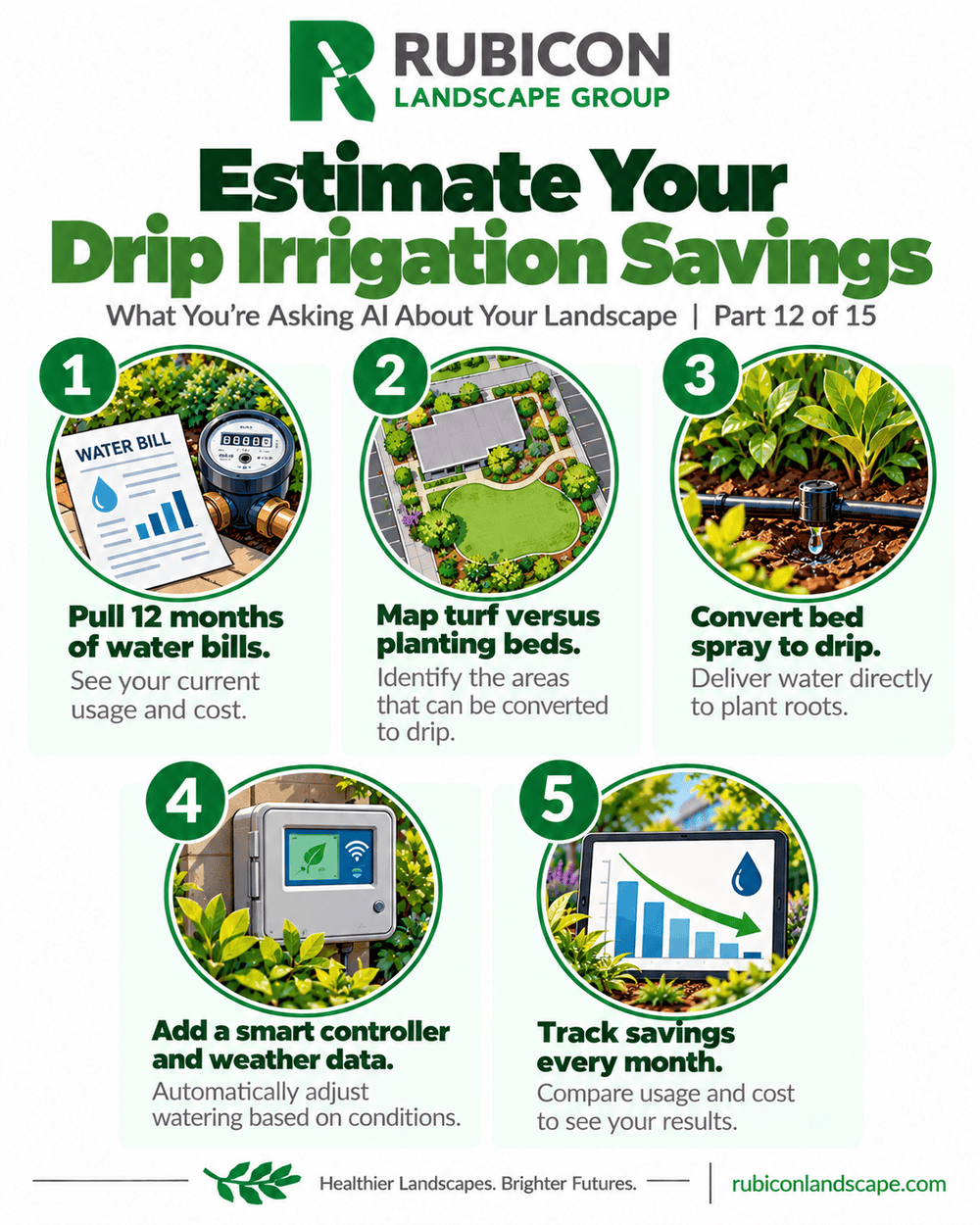
How Much Can Drip Irrigation Save a Commercial Property?

How Much Can Drip Irrigation Save a Commercial Property?

Series Series: What You’re Asking AI About Your Landscape (Part 12)

How Much Can Drip Irrigation Save a Commercial Property?

If you are looking to cut water costs, you may have asked an AI assistant how much drip irrigation can save a commercial property. The honest answer: it depends on the site, so be wary of anyone who promises a single number. What drip does well is deliver water at the root zone, with far less evaporation and overspray than spray heads.

Where Drip Fits Best

Drip is the usual choice for shrubs, slopes, and narrow strips, where spray heads waste water on pavement. In addition, it is the standard approach when converting decorative turf under AB 1572, which we covered in Part 8. Drip also needs good filters, pressure regulation, and regular inspection to keep working, which ties back to Part 11.

How to Estimate Savings for Your Property

  • Pull a baseline. Gather twelve months of water bills.
  • Find the right zones. Identify spray zones on shrubs, slopes, or narrow strips.
  • Convert. Switch those zones to drip with proper filtration and regulation.
  • Track results. Compare bills for a full season after the change.
  • Maintain it. Inspect emitters, filters, and pressure regularly.

Infographic: How Much Can Drip Irrigation Save a Commercial Property?

What to Do Next

Start with a zone-by-zone review to see where drip makes sense. Then request a conversion estimate and check for rebates before work begins. To learn how conversion works, read our guide to drip conversion components. In Part 13, we cover what a commercial landscape audit should include.

Frequently Asked Questions

Will drip always lower my water bill?

Often, but results vary with the site, the plants, and how well the system is maintained.

Can drip be used on lawns?

Drip is typically used for beds and converted areas. Turf usually uses spray or rotor heads.

What maintenance does drip need?

Regular checks of filters, regulators, and emitters, since small leaks and clogs are easy to miss.

Resources for Going Deeper

Ready to talk about your property?

Tell us about your site and we will recommend the right next step.

Why Rubicon

For more than 30 years, Rubicon Landscape has provided dependable, professional landscape services throughout the Bay Area, helping property owners and managers maintain landscapes that are healthy, attractive, and reliably well-functioning.

Our approach is built on quality workmanship, responsive service, and proactive problem-solving, the kind of long-term partnership that protects your landscape investment and delivers consistent results, year after year.

As a division of Rubicon Programs, that work also creates real community impact. Every project supports employment opportunities and workforce development that strengthen the communities we serve.

Professional landscape services. Reliable results. Meaningful community impact.

Looking for a Landscape Partner?

From commercial properties and municipal facilities to institutional sites and multi-site portfolios, our services include:

  • Commercial Landscape Maintenance & Installation
  • Landscape Construction & Renovation
  • Irrigation Installation, Repair & Management
  • Water Efficiency & Conservation Solutions
  • Regenerative Services: Horticulture, Turf Care & Weed Management

Contact us 

"Before and after photos of a commercial turf-to-sheet-mulch conversion: a plain lawn replaced with a drought-tolerant planting bed of catmint, salvia, and phormium grass along a sidewalk, Rubicon Landscape.
What Should a Commercial Landscape Audit Include?

What Should a Commercial Landscape Audit Include?

Series Series: What You’re Asking AI About Your Landscape (Part 13)

What Should a Commercial Landscape Audit Include?

If you want a complete picture of your property, you may have asked an AI assistant what a commercial landscape audit should include. The short answer: a full audit looks at irrigation, plant health, trees, drainage, turf and beds, and ends with a written report. In Part 3 we covered who should perform an irrigation audit. A full landscape audit goes wider.

What a Full Audit Covers

  • Irrigation. Every zone, head, valve, controller, and water meter.
  • Plant health. Stressed, declining, or mismatched plants.
  • Trees. Risk, structure, and clearance.
  • Drainage and slopes. Ponding, erosion, and blocked drains.
  • Turf and beds. What is functional, what is decorative, and what could convert.
  • The deliverable. A written report with photos, priorities, and cost ranges.

Why the Report Matters

A good audit ends with a plan you can budget against, not just a list of problems. As a result, you can sequence repairs, request bids, and explain priorities to ownership. In addition, a baseline report makes future comparisons easy.

Infographic: What Should a Commercial Landscape Audit Include?

What to Do Next

First, decide what you want the audit to answer: cost, safety, water use, or all three. Next, request a scope that covers each area above. Then ask for photos, priorities, and cost ranges in the report. Use our fall landscape audit checklist as a starting point. In Part 14, we cover how to prepare commercial landscaping for drought.

Frequently Asked Questions

How long does a full landscape audit take?

It depends on property size and complexity, from part of a day to several days.

How often should I commission one?

Annually is common, with extra reviews after major changes or events.

Is an audit the same as a maintenance walk?

No. A walk catches visible issues. An audit measures, documents, and prioritizes.

Resources for Going Deeper

Ready to talk about your property?

Tell us about your site and we will recommend the right next step.

Why Rubicon

For more than 30 years, Rubicon Landscape has provided dependable, professional landscape services throughout the Bay Area, helping property owners and managers maintain landscapes that are healthy, attractive, and reliably well-functioning.

Our approach is built on quality workmanship, responsive service, and proactive problem-solving, the kind of long-term partnership that protects your landscape investment and delivers consistent results, year after year.

As a division of Rubicon Programs, that work also creates real community impact. Every project supports employment opportunities and workforce development that strengthen the communities we serve.

Professional landscape services. Reliable results. Meaningful community impact.

Looking for a Landscape Partner?

From commercial properties and municipal facilities to institutional sites and multi-site portfolios, our services include:

  • Commercial Landscape Maintenance & Installation
  • Landscape Construction & Renovation
  • Irrigation Installation, Repair & Management
  • Water Efficiency & Conservation Solutions
  • Regenerative Services: Horticulture, Turf Care & Weed Management

Contact us 

"Before and after photos of a commercial turf-to-sheet-mulch conversion: a plain lawn replaced with a drought-tolerant planting bed of catmint, salvia, and phormium grass along a sidewalk, Rubicon Landscape.