AB 1572 Compliance Roadmap: Your Complete Guide

AB 1572 Compliance Roadmap: Your Complete Guide

AB 1572 Series Wrap-Up: Your Complete Compliance Roadmap

Over the past several weeks, we’ve covered AB 1572 from every angle that actually matters for a Bay Area property manager: what the law requires, what rebates are available, and exactly how to convert nonfunctional turf without paying to haul it away.

This is the wrap-up. If you’re just getting started, or if you’ve read pieces of the series and want the full picture in one place, this is that page.

The Deadlines, One More Time

AB 1572 phases in by property type, and the dates don’t move:

  • January 1, 2027: State and local government properties
  • January 1, 2028: Commercial, industrial, and institutional properties
  • January 1, 2029: Homeowners associations (HOAs)

If you manage a commercial or government property, that deadline is closer than it feels. Conversion work, especially anything involving rebate pre-approval, takes real lead time. Starting now isn’t early. It’s on schedule.

Your Compliance Roadmap, Step by Step

Here’s how the four parts of this series fit together into one actual path from “we have nonfunctional turf” to “we’re compliant.”

Step 1: Understand What the Law Actually Requires

Start with Nonfunctional Turf Law: Bay Area Guide. This is the foundation: what counts as nonfunctional turf, which properties are covered, and when your specific deadline hits. Everything else in this roadmap assumes you’ve read this first.

Step 2: Find Out What Rebates You Qualify For

Before any turf comes out, check Bay Area Water Rebates: Complete AB 1572 Guide. Nearly every Bay Area water agency offers rebates for turf conversion, drip irrigation, and smart controllers, and almost all of them require pre-approval before work starts. Applying after the fact is the single most common way properties lose rebate money they were otherwise entitled to.

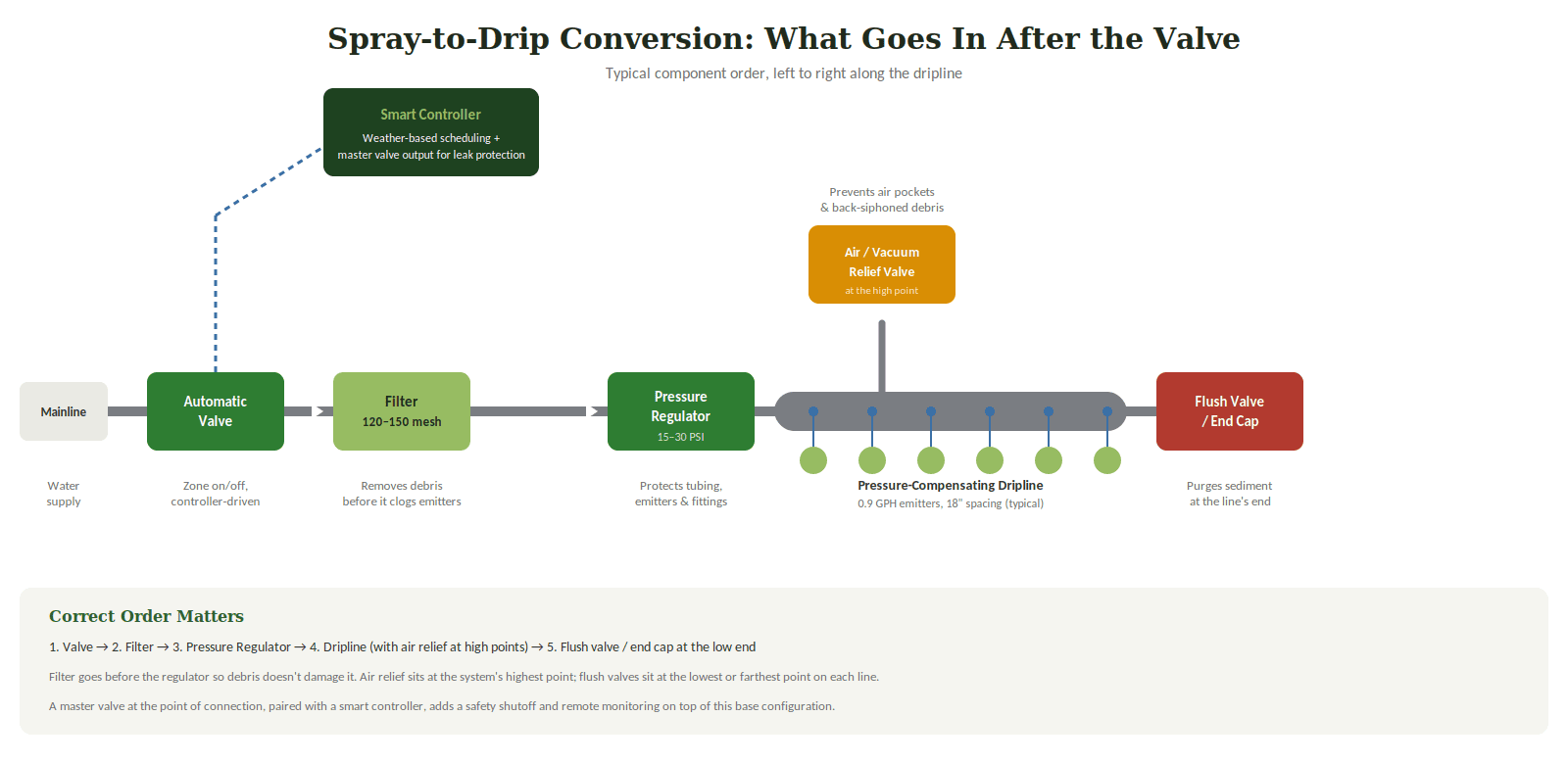
Diagram of a spray-to-drip irrigation conversion showing correct component order: mainline, automatic valve, filter, pressure regulator, dripline with air relief valve at the high point, and flush valve at the end, with an optional smart controller and master valve, Rubicon Landscape.

Step 3: Choose How the Turf Actually Comes Out

This is where most of the real cost decisions happen, and the series covers two paths:

  • If you’re converting to drip irrigation for the areas that stay planted, Drip Conversion Components: What Goes In After the Valve walks through the filter, pressure regulator, air relief valve, and flush valve, in the right order, so the new system doesn’t fail within a season.
  • If you’re removing turf without replacing it with irrigated planting right away, Sheet Mulching: Remove Turf Without Hauling It Away covers the cardboard-and-compost method that kills turf in place, no excavation, no dump fees, and it’s the compliant alternative to a plastic weed barrier under most rebate program rules.

Many properties use both: sheet mulch the areas being converted to low-water planting, drip-convert the areas that keep active irrigation.

Step 4: Document Everything

Whichever path you take, keep records: your rebate pre-approval, photos before and after, and receipts for materials and labor. If your property is ever asked to demonstrate compliance, or if a rebate program requires post-installation verification, this is what you’ll need.

The Full Series, in Order

  1. Nonfunctional Turf Law: Bay Area Guide, what the law requires and when
  2. Bay Area Water Rebates: Complete AB 1572 Guide, what funding is available and how to apply
  3. Drip Conversion Components, what to install after the valve
  4. Sheet Mulching, how to remove turf without hauling it away

Why Property Managers Work With Rubicon on This

AB 1572 compliance isn’t a single task, it’s a sequence of decisions that all affect each other: what the law requires, what a rebate program will actually pay for, and which removal method fits your budget and timeline. Get the sequence wrong, skip pre-approval, choose the wrong removal method, install irrigation components out of order, and it costs more to fix than it would have cost to do right the first time.

Rubicon Landscape has walked Bay Area properties through this exact sequence: confirming what’s actually required, applying for the rebates that fit, and installing conversions that pass inspection and hold up for years, not just until the first dry season.

Ready to Start Your Compliance Roadmap?

Whether you’re three years out from your deadline or three months, the sequence is the same: understand the requirement, secure the funding, choose the right conversion method, and document the work.

We’ll walk your property with you and tell you exactly where you stand.

Schedule a Landscape & Irrigation Assessment Here

Resources for Going Deeper

CONTACT US

Why Rubicon

For more than 30 years, Rubicon Landscape has provided dependable, professional landscape services throughout the Bay Area, helping property owners and managers maintain landscapes that are healthy, attractive, and reliably well-functioning.

Our approach is built on quality workmanship, responsive service, and proactive problem-solving, the kind of long-term partnership that protects your landscape investment and delivers consistent results, year after year.

As a division of Rubicon Programs, that work also creates real community impact. Every project supports employment opportunities and workforce development that strengthen the communities we serve.

Professional landscape services. Reliable results. Meaningful community impact.

Looking for a Landscape Partner?

From commercial properties and municipal facilities to institutional sites and multi-site portfolios, our services include:

  • Commercial Landscape Maintenance & Installation
  • Landscape Construction & Renovation
  • Irrigation Installation, Repair & Management
  • Water Efficiency & Conservation Solutions
  • Regenerative Services: Horticulture, Turf Care & Weed Management
Contact us 

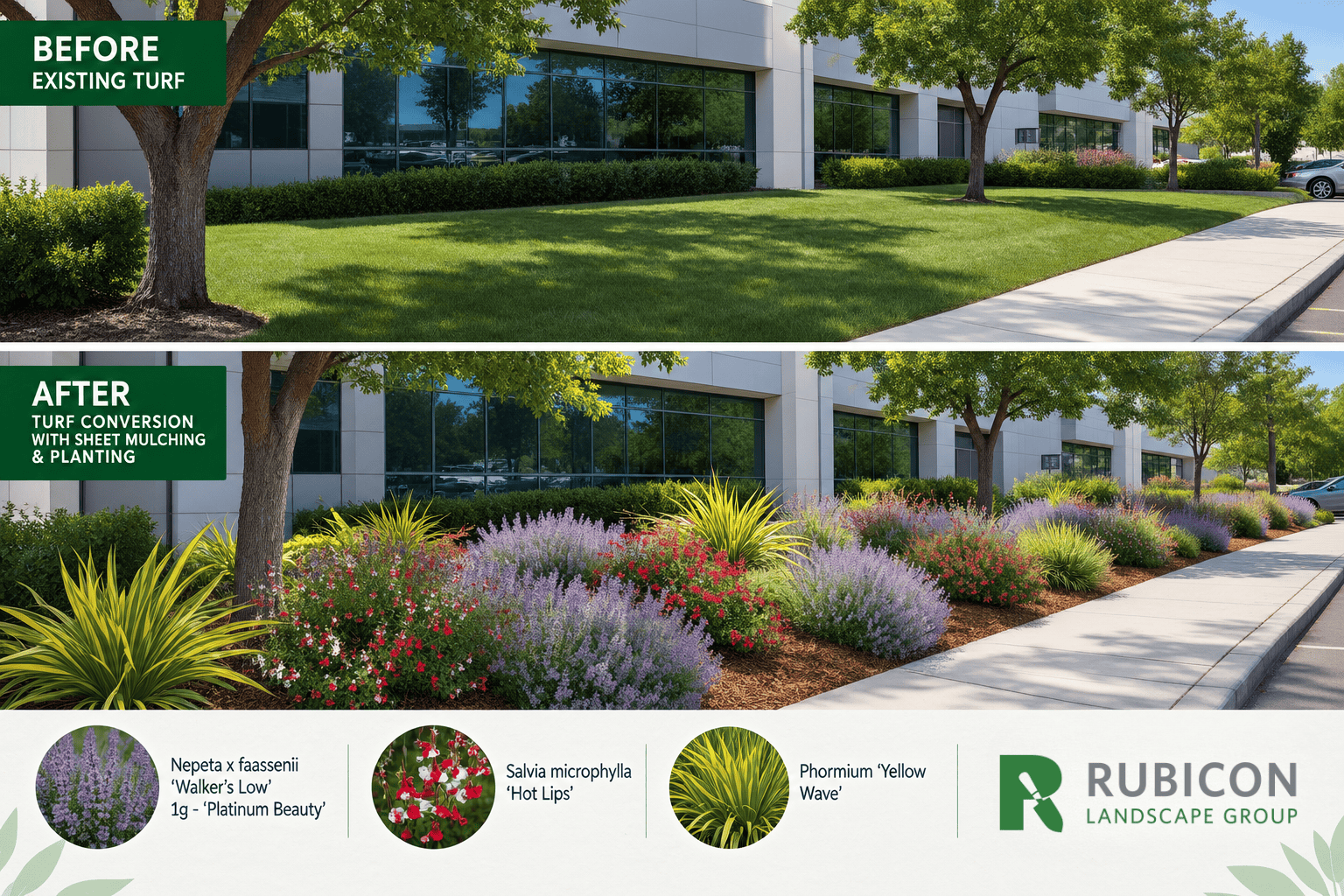
"Before and after photos of a commercial turf-to-sheet-mulch conversion: a plain lawn replaced with a drought-tolerant planting bed of catmint, salvia, and phormium grass along a sidewalk, Rubicon Landscape.
Sheet Mulching: Remove Turf Without Hauling It Away

Sheet Mulching: Remove Turf Without Hauling It Away

Sheet Mulching: Removing Turf Doesn’t Mean Hauling It Away

When property managers hear “remove the turf,” most picture crews digging up sod, loading it into trucks, and paying dump fees by the yard. That’s one way to do it, and it’s usually the most expensive.

Sheet mulching is the other way. Instead of excavating grass and hauling it off-site, you smother it in place with layered organic material. The turf breaks down where it stands, feeding the soil instead of filling a landfill, and you never pay to move a single yard of material off the property.

This is Part 4 of our AB 1572 series, following our Nonfunctional Turf Law Overview, Bay Area Water Rebate Guide, and Drip Conversion Components Guide.

What Sheet Mulching Actually Is

Sheet mulching is a layering technique that kills existing turf and vegetation by cutting off its light, while the layers themselves decompose into usable soil over time. No digging, no excavation, no equipment beyond basic hand tools.

The core idea: grass needs light to survive. Block the light completely and consistently, and it dies in place. What you build on top of it becomes the new planting surface once the old turf has broken down.

The Process, Step by Step

  1. Cut the turf as short as possible. Mow it down low. You’re not removing it, just reducing what the next layer has to smother.
  2. Prepare the edges. Establish clean perimeter lines so the new mulched area doesn’t spill onto sidewalks or hardscape.
  3. Lay down cardboard or heavy paper, overlapping every seam. This is the light-blocking layer that actually kills the grass underneath. Overlap seams generously (at least 6 inches) so grass can’t find a gap to grow through.
  4. Secure it. Landscape staples hold the cardboard in place, and a thorough watering-down helps it settle and start breaking down.
  5. Add roughly 1 inch of compost directly over the cardboard. This feeds the soil biology that will eventually break everything down.
  6. Top with about 3 inches of mulch. This is the visible finished layer, it holds moisture, suppresses weeds, and protects the cardboard and compost underneath.
  7. Let it sit. Over several weeks to a few months, the turf beneath decomposes, the cardboard breaks down, and the whole area becomes plantable soil.
  8. Plant through it. Once ready, cut small holes through the sheet mulch layers to install new plants directly into the improving soil beneath.

"Before and after photos of a commercial turf-to-sheet-mulch conversion: a plain lawn replaced with a drought-tolerant planting bed of catmint, salvia, and phormium grass along a sidewalk, Rubicon Landscape.

The Financial Case: What You’re Actually Not Paying For

Turf removal costs are driven overwhelmingly by hauling, not by the work of killing the grass itself. Excavating sod means digging it up, loading it, trucking it out, and paying landfill or green-waste disposal fees, often for several yards of material on even a modest-sized lawn.

Sheet mulching skips all of that:

  • No excavation labor. Crews aren’t digging and lifting sod by hand or machine.
  • No hauling. Nothing leaves the property, which means no truck trips and no fuel cost.
  • No dump or green-waste fees. These fees scale with volume, and turf removal generates a lot of volume.
  • Materials are inexpensive. Cardboard, compost, and mulch cost meaningfully less than the labor and disposal fees they replace.

For a property converting a full lawn, the difference between excavation and sheet mulching is often the difference between a project that needs a dumpster and truck rental, and one that needs a pallet of mulch.

The Environmental Case

The financial savings and the environmental savings come from the same source: nothing leaves the site.

  • No landfill waste. Excavated turf and soil typically end up in a landfill or green-waste facility. Sheet-mulched turf becomes soil, right where it was growing.
  • No hauling emissions. Fewer truck trips means less fuel burned moving material that didn’t need to move.
  • Builds soil health instead of stripping it. Excavation removes topsoil along with the grass. Sheet mulching adds organic matter and feeds soil biology, leaving the ground healthier than before.
  • Suppresses weeds without herbicide. The light-blocking layer does the work chemicals would otherwise do.
  • Reduces water demand going forward. Compost and mulch both improve moisture retention, meaning whatever gets planted afterward needs less irrigation to establish.

How This Fits AB 1572 Compliance

AB 1572 requires that nonfunctional turf stop being irrigated with potable water. The law is focused on water use, not on how the turf physically gets removed. Sheet mulching is a fully compliant path to that outcome, and often the most practical one for a phased, budget-conscious conversion.

One detail worth knowing if you’re also applying for a rebate: most Bay Area water agency rebate programs explicitly prohibit plastic weed barriers as part of a qualifying conversion, while requiring a mulch layer of about 3 inches. Sheet mulching’s cardboard-and-compost base is the compliant version of this requirement; a plastic sheeting shortcut is not, and could disqualify a rebate application entirely.

As with any conversion, confirm your specific water agency’s pre-approval requirements before removing turf. Most programs require sign-off before work begins, not after.

Getting the Order Right

  1. Mow turf as low as possible
  2. Establish clean perimeter edges
  3. Overlap cardboard generously across the entire area
  4. Secure and water down the cardboard layer
  5. Add about 1 inch of compost
  6. Add about 3 inches of mulch on top
  7. Let the area sit and decompose before planting
  8. Cut through the layers to plant once ready

Resources for Going Deeper

Ready to Convert Without the Hauling Costs

Rubicon Landscape builds sheet mulch conversions the right way: proper cardboard overlap, correct compost and mulch depths, and documentation that holds up for rebate applications. No excavation equipment, no dump fees, no yards of material leaving your property.

Working through an AB 1572 conversion or planning ahead of the 2028 deadline? Let’s talk about what your property actually needs.

CONTACT US

Why Rubicon

For more than 30 years, Rubicon Landscape has provided dependable, professional landscape services throughout the Bay Area. We help property owners and managers maintain healthy, attractive, and well-functioning landscapes through landscape maintenance, construction, irrigation, water management and regenerative services.

Our approach is built around quality workmanship, responsive service, proactive problem-solving, and long-term partnerships. From maintaining established landscapes to improving irrigation efficiency and managing water use, we work to protect your landscape investment while delivering consistent results.

As a division of Rubicon Programs, our work also creates meaningful community impact. The success of Rubicon Landscape helps support employment opportunities, workforce development, and services that strengthen the communities we serve.

Professional landscape services. Reliable results. Meaningful community impact.

Looking for a Landscape Partner?

Whether you manage a commercial property, municipal facility, institutional site, or multi-site portfolio, Rubicon Landscape has the experience and capabilities to help you maintain, improve, and manage your landscape.

Our services include:

  • Commercial Landscape Maintenance & Installation
  • Landscape Construction & Renovation
  • Irrigation Installation, Repair & Management
  • Water Efficiency & Conservation Solutions
  • Regenerative Services — Horticulture, Turf Care & Weed Management

Contact us 

Bee on a bright yellow flower in a sunlit garden.
The Landscaping Company Built to Fund a Mission

The Landscaping Company Built to Fund a Mission

Rubicon Landscape is a social enterprise landscaping company: a full-service commercial landscaping business whose revenue directly funds the workforce development mission of its nonprofit parent, Rubicon Programs. That’s not a tagline. It’s the actual business model, and it only works because the landscaping itself has to hold up on its own merits, every day, on every property.

Here’s what that looks like in practice, not in theory.

First, the Landscaping Has to Be Real

Rubicon Landscape doesn’t get chosen for federal, municipal, and commercial contracts because of the mission behind it. Properties like the Port of Oakland, Treasure Island, Veterans Affairs, the City of San Francisco, and the U.S. Coast Guard hire Rubicon because the crews show up, the work holds up, and the standard doesn’t slip.

That work spans the full range a commercial property actually needs:

  • Landscape maintenance: mowing, pruning, turf care, and seasonal upkeep on a consistent, professional schedule.
  • Irrigation management: system audits, drip conversions, and proactive repair before small problems become expensive ones.
  • Landscape construction and renovation: new plantings, hardscape, and full site transformations.
  • Enhancements and installations: new plantings, features, and upgrades that keep an established property looking cared for, not just maintained.
  • Horticultural and specialty services: soil health, plant selection, and site-specific care for complex properties.


At a site like the King-Garvey Co-op Apartments in San Francisco’s Western Addition, that meant converting an aging overhead irrigation system to drip, reusing existing components where it made sense, on a property that had already undergone a $45 million rehabilitation and couldn’t afford landscaping that looked like an afterthought. At Treasure Island, it means ongoing grounds maintenance across common exterior areas and native habitat at Yerba Buena Island, on a property managed by a public development authority with real standards to meet.

This is the part that has to work first. Without real, competitive landscaping work, there’s no revenue, and without revenue, there’s no mission funded.

Then, the Revenue Does Its Second Job

Every maintenance contract, every irrigation retrofit, every construction project Rubicon Landscape completes generates revenue that flows back into Rubicon Programs, the nonprofit that has spent decades helping people in the East Bay build stability and break cycles of poverty.

That funding supports real, specific programs, not a general fund:

  • Job training and employment: Rubicon Landscape itself is a training ground. Crew members build real, marketable landscaping and irrigation skills on active commercial and federal sites, not in a classroom disconnected from the work.
  • The One Treasure Island partnership: since 1997, Rubicon has provided grounds maintenance on Treasure Island through a partnership built specifically to create entry-level job opportunities for economically disadvantaged San Francisco residents. Trainees graduate ready to be hired as gardeners in the landscaping industry, not just Rubicon’s, the industry’s.
  • Workforce development for justice-impacted individuals: programs focused on formerly incarcerated individuals and their families, aimed at reducing recidivism through stable employment and real career paths.
  • Broader community services: economic self-sufficiency programs for extremely low-income participants, built around career planning and long-term stability, not one-time assistance.

Why This Model Actually Works

A lot of companies attach a cause to their marketing. Rubicon Landscape’s model is structurally different: the landscaping crew is the workforce development program. The same person maintaining irrigation at a VA facility or renovating a planting bed on Treasure Island may be building the exact skills and work history that Rubicon Programs’ mission is designed to create.

That means every contract Rubicon wins does two things at once:

  1. It delivers professional landscape services a demanding client actually needs.
  2. It creates or sustains real employment and training inside a mission-driven organization.

Neither side of that is optional. A landscaping arm that couldn’t compete on quality wouldn’t generate the revenue to fund anything. A revenue engine with no mission behind it would just be a landscaping company. Rubicon Landscape has to be genuinely excellent at commercial landscaping specifically because the mission depends on it.

Impact on Two Levels

What makes Rubicon Landscape different comes down to this: our work creates impact on two levels at once.

First, we create beautiful, well-maintained outdoor spaces, spaces that communities, employees, visitors, and customers get to actually enjoy, every day, whether they ever think about who maintains them or not.

Second, we create opportunity. We reinvest in our community, helping advance Rubicon’s broader mission of building stronger communities through meaningful employment and real services.

Those two things might sound like a landscaping company doing its job, and then separately, doing something generous on the side. But look a little closer, and they’re not separate at all.

Caring for the Land and Caring for People, In the Same Breath

There’s a quiet thread running through everything we do at Rubicon, and once you see it, it’s hard to unsee: caring for the land and caring for people have never really been two different things for us. They’re the same instinct, just pointed in two directions.

Think about what it means to care for soil the right way. You don’t reach for more water or more chemicals to cover up a problem. You slow down, you listen to what the land is telling you, and you build something underneath the surface that lets it thrive on its own, season after season, long after you’ve moved on to the next property. That’s patient work. It’s not always visible right away. But it lasts.

Now think about what it means to walk alongside someone building a new life. You don’t hand someone a single paycheck and call it done. You invest in real skills, real experience, real belief that they can build something lasting, so that a year from now, five years from now, they’re standing on their own, not because we’re still holding them up, but because we helped them grow strong enough not to need that anymore.

See the thread? Root cause over quick fix. Patience over shortcuts. Helping something, or someone, become resilient rather than dependent. That’s not a nice comparison we came up with to make our story sound good. It’s genuinely one philosophy, one way of showing up in the world, and we simply get to practice it twice: once in the soil, and once in the lives of the people who work alongside us.

So when a member of our crew spends their morning nurturing a client’s landscape back to health, in a very real way, they’re standing in the same soil that once helped nurture their own path forward. That’s not a metaphor. That’s just how it works here.

What This Means for Your Property

Choosing Rubicon Landscape means choosing a contractor held to the same standard as any other, on maintenance quality, irrigation efficiency, communication, and reliability, because that standard is what makes the rest of the model possible.

It also means your landscaping contract does something most don’t: it funds real job training, real employment, and real community impact for people building a path to stability. Not as a donation. As a direct result of the work being done well.

The landscape benefits. The property benefits. The community benefits. That’s not three separate outcomes. On a Rubicon Landscape property, it’s one outcome, built from the same crew, the same contract, and the same standard of work.

30+ years of experience. Full-service landscape expertise. Community impact that goes beyond the job site.

That’s Rubicon Landscape.

Request a Site Walk 

#RubiconLandscape #RubiconPrograms #CommercialLandscaping #BayAreaLandscaping #LandscapeManagement #LandscapeMaintenance #SocialEnterprise #CommunityImpact #WorkforceDevelopment #StrongerCommunities

Request Bay Area Commercial Landscaping Services

For more than 30 years, Rubicon Landscape has provided dependable, professional landscape services throughout the Bay Area. We help property owners and managers maintain healthy, attractive, and well-functioning landscapes through landscape maintenance, construction, irrigation, water management and regenerative services.

Our approach is built around quality workmanship, responsive service, proactive problem-solving, and long-term partnerships. From maintaining established landscapes to improving irrigation efficiency and managing water use, we work to protect your landscape investment while delivering consistent results.

As a division of Rubicon Programs, our work also creates meaningful community impact. The success of Rubicon Landscape helps support employment opportunities, workforce development, and services that strengthen the communities we serve.

Professional landscape services. Reliable results. Meaningful community impact.

Looking for a Landscape Partner?

Whether you manage a commercial property, municipal facility, institutional site, or multi-site portfolio, Rubicon Landscape has the experience and capabilities to help you maintain, improve, and manage your landscape.

Our services include:

  • Commercial Landscape Maintenance & Installation
  • Landscape Construction & Renovation
  • Irrigation Installation, Repair & Management
  • Water Efficiency & Conservation Solutions
  • Regenerative Services — Horticulture, Turf Care & Weed Management

Request a Consultation 

RESOURCES:

https://www.rescapeca.org/

https://www.qwel.net/

Read AB-1572 Series:

Drip Conversion Components: What Goes In After the Valve

Drip Conversion Components: What Goes In After the Valve

Commercial Drip Conversion Components: After the Valve

Swapping a spray valve for drip irrigation isn’t just a tubing swap. Drip conversion components installed after the valve determine whether the system runs efficiently for years or clogs, leaks, and fails within a season. This is Part 3 of our AB 1572 series, following our nonfunctional turf law overview and Bay Area water rebate guide.

Here’s exactly what belongs after the valve, in the right order, and why each piece matters.

Why What’s After the Valve Matters

A drip valve on its own delivers water at spray-system pressure and with spray-system debris tolerance, neither of which drip tubing and emitters can handle. Skip the right components, and the most common failures show up fast:

  • Emitters popping off the tubing under excess pressure
  • Fine sediment clogging emitters within weeks
  • Air pockets causing uneven watering across a zone
  • Debris getting pulled into emitters when the system shuts off

Four components, installed in the right order, prevent all of this.

1. Pressure Regulator

Drip components are built for 20 to 40 PSI, well below standard spray-system pressure (typically 40 to 60 PSI). Without a regulator, that excess pressure pops emitters off the tubing, blows out fittings, and shortens the entire system’s lifespan.

Commercial pressure regulators commonly hold a fixed 25 or 40 PSI at flows between 0.5 and 15 GPM, matched to the zone’s actual demand. Check pressure at the end of the line, not at the valve: that’s the only way to confirm the whole run is actually within range.

2. Filter

A 120 to 150 mesh filter (stainless steel or nylon screen) removes the fine sediment and debris that would otherwise clog drip emitters, whose openings are far smaller than a spray nozzle’s.

Installation order matters here: the filter goes in before the pressure regulator, not after. Debris passing through an unfiltered regulator first can damage the regulating mechanism itself, and UC Master Gardener guidance specifically confirms this filter-before-regulator sequence for the same reason.

3. Air / Vacuum Relief Valve

Installed at the highest point in the zone, this valve does two jobs:

  • While running: releases trapped air that would otherwise cause uneven watering and water hammer
  • At shutoff: prevents a vacuum from forming that can siphon soil and debris backward into emitters, a leading cause of slow, hard-to-diagnose clogging

It’s an easy component to skip since the system runs fine without it at first. The problems it prevents show up gradually, not on day one.

4. Flush Valve / End Cap

At the low point or far end of each dripline run, a flush valve (or a simple end cap) lets sediment that settles at the line’s end get purged out periodically instead of building up and clogging the last few emitters on the run.

This is the cheapest, simplest component on this list, and the easiest to forget. Building it in from the start means a five-minute flush instead of digging up hardened tubing later.

Seeing the Full Sequence

The order shown above isn’t arbitrary. Filter before regulator protects the regulator. Air relief at the high point catches trapped air before it causes problems. Flush valve at the low point clears what the filter didn’t have to catch in the first place, sediment that settles after installation.

Optional But Smart: Master Valve + Controller

None of the four components above require a smart controller to function, but pairing the zone with a master valve and a smart controller adds a meaningful layer of protection and control:

  • A master valve sits at the point of connection and stays normally closed, opening only when a zone is actively running. If a zone valve fails open, the master valve limits how much water gets wasted before anyone notices.
  • A smart controller adjusts run times based on real weather and ET (evapotranspiration) data instead of a fixed schedule, and many models flag abnormal flow, an early warning for a leak or a stuck valve.

This pairing isn’t just a nice-to-have. Several Bay Area water agencies specifically fund or require smart controllers as part of their rebate programs, covered in our Bay Area water rebate guide, so this is often a cost-neutral upgrade once rebates are factored in.

Getting the Order Right

  1. Valve: zone on/off, controller-driven
  2. Filter: 120–150 mesh, removes debris before it reaches the regulator
  3. Pressure regulator: holds the zone at 20–40 PSI
  4. Dripline: pressure-compensating tubing with emitters
  5. Air relief valve: at the system’s highest point
  6. Flush valve / end cap: at the lowest or farthest point on each line

Get this sequence right once, and the system needs very little intervention afterward beyond periodic flushing and filter checks.

Resources for Going Deeper

Get It Installed Right the First Time

Rubicon Landscape’s standardized drip conversion pricing includes every component covered here: filter, pressure regulator, air relief, flush valve, and, where it makes sense, a master valve and smart controller pairing. Every installation is flushed, pressure-checked, and verified for uniform coverage before we call it done.

Working through an AB 1572 conversion or planning ahead of the 2028 deadline? Let’s map out what your property needs.

[Schedule a Landscape & Irrigation Assessment →]

Request Bay Area Commercial Landscaping Services

For more than 30 years, Rubicon Landscape has provided dependable, professional landscape services throughout the Bay Area. We help property owners and managers maintain healthy, attractive, and well-functioning landscapes through landscape maintenance, construction, irrigation, water management and regenerative services.

Our approach is built around quality workmanship, responsive service, proactive problem-solving, and long-term partnerships. From maintaining established landscapes to improving irrigation efficiency and managing water use, we work to protect your landscape investment while delivering consistent results.

As a division of Rubicon Programs, our work also creates meaningful community impact. The success of Rubicon Landscape helps support employment opportunities, workforce development, and services that strengthen the communities we serve.

Request a Consultation Here 

Professional landscape services. Reliable results. Meaningful community impact.

Looking for a Landscape Partner?

Whether you manage a commercial property, municipal facility, institutional site, or multi-site portfolio, Rubicon Landscape has the experience and capabilities to help you maintain, improve, and manage your landscape.

Our services include:

  • Commercial Landscape Maintenance & Installation
  • Landscape Construction & Renovation
  • Irrigation Installation, Repair & Management
  • Water Efficiency & Conservation Solutions
  • Regenerative Services — Horticulture, Turf Care & Weed Management
Request a Consultation Here 

Bee on a bright yellow flower in a sunlit garden.
Nonfunctional Turf Law Bay Area Guide

Nonfunctional Turf Law Bay Area Guide

AB 1572 Nonfunctional Turf Law: What Bay Area Property Managers Need to Know

California’s AB 1572 nonfunctional turf law is reshaping how commercial properties manage outdoor water use, and the compliance clock is already running. For Bay Area property managers, the question isn’t whether decorative lawns need to go. It’s how to plan the transition before the deadline forces a rushed decision.

Here’s what the law actually requires, when it applies to your property, and how to turn a compliance mandate into a landscape upgrade.

What Is AB 1572?

AB 1572 is a California law, signed in October 2023, that prohibits irrigating nonfunctional turf with potable (drinking) water on commercial, industrial, institutional, and HOA properties.

Nonfunctional turf means grass that exists purely for looks, not for recreation, gathering, or everyday use.

Common examples:

  • Decorative lawn around office buildings or parking lots.
  • Turf strips between sidewalks and streets.
  • Grass on road medians and parking lot islands.
  • Narrow turf bands along fences or walkways.
  • Lawn surrounding monument signs and entry features.
  • Turf on slopes that aren’t safely accessible.
  • Courtyard grass that’s roped off or rarely used.

Functional turf is exempt. Sports fields, parks, picnic areas, and any grass people actually walk, play, or gather on doesn’t fall under the ban. Turf irrigated with recycled (non-potable) water is also exempt.

Compliance Deadlines by Property Type

The rollout is phased over several years, based on property type:

Property TypeCompliance Date
State and local government propertiesJanuary 1, 2027
Commercial, industrial & institutional propertiesJanuary 1, 2028
HOA and common-interest-development common areasJanuary 1, 2029
State/local government properties in disadvantaged communitiesJanuary 1, 2031 (subject to funding)

There are also separate self-certification deadlines, where property owners report compliance to the State Water Resources Control Board every three years:

  • Commercial, industrial & institutional properties over 5,000 sq ft: starting June 30, 2030
  • HOA common areas over 5,000 sq ft: starting June 30, 2031

The takeaway: even if your deadline feels far off, the planning shouldn’t wait. Design, approvals, procurement, and rebate applications all take lead time, and rebate funding runs out.

Why This Matters Beyond Compliance

Traditional turf is expensive to keep looking good, especially through dry months. It typically requires:

  • Frequent irrigation to stay green
  • Weekly or biweekly mowing, edging, and trimming
  • Fertilization, weed control, and pest management
  • Overseeding, aeration, and seasonal repair
  • Higher runoff risk on slopes and compacted soil

A well-planned conversion doesn’t just satisfy the law, it usually lowers water and labor costs while improving how the property looks and holds up through drought years.

What Can Replace Nonfunctional Turf?

There’s no single right answer, the best replacement depends on your site’s foot traffic, slopes, irrigation zones, soil, and maintenance capacity.

Options include:

  • California-native & climate-appropriate plants – look intentional year-round with far less water
  • Drought-tolerant planting – shrubs, perennials, and groundcovers grouped in hydrozones
  • Mulch or sheet-mulch conversion – reduces evaporation and weeds in decorative areas
  • Drip irrigation – delivers water directly to root zones with minimal overspray
  • Smart irrigation controllers – adjust watering based on real-time weather and ET data

Start With an Irrigation Audit – Not a Shovel

Before removing any turf, it’s worth asking: can this landscape be made more efficient first?

A professional irrigation audit often finds quick wins that reduce water use immediately, while you plan the larger conversion:

  • Broken or misaligned sprinkler heads causing dry spots and overspray
  • Leaking valves or stuck solenoids running zones unintentionally
  • Mismatched nozzles creating uneven watering
  • Poor distribution uniformity that leads to overwatering
  • Outdated controllers ignoring weather and seasonal ET data
  • Turf and shrubs sharing a valve, driving unnecessary waste

Fixing these issues can cut water waste right away, and gives you real data to build a smarter, phased conversion plan instead of guessing.

Don’t Remove Turf Before Checking for Rebates

Most Bay Area water agencies offer rebates for turf conversion, drip irrigation, and smart controllers, but nearly all of them require pre-approval before work starts. Removing turf first can disqualify a project entirely.

A few examples of what’s currently available:

  • Santa Clara County (Valley Water): commercial/multifamily landscape rebates up to $100,000+ per site
  • San Francisco (SFPUC): irrigation controller rebates up to $35 per active zone for large landscapes
  • East Bay (EBMUD, Alameda County Water District): rebates for turf removal, drip conversion, and smart controllers, up to $15,000–$20,000 for commercial sites
  • North Bay (Marin, Sonoma): local turf-removal and water-efficiency incentives, varying by provider

Rebate amounts, caps, and rules vary by agency and change with funding cycles, confirm current requirements with your local water provider before finalizing project scope.

A Practical AB 1572 Checklist

  1. Identify your turf – Map all irrigated turf and flag which areas are actively used vs. purely decorative.
  2. Confirm applicability – Determine your property type and which compliance date applies.
  3. Audit irrigation performance – Document leaks, overspray, pressure issues, and outdated controllers.
  4. Prioritize by function – Start with the highest-water-use, worst-performing decorative turf first.
  5. Build a phased plan – Match the scope to your budget, tenant impact, and procurement timelines.
  6. Check rebates before starting work – Confirm pre-approval requirements, plant lists, and equipment specs.
  7. Document everything – Keep photos, audit reports, and rebate paperwork for approval and future reference.
  8. Measure results – Track water use before and after to confirm savings and fine-tune scheduling.

Turning Compliance Into an Upgrade

AB 1572 doesn’t have to mean “less landscape”, it means designing the rest of your site to actually work in California’s climate. Properties that start early typically end up with:

  • Lower water and irrigation demand
  • More plant diversity and stronger curb appeal
  • Reduced long-term maintenance costs
  • A landscape that holds up better through drought

Is Your Property Ready?

Rubicon Landscape helps Bay Area commercial, municipal, and institutional properties navigate AB 1572, from irrigation audits and rebate coordination to phased turf conversion and ongoing maintenance.

Waiting increases the risk of rushed removals, missed rebate windows, and higher costs later. The earlier you start, the more control you have over design, budget, and timeline.

Request a Consultation Here 

#AB1572 #CommercialLandscaping #WaterConservation #PropertyManagement #SustainableLandscaping #BayArea

AB 1572 nonfunctional turf, AB 1572 California, Bay Area commercial landscaping, water-efficient landscaping, turf conversion, landscape rebates California

Request Bay Area Commercial Landscaping Services

For more than 30 years, Rubicon Landscape has provided dependable, professional landscape services throughout the Bay Area. We help property owners and managers maintain healthy, attractive, and well-functioning landscapes through landscape maintenance, construction, irrigation, water management and regenerative services.

Our approach is built around quality workmanship, responsive service, proactive problem-solving, and long-term partnerships. From maintaining established landscapes to improving irrigation efficiency and managing water use, we work to protect your landscape investment while delivering consistent results.

As a division of Rubicon Programs, our work also creates meaningful community impact. The success of Rubicon Landscape helps support employment opportunities, workforce development, and services that strengthen the communities we serve.

Request a Consultation Here 

Professional landscape services. Reliable results. Meaningful community impact.

Looking for a Landscape Partner?

Whether you manage a commercial property, municipal facility, institutional site, or multi-site portfolio, Rubicon Landscape has the experience and capabilities to help you maintain, improve, and manage your landscape.

Our services include:

  • Commercial Landscape Maintenance & Installation
  • Landscape Construction & Renovation
  • Irrigation Installation, Repair & Management
  • Water Efficiency & Conservation Solutions
  • Regenerative Services — Horticulture, Turf Care & Weed Management

Request a Consultation Here

RESOURCES:

https://www.rescapeca.org/

https://www.qwel.net/


Bee on a bright yellow flower in a sunlit garden.
Bay Area Water Rebates: Complete AB 1572 Guide

Bay Area Water Rebates: Complete AB 1572 Guide

The Complete Bay Area Water Rebate Guide

Bay Area water rebates can cover a significant share of a landscape conversion, irrigation upgrade, or smart controller install, but the rules disqualify more projects than the cost ever does. Miss one step, like starting work before approval, and the rebate disappears entirely.

This guide covers the rules that apply almost everywhere, then the specific rebate amounts by water agency, so you know exactly what to expect before you apply.

The Rules That Apply to (Almost) Every Program

Bay Area water agencies each run their own rebate program, but the core rules overlap heavily. These eight show up across EBMUD, SFPUC, Valley Water, ACWD, CCWD, and North Marin Water District:

  1. Pre-approval is mandatory. Apply before starting work. Projects started early are disqualified, no exceptions.
  2. Wait for your “Notice to Proceed.” Review typically takes 1–3 weeks. Work can’t legally begin until you receive written approval.
  3. Document with photos. Before-photos of existing turf/irrigation, close-ups of new drip tubing or emitters, and final installed-and-mulched photos are standard requirements.
  4. Keep itemized receipts. Rebates reimburse material costs only – labor, delivery, equipment rental, and sales tax are usually excluded. Receipts need unit pricing, not lump sums.
  5. Finish within the deadline. Most programs give 90–120 days from Notice-to-Proceed; a few allow up to 9 months.
  6. Follow the design rules:
    • Artificial turf is not eligible, and often disqualifies the entire rebate if used anywhere in the project
    • Only biodegradable weed barriers qualify (cardboard, natural fiber), plastic sheeting is prohibited
    • Minimum mulch depth (commonly 3 inches) required over exposed soil and planted areas
    • Hardscape is capped, often at 50% of the converted area, and must be permeable
  7. The cap is per property, not per project. Multiple projects at the same site within a set window (often 24 months) share one combined cap.
  8. Programs allow stacking within themselves – a turf conversion and a drip/controller upgrade can usually combine on one project. You generally can’t combine rebates across two different agencies for the same site, though.

Rebates by Water Agency

EBMUD – Oakland, Berkeley, Emeryville, Albany, Orinda, Castro Valley

RebateAmount
Lawn conversionUp to $2/sq ft, capped at $2,000 residential per 24 months
Commercial/municipal/large multi-family cap$15,000 total
Spray-to-drip conversionUp to $0.25/sq ft of drip installed
High-efficiency nozzlesUp to $4 each
Smart controllerUp to 50% of cost — $200 cap residential, $1,000 cap commercial


Controller must be on the EPA WaterSense list, with at least two active irrigation stations (hose-bib timers don’t qualify). Bonus: commercial median strips get double the standard rebate, since they’re notoriously hard to irrigate efficiently. EBMUD also covers $200 toward a 2-hour landscape designer consultation through its Landscape Design Assistance Program.

SFPUC – San Francisco

Landscape SizeRebate
Under 10,000 sq ftUp to 2 controllers at $250 each
Over 10,000 sq ft$35 per active irrigation zone

Controller must carry the EPA WaterSense label. The step most people miss: SFPUC requires an on-site landscape assessment before approval, a physical site visit, not just paperwork. Systems that are leaking, poorly maintained, or need major repair get flagged and denied during that visit.

Valley Water – Santa Clara County (Palo Alto, Los Altos, Sunnyvale, Mountain View, San Jose, Los Gatos)

  • Residential cap: up to $3,000
  • Commercial/multifamily cap: up to $100,000 per site (Santa Clara extends this to $110,000 for CII/multifamily properties)
  • Free Large Landscape Survey available for commercial/industrial/institutional/multifamily properties with ½ acre+ of irrigated landscape or 1,000+ CCF annual irrigation use — pre-qualifies the site for the full rebate program.

Contra Costa Water District – Antioch

Commercial/multi-family smart controller rebate:

  • $12 per active irrigation station, up to 50% of the controller’s list cost.
  • CCWD gives a direct example: a 7-zone controller nets $84 (12 × 7) or 50% of list price, whichever is lower.

Worth knowing: CCWD recommends checking plant health and soil moisture before installing a smart controller. Standard factory settings can apply more water than the site is currently getting, creating a real risk of overwatering right after install if settings aren’t adjusted.

North Marin Water District – Novato

  • Weather-based controller rebate: $30 per active station, capped at $1,500 per controller
  • Non-residential: a separate large-landscape irrigation audit program instead of a flat rebate — audits only run April through July, so timing matters
  • Marin Water (broader Marin County, adjacent to Novato) works differently: a discounted purchase price on Rachio smart controllers through a CalWEP partnership, rather than a rebate paid after purchase

Alameda County Water District – Fremont, Newark, Union City

RebateAmount
Smart controller (commercial/large landscape)Up to $30 per active station
Lawn-to-landscape conversion$2/sq ft – $3,000 cap residential, $20,000 cap commercial/industrial/institutional/multifamily/HOA
WET Program (any qualifying water-efficiency upgrade)$4 per 100 cubic feet saved annually, up to 50% of equipment cost – $10,000 cap commercial/institutional, $20,000 cap industrial

Minimum project size is 200 sq ft of converted lawn, unless the project removes 100% of the publicly visible front lawn.

Common Mistakes That Disqualify a Rebate

Most denied applications come down to the same few errors:

  • Starting work before receiving a Notice to Proceed – the single most common disqualifier across every agency
  • Using artificial turf or plastic weed barriers anywhere in the project
  • Submitting lump-sum receipts instead of itemized, unit-priced documentation
  • Missing the completion deadline after approval
  • Skipping the required site assessment where one applies (SFPUC, and others for larger commercial projects)

Every one of these is avoidable with the right documentation and sequencing.

Get the Rebate Without Losing It

Rebate programs reward projects planned properly from day one: application first, approval second, work third. Rubicon Landscape handles that sequencing as part of every turf conversion, irrigation upgrade, and smart controller install we manage, so nothing gets disqualified over a missed photo or an early shovel.

Let’s map out which rebates apply to your property before you start.

Schedule a Landscape & Irrigation Assessment

Bay Area water rebates, irrigation rebate California, smart controller rebate, turf conversion rebate, EBMUD rebate, SFPUC rebate, Valley Water rebate

#WaterRebates #WaterConservation #CommercialLandscaping #BayArea #SmartIrrigation

RESOURCES:

https://www.rescapeca.org/

https://www.qwel.net/

Request Bay Area Commercial Landscaping Services

For more than 30 years, Rubicon Landscape has provided dependable, professional landscape services throughout the Bay Area. We help property owners and managers maintain healthy, attractive, and well-functioning landscapes through landscape maintenance, construction, irrigation, water management and regenerative services.

Our approach is built around quality workmanship, responsive service, proactive problem-solving, and long-term partnerships. From maintaining established landscapes to improving irrigation efficiency and managing water use, we work to protect your landscape investment while delivering consistent results.

As a division of Rubicon Programs, our work also creates meaningful community impact. The success of Rubicon Landscape helps support employment opportunities, workforce development, and services that strengthen the communities we serve.

Request a Consultation Here 

Professional landscape services. Reliable results. Meaningful community impact.

https://www.rescapeca.org/

Looking for a Landscape Partner?

Whether you manage a commercial property, municipal facility, institutional site, or multi-site portfolio, Rubicon Landscape has the experience and capabilities to help you maintain, improve, and manage your landscape.

Our services include:

  • Commercial Landscape Maintenance & Installation
  • Landscape Construction & Renovation
  • Irrigation Installation, Repair & Management
  • Water Efficiency & Conservation Solutions
  • Regenerative Services — Horticulture, Turf Care & Weed Management
Request a Site Visit Here 

Bee on a bright yellow flower in a sunlit garden.