
How Much Does Commercial Landscape Maintenance Cost?

How Much Does Commercial Landscape Maintenance Cost?

The honest answer is “it depends,” but that’s not a very useful answer when you’re trying to budget. So instead of leaving it there, here’s what commercial landscape maintenance actually costs in the Bay Area, backed by real public contract data, not a generic national average that doesn’t reflect your market.

Why a Single Number Doesn’t Exist

Commercial landscape maintenance pricing varies more than most property managers expect, and not randomly. It moves based on a few specific, predictable factors:

  • Property size and layout: a large, contiguous park or campus costs less per acre to maintain than the same total acreage spread across small, disconnected roadway medians
  • Service level: how often turf gets mowed, whether fertilization is included, how tight the weed-cover tolerance is
  • What’s included: irrigation repair, pest management, and fertilization are sometimes bundled in, sometimes billed separately
  • Site type: a historic or specialty site with a limited, careful scope costs more per acre than a standard greenbelt, even though it’s smaller

Real Pricing Data, Not a National Average

Here’s what public Bay Area contracts actually show, pulled from real, awarded agreements:

Property TypeRateWhat Drove It
Large contiguous parks and greenbelts~$1,800/acre/yearStandard service tier, efficient to maintain in one continuous area
Small, specialty, or historic sites~$7,800/acre/yearFixed visit costs spread across very little area, more handling per square foot
Roadway medians and disconnected segmentsHigher than large parks, lower than specialty sitesMore edging and trimming per acre, traffic control, more drive time between segments

The takeaway: acreage alone doesn’t determine your cost, the shape and type of your property does. Two properties with identical total square footage can have very different maintenance costs depending on whether that space is one open area or a dozen scattered medians.

What Typically Drives Your Price Up or Down

Pushes cost up:

  • Narrow, disconnected areas (medians, street frontages) instead of one contiguous site
  • Higher service tiers (weekly mowing vs. biweekly, tighter weed-cover standards)
  • Included irrigation repair and fertilization versus billed separately
  • Specialty or historic sites with careful, limited-scope requirements

Keeps cost down:

  • Large, contiguous properties that are efficient to service in one visit
  • Drought-tolerant, low-water landscaping versus high-maintenance turf
  • A clear, well-defined scope of work from the start, fewer surprises mean fewer change orders later

A Realistic Way to Think About Your Budget

Rather than one number, think in a range based on your property type:

  • Large park, campus, or greenbelt property: budget in the neighborhood of $1,500 to $2,200 per acre per year for standard-tier maintenance
  • Roadway medians or disconnected segments: expect a meaningfully higher per-acre rate than a large contiguous site, due to the logistics involved
  • Small or specialty sites: budget well above typical per-acre rates, fixed costs concentrate fast on a small footprint

These ranges reflect real, awarded public contracts, not list prices, actual pricing always depends on your specific site conditions and the scope you need.

The Fastest Way to Get an Accurate Number

Public contract data is useful for budgeting, but it can’t replace an actual look at your property. Two sites with the same acreage can need very different levels of care depending on existing plant health, irrigation condition, and how the space is actually used.

Ready for a Real Number for Your Property?

We’ll walk your site, look at what it actually needs, and give you a straightforward quote, no inflated estimate to negotiate down from.

Schedule a Landscape Consultation HERE

#CommercialLandscaping #BayArea #LandscapeMaintenance #PropertyManagement

CONTACT US

Resources for Going Deeper

Why Rubicon

For more than 30 years, Rubicon Landscape has provided dependable, professional landscape services throughout the Bay Area, helping property owners and managers maintain landscapes that are healthy, attractive, and reliably well-functioning.

Our approach is built on quality workmanship, responsive service, and proactive problem-solving, the kind of long-term partnership that protects your landscape investment and delivers consistent results, year after year.

As a division of Rubicon Programs, that work also creates real community impact. Every project supports employment opportunities and workforce development that strengthen the communities we serve.

Professional landscape services. Reliable results. Meaningful community impact.

Looking for a Landscape Partner?

From commercial properties and municipal facilities to institutional sites and multi-site portfolios, our services include:

  • Commercial Landscape Maintenance & Installation
  • Landscape Construction & Renovation
  • Irrigation Installation, Repair & Management
  • Water Efficiency & Conservation Solutions
  • Regenerative Services: Horticulture, Turf Care & Weed Management
Contact us 

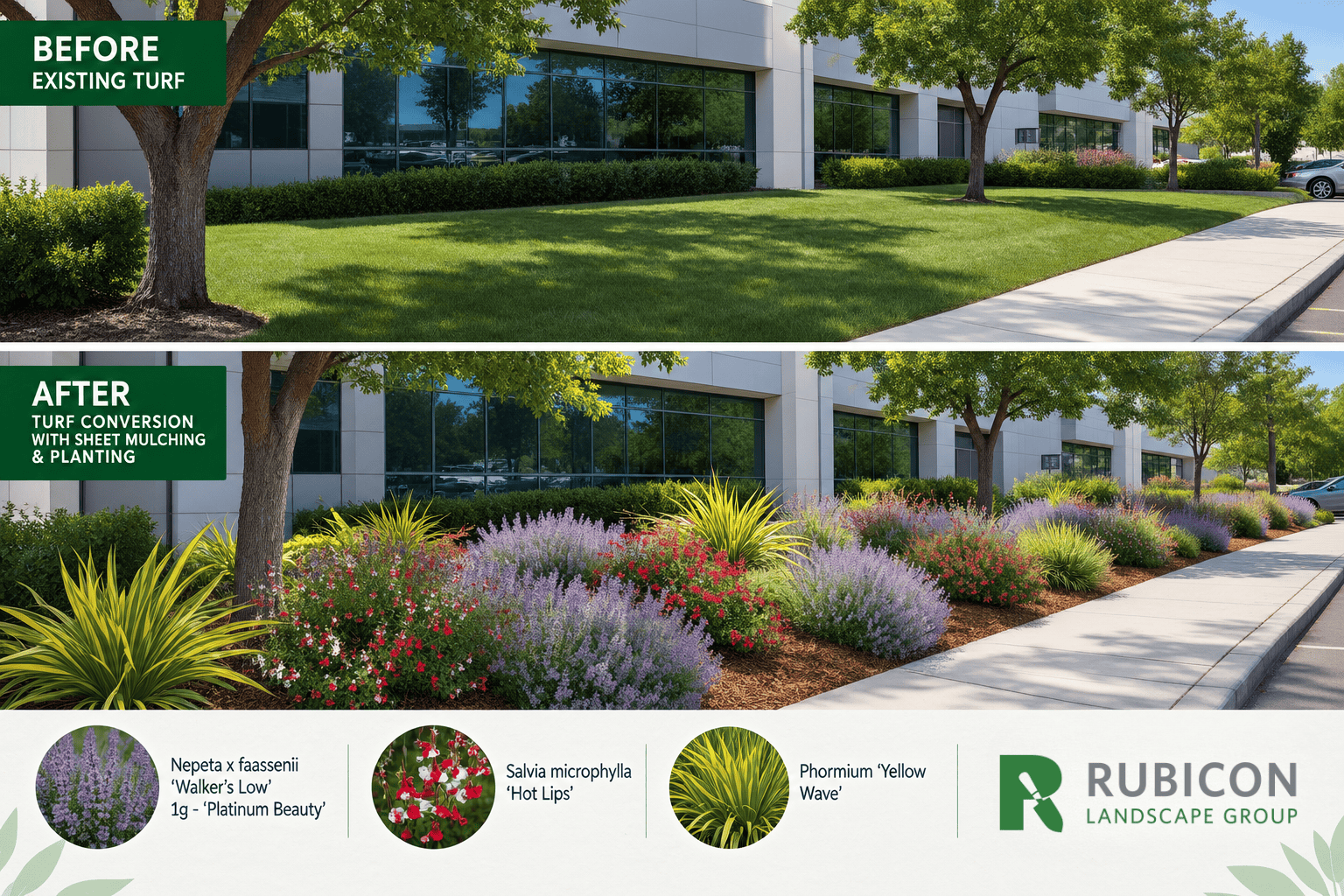
"Before and after photos of a commercial turf-to-sheet-mulch conversion: a plain lawn replaced with a drought-tolerant planting bed of catmint, salvia, and phormium grass along a sidewalk, Rubicon Landscape.
Tree Risk Before Winter Storms: What Property Managers Should Look For

Tree Risk Before Winter Storms: What Property Managers Should Look For

Series: Storm Season / El Niño Prep (Part 3)

What should property managers look for before winter storms? Start with four things: dead or weak limbs, weak branch connections, signs of root trouble, and what sits underneath each tree. With a very strong El Niño forecast, saturated soil can loosen a tree’s grip on the ground, so a tree that has stood for decades can fail with little warning. Checking now, while the ground is still dry, costs far less than responding to a failure in January.

This is Part 3 of our storm-prep series, following Drainage 101: Spot Problems Before the Rain Does and A Super El Niño Is Coming: Is Your Property Ready? Drainage problems are mostly about water. Tree problems are about safety and liability, which is why this topic gets a full article of its own.

Know a property manager or facility manager with mature trees on site? Share this guide with them before the first storm.

Why a Strong El Niño Raises Tree Risk

NOAA’s Climate Prediction Center puts the chance of a very strong El Niño this fall and winter above 90%, with a 75% chance that the October to December season will exceed every El Niño on record since 1950. For Bay Area properties, the wettest signal falls in January through March, when soil is already full from earlier storms.

That matters because trees depend on soil to hold their roots in place. When soil is saturated, water takes up the space between soil particles and carries part of the load that the soil would normally carry. As a result, roots lose grip, and a compromised tree can fall even when the wind is not especially strong. In addition, back-to-back storms repeat that wind load on ground that never has time to firm up.

The Four Things to Check

1. Weak Limbs and Branch Connections

What to look for:

  • Dead branches, and limbs that are cracked, split, or hanging.
  • Codominant stems, where two trunks of similar size grow from the same point and compete.
  • Included bark, a seam of bark trapped inside a branch union. It leaves a narrow, weak connection that can split as the limbs grow heavier.
  • Heavy limbs that extend over parking, entries, walkways, or play areas.

Quick check: Walk the canopy line with binoculars and note any limb over a place where people or vehicles pass.

2. Root Problems

What to look for:

  • Soil that is heaved or mounded on the side opposite a lean. This can mean roots are pulling out of the ground.
  • A new lean, or a lean that has increased since last year.
  • Mushrooms or conks at the base of the trunk or along the root flare, which often indicate internal decay.
  • Roots cut or damaged by trenching, paving, irrigation, or utility work.
  • Soil or mulch piled high against the trunk, and shallow roots at the surface.

Quick check: Take dated photos of each tree base now. Next month, compare them. A lean that changes is a reason to call a professional immediately.

3. Wind Exposure

What to look for:

  • Trees on ridgelines, slopes, or the open edge of a parking lot.
  • Trees that were recently sheltered by a neighboring tree or building that has since been removed.
  • Recently planted or transplanted trees, which have shallower root systems and are more likely to lean in strong wind.

Quick check: Ask which direction winter storms usually come from on your site, then look at the trees on that side first.

4. What Is Underneath: The Targets

A weak tree over an empty planting bed and the same tree over a main entrance carry very different consequences. Professional risk assessments weigh both the likelihood of failure and what the tree would hit, so list the cars, doors, walkways, play areas, utility lines, and buildings under each canopy. In practice, that list tells you which trees to deal with first.

The Liability Angle Property Managers Should Understand

California courts apply a negligence standard to tree failures. In general, an owner is not automatically responsible just because a tree falls. Instead, the question is usually whether the owner knew, or should have known, about a hazard and failed to act reasonably. Visible warning signs such as dead branches, rot, fungal growth at the base, a significant lean, or earlier limb failures can show that a problem was knowable. Ownership generally follows where the trunk stands, so trees along property lines deserve attention too.

On the other hand, when a healthy, properly maintained tree fails in a severe storm, courts have generally found no liability, often treating it as an act of nature. In other words, the question is less “did a tree fall?” and more “what did we know, and what did we do about it?”

For that reason, documentation matters. Dated inspection notes, photos, arborist reports, work orders, and pruning invoices help show that your team exercised reasonable care. They also give your insurance carrier a clear record if a claim ever arises.

A note on scope: This is general information, not legal advice. Talk with your attorney and your insurance carrier about your specific obligations.

Save this section for your next risk review, and share it with your insurance contact.

What a Professional Tree Risk Assessment Includes

The International Society of Arboriculture (ISA) trains arborists through its Tree Risk Assessment Qualification (TRAQ) to follow a consistent method. Assessments are described in levels:

  • Level 1, limited visual: a walk-by or drive-by that looks for prominent issues such as large dead trees, severe leans, or hanging limbs. Property managers with many trees often use it to screen quickly and set priorities.
  • Level 2, basic: the standard professional evaluation, where a qualified arborist inspects each tree on the ground, including its base, trunk, and canopy.
  • Level 3, advanced: a deeper investigation of a specific tree using additional tools when a Level 2 finding calls for it.

A good assessment documents the targets, the defects, the likelihood of failure, the consequences, and the options for reducing risk. Ultimately, that report gives you something specific to act on and to file.

Before You Cut: Check Your City’s Tree Rules

Many Bay Area cities protect certain trees, so removing one without a permit can create a different kind of problem. For example, Concord requires a permit to remove protected trees, including native oaks, California bay, buckeye, and sycamore at 12 inches in diameter and other trees at 24 inches, measured 54 inches above the ground. Walnut Creek protects trees with a trunk circumference of 28 inches or more, about 9 inches in diameter. Danville protects heritage trees and certain species.

Cities generally allow emergency removal of a hazardous tree, but they usually want written approval. Because rules differ by city and change over time, confirm the current requirements with your city before any removal.

Property Manager Tree Risk Checklist

☐  Walk every tree near buildings, parking, walkways, play areas, and entries

☐  Note dead, cracked, or hanging limbs, and any limb over a target

☐  Look for codominant stems and included bark at branch unions

☐  Check each base for mushrooms, conks, heaved soil, or a new or increased lean

☐  Look for root damage from trenching, paving, or utility work

☐  Identify trees that are newly exposed to wind or recently planted

☐  Photograph every concern with the date and location

☐  Rank concerns by what sits underneath

☐  Request a qualified arborist assessment for anything on this list

☐  Confirm local permit requirements before any removal

☐  File the notes, photos, and reports where your team can find them

Not sure what you are looking at? Request a pre-storm walkthrough and we will help you sort what can wait from what cannot. Contact Rubicon Landscape Group.

Common Mistakes to Avoid

  • Waiting for the first storm. Once the first serious storm makes the news, every property in the Bay Area calls for the same services at the same time.
  • Checking only from a distance. Roots and the base of the trunk need a close look.
  • Pruning without a plan. Topping a tree, which means cutting main branches back to stubs, creates weakly attached regrowth and is not recommended.
  • Skipping the paperwork. Work that is not documented is hard to prove later.
  • Ignoring trees at the property edge. A neighbor’s fence or a public sidewalk is a target too.

Quick Answers

Who is responsible when a tree falls on a commercial property in California?

Ownership generally follows where the trunk stands. Responsibility for damage usually turns on negligence, meaning whether the owner knew or should have known about a hazard and failed to act reasonably. Talk with your attorney and insurer about your situation.

How often should commercial property trees be inspected?

As a practical standard, we recommend a walkthrough at least once a year and again after any major storm, with closer attention to trees that have known defects or that stand over busy areas.

Can saturated soil cause a healthy-looking tree to fall?

Yes. Saturated soil reduces how firmly roots are held, and the risk is higher for trees that already have root damage, decay, or a lean. A tree can look healthy from the canopy while its roots are not.

Who should assess a tree I am worried about?

Look for an ISA Certified Arborist who also holds the ISA Tree Risk Assessment Qualification (TRAQ). Ask for a written report.

What Comes Next in the Series

Next, we look at drainage upgrades: what French drains, catch basins, and retention basins each solve, and when to install them. If you have not read Part 1 and Part 2 yet, start with A Super El Niño Is Coming and Drainage 101. Follow Rubicon for the rest of the series.

Ready to Check Your Trees Before the Rain?

Schedule a pre-storm property walkthrough with Rubicon. We will review your trees, drainage, and slopes together, flag what needs attention, and help coordinate a qualified arborist assessment where one is warranted.

CONTACT US

Resources for Going Deeper

Why Rubicon

For more than 30 years, Rubicon Landscape has provided dependable, professional landscape services throughout the Bay Area, helping property owners and managers maintain landscapes that are healthy, attractive, and reliably well-functioning.

Our approach is built on quality workmanship, responsive service, and proactive problem-solving, the kind of long-term partnership that protects your landscape investment and delivers consistent results, year after year.

As a division of Rubicon Programs, that work also creates real community impact. Every project supports employment opportunities and workforce development that strengthen the communities we serve.

Professional landscape services. Reliable results. Meaningful community impact.

Looking for a Landscape Partner?

From commercial properties and municipal facilities to institutional sites and multi-site portfolios, our services include:

  • Commercial Landscape Maintenance & Installation
  • Landscape Construction & Renovation
  • Irrigation Installation, Repair & Management
  • Water Efficiency & Conservation Solutions
  • Regenerative Services: Horticulture, Turf Care & Weed Management

Contact us 

"Before and after photos of a commercial turf-to-sheet-mulch conversion: a plain lawn replaced with a drought-tolerant planting bed of catmint, salvia, and phormium grass along a sidewalk, Rubicon Landscape.
Drainage Upgrades Explained: What to Actually Install Before the Rain

Drainage Upgrades Explained: What to Actually Install Before the Rain

Series: Storm Season / El Niño Prep (Part 4)

What drainage upgrades work best for a commercial landscape? Match the fix to the problem, and start with the simplest option that solves it. Fix the grade, fill the low spots, and keep irrigation off before storms. Then add planted features such as bioswales that slow and soak up water. Finally, use piped systems, such as French drains and catch basins, or engineered basins when water has to be collected and moved. In many cases, the sustainable options come first because they work with the landscape instead of just sending water somewhere else.

This is Part 4 of our storm-prep series. In Drainage 101 we showed you how to find problems. Here, we cover what to actually install, building on A Super El Niño Is Coming and the tree-risk guidance in Part 3.

Save this guide before your next site walk, and share it with anyone who manages a property with standing water.

Start With the Simple Fixes

Before anyone digs a trench, three low-cost fixes deserve a look. Each one changes where water goes without adding hardware.

1. Use Smart Controllers to Turn Irrigation Off Before Storms

Irrigation that runs on saturated ground adds runoff to a site that is already struggling. EPA WaterSense labels two types of controllers that help. Weather-based controllers adjust schedules to local weather and landscape conditions, and soil moisture-based controllers prevent watering when the soil is already moist. A basic rain sensor can also interrupt irrigation after a set amount of rainfall, although it does not replace correct scheduling.

For that reason, check your controllers before the first storm. Confirm that rain delay or weather features are active, that sensors are working, and that nobody has left a manual schedule running through the wet season. Meanwhile, if you manage several sites, remember that each controller needs its own check.

2. Eliminate Low Spots Before the Rain Does

A low spot is simply a place where water has nowhere else to go. Filling it with soil, then planting groundcover, removes that pocket and gives roots and foliage a way to slow water down. As a result, water moves across the surface instead of pooling.

Do this carefully: Keep new soil below siding, weep screeds, and any trunk flare. Do not bury the base of a tree or shrub. Most importantly, confirm where the water will go once the low spot is gone, because filling one hollow can push water toward a building or a neighboring property.

3. Make Sure the Landscape Slopes Away From Buildings

Water should leave a building, not sit against it. A widely used benchmark in the International Residential Code calls for the ground to fall at least 6 inches within the first 10 feet from a foundation, which is a 5% slope. It also calls for hard surfaces within 10 feet to slope at least 2% away. Where a wall, slope, or property line makes that impossible, the code calls for a drain or swale instead.

Commercial buildings follow the California Building Code and the project’s own civil drawings, so treat that benchmark as a starting point and compare it with your plans. In practice, a long, level or backward-sloping strip beside a foundation is one of the most common problems we see.

Sustainable Upgrades That Handle More Water

Bioswales

A bioswale is a shallow channel, densely planted with grasses, shrubs, or other vegetation, designed to slow, filter, and soak in storm water. It works well along parking lots, drive aisles, and building edges where runoff is moderate. Contra Costa County lists bioswales among its green infrastructure practices, and larger projects may fall under local stormwater requirements.

Design basics that matter:

  • Size: a common guideline sets the swale surface at about 1% of the area that drains to it.
  • Slope: slopes of 5% or less are recommended, and 1% to 4% is ideal.
  • Check dams: at slopes near or above 4%, check dams slow the flow. They should not be built from earth, which erodes, and are often spaced about every 50 feet.
  • Plants: dense, deep-rooted native grasses and plants hold soil and take up water.
  • Overflow: every bioswale needs a safe overflow path that does not send water toward buildings, unstable slopes, or neighbors.
  • Setbacks: place rain gardens and bioswales at least 10 feet from a foundation.

Bay Area note: Many East Bay soils contain a lot of clay, and clay absorbs water slowly. In that case, a bioswale may need an underdrain, a shallower depth, or compost to improve how quickly water soaks in. Because of that, a site-specific assessment matters more than a standard template.

Piped Systems for When Water Has to Be Moved

French Drains

A French drain is a trench filled with gravel and a perforated pipe. It collects water over a wide area, including groundwater and surface runoff, and carries it downhill. It suits wet strips, seepage near a foundation, and runoff from a slope. However, it needs a place to discharge, and it must be kept free of silt.

Catch Basins

A catch basin is a box set into the ground with a grate on top. Surface water enters through the grate and is directed into a drain pipe. It works best at a clear low point where water already collects. As we covered in Drainage 101, leaves, mulch, and sediment can clog a basin, so it needs cleaning before storm season.

Dry Wells

When there is no downhill outlet, a dry well gives collected water a place to soak in underground. Whether it will work depends on the soil and the site, so an engineer should confirm it first.

In many cases, the best answer combines these tools. For example, a catch basin under a downspout can feed a pipe that leads to a French drain, a bioswale, or a basin.

Retention and Detention Basins

Basins store larger volumes of water. The two terms are often confused:

  • Detention basin: often called a dry pond. It holds water temporarily after a storm and releases it slowly at a controlled rate.
  • Retention basin: it holds water permanently, such as a pond, and is often used to improve water quality or add visual value.

On commercial properties, basins are usually engineered by a civil engineer and may be required as part of a stormwater permit. Once built, they need regular inspection of outlets, removal of sediment and debris, and care for the plantings around them.

Which Upgrade Fits Which Problem?

If you see…

Start with

Add if needed

Puddles in a lawn or bed

Fill the low spot, add soil and groundcover

Catch basin or French drain

Water against a building

Regrade away from the foundation, check downspouts

French drain or swale

Runoff from a parking lot or hard surface

Bioswale or planted strip

Catch basin and overflow route

Wet strip or seepage on a slope

French drain with a clear outlet

Engineer review for slope stability

Overwatered, soggy turf

Smart controller with rain delay or soil moisture sensor

Irrigation audit

Large site with a lot of runoff

Basin designed by a civil engineer

Bioswales upstream to slow flow


Not sure which row you are in? Request a pre-storm drainage walkthrough and we will help you match the fix to the problem. Contact Rubicon Landscape Group.

Mistakes That Make Drainage Worse

  • Filling a low spot with nowhere for water to go. The water will simply find another low place.
  • Installing a French drain with no outlet. A drain that cannot discharge only moves the pool.
  • Sending water toward a neighbor or a slope. Overflow should never move water toward buildings, unstable slopes, or adjoining property.
  • Leaving irrigation running through storms. It wastes water and adds to saturation.
  • Skipping maintenance. Basins, swales, and drains lose capacity as sediment builds up.
  • Skipping permits and engineering. Larger changes may trigger city or stormwater requirements.

Quick Answers

What is the difference between a French drain and a catch basin?

A French drain is a long, gravel-filled trench with a perforated pipe that collects water over an area. A catch basin is a box with a grate that collects water at one low point and directs it into a pipe.

How do I stop water pooling on my commercial property?

Find out why it pools: a low spot, poor grading, a clogged basin, or irrigation. Fix the cause first, then add drainage hardware if water still collects.

Do smart irrigation controllers help with storm prep?

Yes. Weather-based and soil moisture-based controllers delay or skip watering when it is not needed, which reduces runoff and saturation. They work best when they are programmed and maintained correctly.

What is the difference between a retention basin and a detention basin?

A detention basin holds water temporarily and releases it slowly. A retention basin holds water permanently.

Plan It in Phases

Drainage work does not have to happen all at once. Costs vary with soils, access, permits, and the size of the site. In general, the simplest fixes come first, and larger upgrades can follow in phases across budget cycles. Because every property is different, we start with a walkthrough and a written plan instead of a one-size-fits-all package.

Rubicon offers free estimates, free consultations, and free phased planning for rehabilitation and enhancement projects, so you can see the full picture before you commit.

What Comes Next in the Series

Next, we close out the pre-storm checklist: a final round of checks to run right before the wettest weeks arrive. Follow Rubicon so you do not miss it.

Ready to Upgrade Before the Rain Arrives?

Schedule a pre-storm drainage walkthrough with Rubicon. We will review grading, low spots, irrigation, basins, and slopes together, recommend the simplest effective upgrades, and give you a phased plan.

CONTACT US

Resources for Going Deeper

Why Rubicon

For more than 30 years, Rubicon Landscape has provided dependable, professional landscape services throughout the Bay Area, helping property owners and managers maintain landscapes that are healthy, attractive, and reliably well-functioning.

Our approach is built on quality workmanship, responsive service, and proactive problem-solving, the kind of long-term partnership that protects your landscape investment and delivers consistent results, year after year.

As a division of Rubicon Programs, that work also creates real community impact. Every project supports employment opportunities and workforce development that strengthen the communities we serve.

Professional landscape services. Reliable results. Meaningful community impact.

Looking for a Landscape Partner?

From commercial properties and municipal facilities to institutional sites and multi-site portfolios, our services include:

  • Commercial Landscape Maintenance & Installation
  • Landscape Construction & Renovation
  • Irrigation Installation, Repair & Management
  • Water Efficiency & Conservation Solutions
  • Regenerative Services: Horticulture, Turf Care & Weed Management

Contact us 

"Before and after photos of a commercial turf-to-sheet-mulch conversion: a plain lawn replaced with a drought-tolerant planting bed of catmint, salvia, and phormium grass along a sidewalk, Rubicon Landscape.
How Women May Have Discovered Cultivation Itself

How Women May Have Discovered Cultivation Itself

Series: Women and Plants / The Beginning (Part 1)

How Women and Plants Have Been Helping Each Other Since the Beginning

Somewhere, thousands of years before the word “agriculture” existed, a woman knelt beside a pile of discarded plant trimmings near her camp and noticed something. Where she’d tossed the cuttings weeks before, new shoots were pushing up through the soil.

She hadn’t planted anything. The plant had done that on its own. But she was the one who noticed, who remembered, and who, the next time, may have placed the trimmings there on purpose instead of by accident.

That small, repeatable act, noticing, remembering, repeating, may be the actual origin of cultivation itself.

A Theory, Not a Legend

This isn’t folklore. It’s a real, seriously considered idea in anthropology, sometimes called the gathering hypothesis or the refuse heap theory of early cultivation. The reasoning is straightforward: in most hunter-gatherer societies studied by anthropologists, plant gathering, processing, and preparation were primarily women’s work. That meant women spent far more cumulative time with plants than anyone else in the group, watching them up close, season after season, generation after generation.

That kind of sustained, repeated observation is exactly what it takes to notice something as subtle as regrowth from a discarded root or a dropped seed head near a living space. Not a single flash of insight, but thousands of small, patient observations, compounding.

It’s worth saying plainly: this is a theory, one among several explanations for how cultivation began, not a settled fact carved into stone. Archaeologists and anthropologists still debate the exact path from gathering to farming, and it likely didn’t happen the same way in every region at once. But the gathering hypothesis has real evidentiary support, and it points to something worth sitting with: the relationship between women and plants may not just be old. It may be foundational to how humans learned to grow food at all.

Rubicon Landscape Group field staff in branded hats and work apparel standing together at a commercial landscape site.

What That First Noticing Actually Required

Think about what it actually takes to go from “huh, that’s growing back” to intentional cultivation. It’s not one moment of genius. It’s a chain of small, deliberate acts:

  • Noticing that regrowth happened at all, rather than walking past it
  • Remembering where and when it happened
  • Connecting the regrowth to the discarded trimmings, rather than assuming it was random
  • Testing that connection on purpose, placing trimmings somewhere intentionally to see if it happened again
  • Repeating what worked, and passing that knowledge to someone else

That’s not luck. That’s the scientific method, practiced long before anyone had a name for it, likely by women whose daily, hands-in-the-soil relationship with plants gave them the observational depth to see a pattern that a more occasional visitor to the same ground would have missed entirely.

A Relationship That Runs Both Directions

What’s easy to miss in the “who discovered farming” framing is that this was never a one-way relationship. The plants needed something too. Disturbed soil. Cleared competition. A gatherer willing to leave a root system intact instead of destroying it. Cultivation, in this telling, isn’t a story of humans conquering plants. It’s a story of two things learning to help each other, the plant offering food and medicine, the woman offering the conditions the plant needed to keep growing.

That reciprocity is still the actual job today. A horticulturist, whether tending a single garden bed or a multi-acre commercial property, is still doing a version of the same thing: watching closely enough to notice what a plant needs, and giving it that, in exchange for what it gives back.

Where This Series Goes From Here

This is Part 1 of a short series on the long relationship between women and plants. From here, we’ll look at how that early observational knowledge became something else entirely: medicine. Long before pharmacies, women were often the ones who knew which plant eased a fever, which one calmed a stomach, which one helped a wound close. That knowledge didn’t come from nowhere. It came from the same patient, generational noticing that may have started cultivation in the first place.

Part 3 will follow that thread even further, into something harder to measure but just as real: the way plants have always been used not just to heal the body, but to soothe something quieter, the mind, the nervous system, the parts of us that a garden seems to reach in ways little else does.

Why We’re Telling This Story

At Rubicon, plenty of the hands doing this work today, our horticulturists, our plant health specialists, are continuing something genuinely old. Not a metaphor. An actual, traceable line of patient, close attention to what a living thing needs, stretching back further than written history goes.

It felt worth telling that story, not because it sells a service, but because it’s true, and because understanding where this relationship started makes it a little easier to see why it still matters.

CONTACT US

Resources for Going Deeper

Why Rubicon

For more than 30 years, Rubicon Landscape has provided dependable, professional landscape services throughout the Bay Area, helping property owners and managers maintain landscapes that are healthy, attractive, and reliably well-functioning.

Our approach is built on quality workmanship, responsive service, and proactive problem-solving, the kind of long-term partnership that protects your landscape investment and delivers consistent results, year after year.

As a division of Rubicon Programs, that work also creates real community impact. Every project supports employment opportunities and workforce development that strengthen the communities we serve.

Professional landscape services. Reliable results. Meaningful community impact.

Looking for a Landscape Partner?

From commercial properties and municipal facilities to institutional sites and multi-site portfolios, our services include:

  • Commercial Landscape Maintenance & Installation
  • Landscape Construction & Renovation
  • Irrigation Installation, Repair & Management
  • Water Efficiency & Conservation Solutions
  • Regenerative Services: Horticulture, Turf Care & Weed Management

Contact us 

"Before and after photos of a commercial turf-to-sheet-mulch conversion: a plain lawn replaced with a drought-tolerant planting bed of catmint, salvia, and phormium grass along a sidewalk, Rubicon Landscape.
Drainage 101: Spot Problems Before the Rain Does

Drainage 101: Spot Problems Before the Rain Does

Series: Storm Season / El Nino Prep (Part 2)

With NOAA putting the odds of a very strong El Nino above 90% this winter, the properties that come through this season without damage won’t be the lucky ones. Instead, they’ll be the ones that checked their drainage in October, rather than finding out what’s wrong during the first real storm.

This is Part 2 of our storm-prep series, following A Super El Nino Is Coming: Is Your Bay Area Property Ready? We’re starting with drainage for a reason: it’s not only the single most common source of storm damage, but almost all of it is also visible before the rain arrives, as long as you know where to look.

Why Drainage Problems Hide Until It’s Too Late

A drainage system can look completely fine on a dry day. Catch basins sit empty. Grading looks flat enough. Downspouts are attached to the building. Because of that, nothing raises a flag.

Then it rains, and suddenly every weakness the dry season was hiding shows up at once: water pooling where it shouldn’t, basins that can’t keep up, downspouts dumping straight at the foundation instead of away from it. By then, you’re no longer doing prevention, you’re doing damage control instead.

Fortunately, almost every drainage problem leaves a visible clue even when it’s dry. So really, you just have to know what you’re looking at.

What to Check: The Four Problem Areas


1. Clogged Catch Basins & Storm Drains

Over the course of a full summer and fall, leaves, mulch, and sediment settle into catch basins and storm drain grates without anyone noticing, until the first storm tries to push water through them.

What to look for:

  • Visible debris, leaves, or sediment sitting in or over the grate
  • A grate that’s noticeably harder to see into than it should be
  • Standing water near a basin even after light rain, a sign it’s already restricted

Quick check: pour a few buckets of water near the basin. If it doesn’t drain within a couple of minutes, that likely means something downstream is blocked.

2. Poor Grading

Grading determines whether water moves away from your buildings and hardscape, or toward them instead. Because grading problems often develop slowly, through settling soil, root growth, or years of mulch buildup, a property that graded correctly when it was built can still grade poorly now.

What to look for:

  • Water pooling near a building foundation after rain
  • Bare, eroded channels in turf or beds that show where water has been flowing
  • Mulch or soil visibly washed downhill in a consistent pattern

Quick check: walk the property during or right after a rain, even a light one, and watch where water actually goes. That way, you’ll see real drainage behavior instead of guessing from a dry-day walkthrough.

3. Standing Water Spots

A puddle that disappears within an hour or two is normal. However, a puddle that’s still there a day or two later is a drainage problem, and during a wet winter, it becomes a liability and mosquito issue on top of a landscape one.

What to look for:

  • Any spot that holds water noticeably longer than the rest of the property
  • Compacted soil (often in high-traffic areas) that visibly resists absorbing water
  • Turf that’s consistently thin, yellowed, or mossy in the same spot every year, a classic sign of chronic standing water

Quick check: if you can point to the same wet spot in your memory from last winter, that’s not a fluke, it’s a pattern.

4. Downspout Issues

Downspouts are supposed to move roof water well away from the building. When they don’t, that water usually ends up right at the foundation instead, which is exactly where you don’t want it during a heavy rain year.

What to look for:

  • Downspouts that end at ground level with no extension or connection to a drain line
  • Erosion channels or bare soil directly below a downspout outlet
  • Extensions pointed into planting beds or turf instead of toward a drain or daylight point away from the structure

Quick check: trace each downspout from roof to final discharge point. If you lose the trail before the water is clearly routed away from the building, that’s the problem right there.

Your Drainage Walkthrough Checklist

Check every catch basin and storm drain grate for debris or sediment

Run a bucket test on any basin that looks questionable

Walk the property during or right after rain to see where water actually flows

Flag any bare or eroded channels in turf or planting beds

Note any spot where water stands for more than a few hours

Trace every downspout from roof to final discharge point

Confirm downspout extensions point away from the building, not into beds against the foundation

Photograph problem areas now, since dry-season photos make it much easier to plan and prioritize fixes later

What Happens If These Go Unaddressed

None of these four problems are dramatic on their own. Together, though, in a winter NOAA expects to bring above-normal rainfall concentrated into a few intense months, they compound fast:

  • Clogged basins back up and flood hardscape or parking areas
  • Poor grading sends water toward foundations instead of away from them
  • Standing water areas get worse with every storm instead of draining between them
  • Misdirected downspouts add concentrated volume exactly where erosion and foundation issues start

As a result, fixing any one of these in October is a maintenance task. Fixing all four in January, during an active storm, is an emergency call instead, and those cost more, take longer, and often happen while the damage is still getting worse.

Why Property Managers Check This With Rubicon

We don’t just look for standing water and call it done. Instead, our teams trace the actual system, basins, grading, and downspouts, together, because a fix in one spot that ignores the other two doesn’t actually solve anything. That’s ultimately the difference between a real drainage assessment and a surface-level walkthrough.

Ready to Check Your Drainage Before the Rain Does?

We’ll walk your property with the same checklist above, and tell you exactly what needs attention before the season’s first real storm.

CONTACT US

Resources for Going Deeper

Why Rubicon

For more than 30 years, Rubicon Landscape has provided dependable, professional landscape services throughout the Bay Area, helping property owners and managers maintain landscapes that are healthy, attractive, and reliably well-functioning.

Our approach is built on quality workmanship, responsive service, and proactive problem-solving, the kind of long-term partnership that protects your landscape investment and delivers consistent results, year after year.

As a division of Rubicon Programs, that work also creates real community impact. Every project supports employment opportunities and workforce development that strengthen the communities we serve.

Professional landscape services. Reliable results. Meaningful community impact.

Looking for a Landscape Partner?

From commercial properties and municipal facilities to institutional sites and multi-site portfolios, our services include:

  • Commercial Landscape Maintenance & Installation
  • Landscape Construction & Renovation
  • Irrigation Installation, Repair & Management
  • Water Efficiency & Conservation Solutions
  • Regenerative Services: Horticulture, Turf Care & Weed Management

Contact us 

"Before and after photos of a commercial turf-to-sheet-mulch conversion: a plain lawn replaced with a drought-tolerant planting bed of catmint, salvia, and phormium grass along a sidewalk, Rubicon Landscape.
A Super El Nino Is Coming: Is Your Property Ready?

A Super El Nino Is Coming: Is Your Property Ready?

Series: Storm Season / El Nino Prep (Part 1)

Most winters, “storm prep” is a routine line item. This winter is different, and the forecast isn’t coming from a headline writer looking for a dramatic angle. It’s coming directly from NOAA’s own Climate Prediction Center.

What NOAA Is Actually Saying

On September 10, 2026, NOAA’s Climate Prediction Center issued an updated El Nino Advisory. The numbers are worth sitting with:

  • Greater than 90% chance of a very strong El Nino during fall and winter 2026-27
  • 75% chance that the October-December 2026 season will exceed the strength of every El Nino on record dating back to 1950, based on the three-month Relative Oceanic Nino Index (RONI)
  • Sea-surface temperature anomalies in the eastern equatorial Pacific have already exceeded +3.0\u00b0C, well above the threshold that defines El Nino conditions in the first place

That combination, a greater-than-90% chance of “very strong,” with a real shot at “strongest on record,” is why some meteorologists are calling this a potential Super El Nino. NOAA updates this forecast on the second Thursday of every month, and each revision since June has moved in the same direction: stronger, not weaker.

What This Typically Means for California

NOAA is careful to note that El Nino shifts probabilities, it doesn’t guarantee a specific outcome in any one location. But the pattern isn’t a mystery. Strong El Nino winters have a well-documented history in California, and it isn’t a gentle one. The 1997-98 and 2015-16 events, both strong El Nino winters, brought significant Bay Area rainfall, flooding, and landslide activity. A very strong or record-strength event raises the odds of a repeat, or worse.

For Bay Area properties specifically, that means an elevated chance of above-normal rainfall, concentrated heavily in the January through March window, exactly when soil is already saturated from earlier storms and has the least capacity left to absorb more.

Why This Matters for Your Property, Not Just the Forecast

A strong rain year doesn’t create new problems. It finds every existing one and makes it expensive.

  • Drainage systems that were “fine” in a normal year get overwhelmed fast when storms come back to back instead of spaced out
  • Erosion on slopes and hillsides accelerates dramatically once soil is already saturated
  • Trees with existing weak limbs or root issues face far more wind and saturated-soil stress than in a typical winter
  • Standing water and runoff issues that were a minor nuisance in a dry year become liability and safety issues in a wet one

None of this is hypothetical. It’s the direct, predictable result of more water hitting the same infrastructure, more often, in a shorter window.

What This Series Will Cover

This is the first piece in a short series on getting Bay Area properties ready before the rain does the finding-problems part for you. Over the next several weeks, we’ll cover:

  • Drainage basics: how to spot problems before the first real storm hits
  • Erosion control for slopes and hillsides specifically
  • Tree risk assessment: what to look for before wind and saturated soil turn a weak limb into a liability
  • Drainage upgrades: French drains, catch basins, and retention basins, what each one actually solves
  • A final pre-storm checklist, timed for right before the wettest window arrives
  • What to do after a storm, if damage does happen despite the prep

The Time to Start Is Now, Not in January

NOAA’s forecast puts the wettest signal squarely in January through March 2027. That sounds like time to spare. It isn’t. Drainage work, tree assessments, and erosion control all take real lead time, and every property in the Bay Area will be trying to book the same services at the same time once the first serious storm makes the news.

Acting in the fall, while the ground is still dry and schedules are still open, is the difference between a proactive fix and an emergency call during a storm.

Ready to Get Ahead of This Winter?

We’ll walk your property, check your drainage, and flag what needs attention before the rain arrives, not after.

[Schedule a Storm-Readiness Property Assessment \u2192]

CONTACT US

Resources for Going Deeper

Why Rubicon

For more than 30 years, Rubicon Landscape has provided dependable, professional landscape services throughout the Bay Area, helping property owners and managers maintain landscapes that are healthy, attractive, and reliably well-functioning.

Our approach is built on quality workmanship, responsive service, and proactive problem-solving, the kind of long-term partnership that protects your landscape investment and delivers consistent results, year after year.

As a division of Rubicon Programs, that work also creates real community impact. Every project supports employment opportunities and workforce development that strengthen the communities we serve.

Professional landscape services. Reliable results. Meaningful community impact.

Looking for a Landscape Partner?

From commercial properties and municipal facilities to institutional sites and multi-site portfolios, our services include:

  • Commercial Landscape Maintenance & Installation
  • Landscape Construction & Renovation
  • Irrigation Installation, Repair & Management
  • Water Efficiency & Conservation Solutions
  • Regenerative Services: Horticulture, Turf Care & Weed Management
Contact us 

"Before and after photos of a commercial turf-to-sheet-mulch conversion: a plain lawn replaced with a drought-tolerant planting bed of catmint, salvia, and phormium grass along a sidewalk, Rubicon Landscape.