
Series Storm Season / El Niño Prep (Part 5)
What is the best way to control erosion on a commercial slope? Combine three layers: ground cover that holds the soil in place (shredded mulch, erosion control blankets, or hydroseed), structures that slow the water down (straw wattles, terraces, and swales), and deep-rooted plants that stabilize the slope over time. Slope erosion control works best when it is installed before the first big storms, because bare, loose soil is the most vulnerable when heavy rain arrives.
This is Part 5 of our storm-prep series, following Drainage 101: Spot Problems Before the Rain Does, A Super El Niño Is Coming: Is Your Property Ready?, tree risk before winter storms, and drainage upgrades explained. Drainage moves water away from buildings and walkways. However, slopes are where water picks up speed, and that is where soil, mulch, and plants can end up in the parking lot.
Key Takeaways
- Install erosion controls before the wet season, not during the first storm.
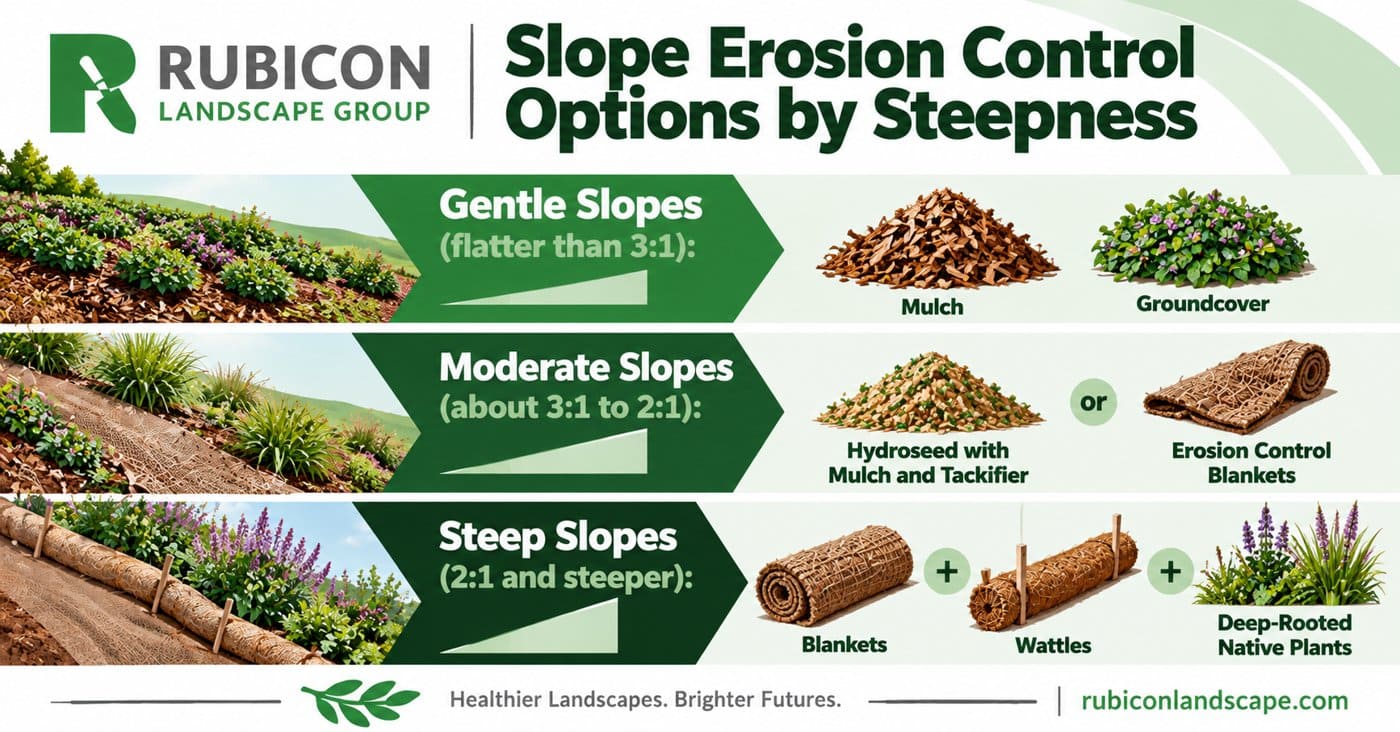
- Match the control to the slope: mulch for gentle slopes, blankets or hydroseed near 2:1 and steeper.
- Plant deep-rooted California natives for lasting stability.
- Manage irrigation and downspout discharge first, because water you control is water you do not have to manage in a storm.
- Bring in a licensed civil engineer for steep, structural, or moving slopes.
Why Slopes Fail During Heavy Rain
Slopes rarely fail for one reason. Instead, several small problems stack up, and a strong El Niño season gives them every chance to show.
- Bare soil: Raindrops loosen exposed soil, and runoff carries it downhill.
- Concentrated flow: Water that collects at a downspout, a pipe outlet, or a low point cuts channels (rills) that grow into gullies.
- Saturated ground: After weeks of rain, soil holds less strength, so even a well-planted slope can slump.
- Irrigation problems: Overspray and leaks add water to a slope before the storm even starts.
- Thin or failing cover: Mulch that has washed away or thinned out no longer protects the soil underneath.
Step 1: Walk the Slope Before the Rain
A simple walk-through, done while the ground is still dry, shows most problems early. Look for:
- Small channels, rills, or gullies running downhill.
- Bare patches or thin mulch, especially below irrigation heads and downspouts.
- Exposed roots or soil undercutting the edge of a bed or walkway.
- Soil, mulch, or debris already collecting at the base of the slope.
- Clogged drains, inlets, and swales at the bottom of the slope.
- Cracks or settling near the top of the slope or behind retaining walls.
- Irrigation leaks, broken heads, or overspray reaching the slope.
Take dated photos of every issue. As a result, you will have a clear before-and-after record, which also helps if you ever need to document conditions later (see Part 6 of this series).
Slope Erosion Control Options, Compared
No single product fits every slope. The right choice depends on steepness, soil type, sun exposure, and how quickly you need protection. Therefore, treat the table below as a starting point for a conversation, not a specification.
| Option | Best for | Key notes |
|---|---|---|
| Shredded or interlocking mulch. | Planted beds on gentle to moderate slopes. | Locks together better than round chips, which can roll downhill. Keep it out of drains and swales. |
| Erosion control blankets | Steeper slopes and sandy or silty soils. | Commonly recommended where slopes are steeper than 2:1. Pin them flat to the soil so plants can grow through. |
| Hydroseed with mulch and tackifier. | Large, open slopes that need quick cover. | Works best when applied early enough for seed to establish before heavy rain. |
| Straw wattles | Breaking up long slopes. | Staked along the contour to slow runoff and catch sediment. |
| Silt fence | Temporary protection at the base of a slope. | Must be anchored properly to work, and is not a substitute for permanent cover. |
| Deep-rooted native plants | Long-term stability | Roots hold soil together after the mulch and blankets break down. |
A slope of 2:1 means two feet of horizontal distance for every one foot of vertical rise. In other words, it is steep enough that mulch alone is often not enough.
Plants That Hold a Slope in Place
Mulch and blankets protect a slope in the short term. Plants protect it for decades. For Bay Area slopes, deep-rooted California natives such as coyote brush (Baccharis pilularis) and coffeeberry (Frangula californica) are common, reliable choices. Plant selection still depends on sun, soil, and irrigation access, so a site-specific plan matters. In addition, native plantings typically need less water once established, which supports your water-use goals as well. For more on that side of the plan, see our guide to drip conversion and our fall landscape and irrigation audit.
Irrigation and Drainage on Slopes
Water you control is water you do not have to manage in a storm. Before the rains, check that irrigation is not overspraying the slope, switch to drip where it makes sense, and confirm your controller has a rain delay or rain sensor active. Furthermore, make sure downspouts, pipe outlets, and catch basins discharge to a safe place and not onto bare soil.
When to Install, and What to Check First
- Timing: Install erosion controls before the wet season, not during the first storm. Soil that has had time to settle and plants that have had time to root perform much better.
- Keep materials out of runoff paths: Do not place loose compost or fine mulch where water will carry it into storm drains.
- Know the rules: Grading and stormwater requirements vary by city and county, and the San Francisco Bay Regional Water Quality Control Board oversees stormwater protection in our region. Check local requirements for larger slope work.
- Get engineering help when needed: If a slope is very steep, supports a structure, or is already moving, have a licensed civil engineer verify the design.
Frequently Asked Questions About Slope Erosion Control
How steep is too steep for mulch alone?
As a general rule of thumb, mulch works well on gentle slopes. As a slope approaches 2:1, blankets or hydroseed are typically needed, and very steep slopes may need engineered solutions. A professional assessment will tell you which category your slope falls into.
What is the best mulch for a slope?
Shredded or interlocking mulch generally stays in place better than round chips, which tend to roll or float away in heavy rain.
When should we install erosion controls?
Before the wet season. In the Bay Area, that means completing slope work in the fall, ideally several weeks before the heaviest rain is expected.
Do erosion control projects need permits?
It depends on the size of the project and your city or county. Routine mulching and planting usually do not, while grading work often does. Confirm with your local jurisdiction.
Can native plants really stop erosion?
Native plants with deep, fibrous roots are one of the best long-term fixes, but they work best together with mulch, blankets, and good drainage while they establish.
Next Step: Get Your Slopes Assessed Before the Rain
Rubicon Landscape inspects slopes, repairs washouts, installs mulch, blankets, and native plantings, and coordinates with your civil engineer when a slope needs more than landscaping. Tell us which properties have slopes you are worried about, and we will walk them with you. Schedule a Slope and Landscape Assessment.
Sources and Further Reading
Resources for Going Deeper
- Save Our Water: California’s statewide water conservation program, including outdoor watering guidance.
- QWEL (Qualified Water Efficient Landscaper): EPA WaterSense-recognized certification covering irrigation auditing and system design.
- NALP (National Association of Landscape Professionals): industry certification and continuing education for landscape and irrigation professionals.
- CLCA (California Landscape Contractors Association): California-specific water management certification and continuing education.
Get Your Slopes Checked Before the Rain
Rubicon Landscape inspects slopes, repairs washouts, and installs erosion controls and native plantings.
Why Rubicon
For more than 30 years, Rubicon Landscape has provided dependable, professional landscape services throughout the Bay Area, helping property owners and managers maintain landscapes that are healthy, attractive, and reliably well-functioning.
Our approach is built on quality workmanship, responsive service, and proactive problem-solving, the kind of long-term partnership that protects your landscape investment and delivers consistent results, year after year.
As a division of Rubicon Programs, that work also creates real community impact. Every project supports employment opportunities and workforce development that strengthen the communities we serve.
Professional landscape services. Reliable results. Meaningful community impact.
Looking for a Landscape Partner?
From commercial properties and municipal facilities to institutional sites and multi-site portfolios, our services include:
- Commercial Landscape Maintenance & Installation.
- Landscape Construction & Renovation.
- Irrigation Installation, Repair & Management.
- Water Efficiency & Conservation Solutions.
- Regenerative Services: Horticulture, Turf Care & Weed Management.