

Sheet Mulching: Removing Turf Doesn’t Mean Hauling It Away
When property managers hear “remove the turf,” most picture crews digging up sod, loading it into trucks, and paying dump fees by the yard. That’s one way to do it, and it’s usually the most expensive.
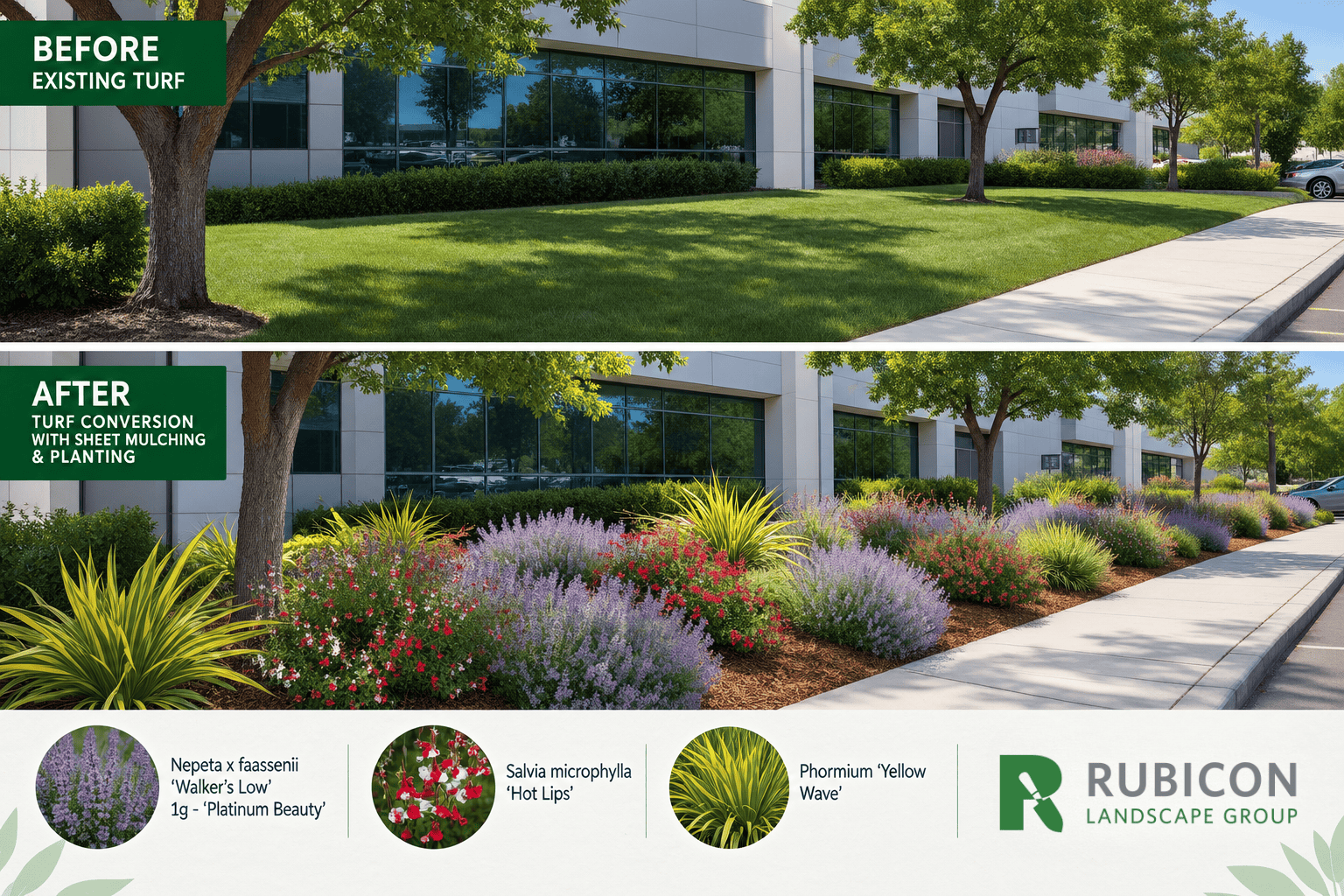
Sheet mulching is the other way. Instead of excavating grass and hauling it off-site, you smother it in place with layered organic material. The turf breaks down where it stands, feeding the soil instead of filling a landfill, and you never pay to move a single yard of material off the property.
This is Part 4 of our AB 1572 series, following our Nonfunctional Turf Law Overview, Bay Area Water Rebate Guide, and Drip Conversion Components Guide.
What Sheet Mulching Actually Is
Sheet mulching is a layering technique that kills existing turf and vegetation by cutting off its light, while the layers themselves decompose into usable soil over time. No digging, no excavation, no equipment beyond basic hand tools.
The core idea: grass needs light to survive. Block the light completely and consistently, and it dies in place. What you build on top of it becomes the new planting surface once the old turf has broken down.
The Process, Step by Step
- Cut the turf as short as possible. Mow it down low. You’re not removing it, just reducing what the next layer has to smother.
- Prepare the edges. Establish clean perimeter lines so the new mulched area doesn’t spill onto sidewalks or hardscape.
- Lay down cardboard or heavy paper, overlapping every seam. This is the light-blocking layer that actually kills the grass underneath. Overlap seams generously (at least 6 inches) so grass can’t find a gap to grow through.
- Secure it. Landscape staples hold the cardboard in place, and a thorough watering-down helps it settle and start breaking down.
- Add roughly 1 inch of compost directly over the cardboard. This feeds the soil biology that will eventually break everything down.
- Top with about 3 inches of mulch. This is the visible finished layer, it holds moisture, suppresses weeds, and protects the cardboard and compost underneath.
- Let it sit. Over several weeks to a few months, the turf beneath decomposes, the cardboard breaks down, and the whole area becomes plantable soil.
- Plant through it. Once ready, cut small holes through the sheet mulch layers to install new plants directly into the improving soil beneath.
The Financial Case: What You’re Actually Not Paying For
Turf removal costs are driven overwhelmingly by hauling, not by the work of killing the grass itself. Excavating sod means digging it up, loading it, trucking it out, and paying landfill or green-waste disposal fees, often for several yards of material on even a modest-sized lawn.
Sheet mulching skips all of that:
- No excavation labor. Crews aren’t digging and lifting sod by hand or machine.
- No hauling. Nothing leaves the property, which means no truck trips and no fuel cost.
- No dump or green-waste fees. These fees scale with volume, and turf removal generates a lot of volume.
- Materials are inexpensive. Cardboard, compost, and mulch cost meaningfully less than the labor and disposal fees they replace.
For a property converting a full lawn, the difference between excavation and sheet mulching is often the difference between a project that needs a dumpster and truck rental, and one that needs a pallet of mulch.
The Environmental Case
The financial savings and the environmental savings come from the same source: nothing leaves the site.
- No landfill waste. Excavated turf and soil typically end up in a landfill or green-waste facility. Sheet-mulched turf becomes soil, right where it was growing.
- No hauling emissions. Fewer truck trips means less fuel burned moving material that didn’t need to move.
- Builds soil health instead of stripping it. Excavation removes topsoil along with the grass. Sheet mulching adds organic matter and feeds soil biology, leaving the ground healthier than before.
- Suppresses weeds without herbicide. The light-blocking layer does the work chemicals would otherwise do.
- Reduces water demand going forward. Compost and mulch both improve moisture retention, meaning whatever gets planted afterward needs less irrigation to establish.
How This Fits AB 1572 Compliance
AB 1572 requires that nonfunctional turf stop being irrigated with potable water. The law is focused on water use, not on how the turf physically gets removed. Sheet mulching is a fully compliant path to that outcome, and often the most practical one for a phased, budget-conscious conversion.
One detail worth knowing if you’re also applying for a rebate: most Bay Area water agency rebate programs explicitly prohibit plastic weed barriers as part of a qualifying conversion, while requiring a mulch layer of about 3 inches. Sheet mulching’s cardboard-and-compost base is the compliant version of this requirement; a plastic sheeting shortcut is not, and could disqualify a rebate application entirely.
As with any conversion, confirm your specific water agency’s pre-approval requirements before removing turf. Most programs require sign-off before work begins, not after.
Getting the Order Right
- Mow turf as low as possible
- Establish clean perimeter edges
- Overlap cardboard generously across the entire area
- Secure and water down the cardboard layer
- Add about 1 inch of compost
- Add about 3 inches of mulch on top
- Let the area sit and decompose before planting
- Cut through the layers to plant once ready
Resources for Going Deeper
- Save Our Water: California’s statewide water conservation program, including outdoor watering guidance
- QWEL (Qualified Water Efficient Landscaper): EPA WaterSense-recognized certification covering irrigation auditing and system design
- NALP (National Association of Landscape Professionals): industry certification and continuing education for landscape and irrigation professionals
- CLCA (California Landscape Contractors Association): California-specific water management certification and continuing education
Ready to Convert Without the Hauling Costs
Rubicon Landscape builds sheet mulch conversions the right way: proper cardboard overlap, correct compost and mulch depths, and documentation that holds up for rebate applications. No excavation equipment, no dump fees, no yards of material leaving your property.
Working through an AB 1572 conversion or planning ahead of the 2028 deadline? Let’s talk about what your property actually needs.
Why Rubicon
For more than 30 years, Rubicon Landscape has provided dependable, professional landscape services throughout the Bay Area. We help property owners and managers maintain healthy, attractive, and well-functioning landscapes through landscape maintenance, construction, irrigation, water management and regenerative services.
Our approach is built around quality workmanship, responsive service, proactive problem-solving, and long-term partnerships. From maintaining established landscapes to improving irrigation efficiency and managing water use, we work to protect your landscape investment while delivering consistent results.
As a division of Rubicon Programs, our work also creates meaningful community impact. The success of Rubicon Landscape helps support employment opportunities, workforce development, and services that strengthen the communities we serve.
Professional landscape services. Reliable results. Meaningful community impact.
Looking for a Landscape Partner?
Whether you manage a commercial property, municipal facility, institutional site, or multi-site portfolio, Rubicon Landscape has the experience and capabilities to help you maintain, improve, and manage your landscape.
Our services include:
- Commercial Landscape Maintenance & Installation
- Landscape Construction & Renovation
- Irrigation Installation, Repair & Management
- Water Efficiency & Conservation Solutions
- Regenerative Services — Horticulture, Turf Care & Weed Management